
Byblus Sulcus
A bright, grooved trough on Ganymede, younger than surrounding dark terrain.

NASA / JPL / OWW · CC BY 3.0
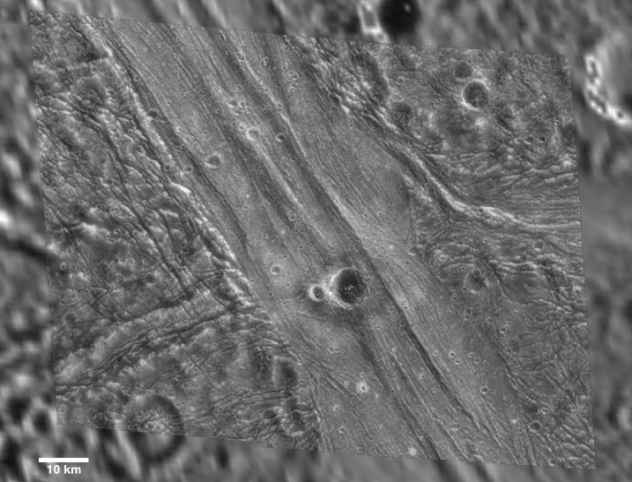
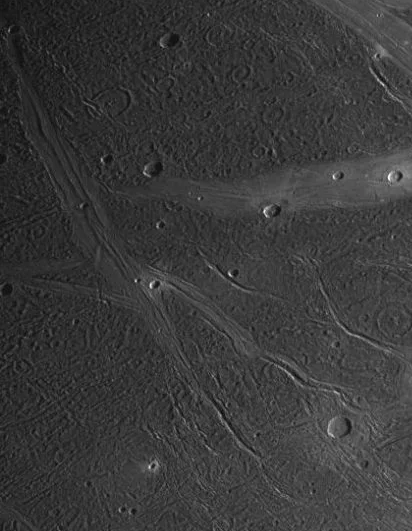
Byblus Sulcus is a relatively narrow, grooved terrain on Jupiter's moon Ganymede. It is a trough that runs for approximately 645 kilometers (401 miles) across the moon's surface, and its surface is thought to be younger than the darker materials found in other regions elsewhere on the moon. It is a classic example of bright and young Ganymedean terrain marked by multiple sets of ridges and grooves.
Quick Facts
- Length
- 645 km
- Eponym
- Βύβλος Byblos
Facts from the source article.
Lore & Background
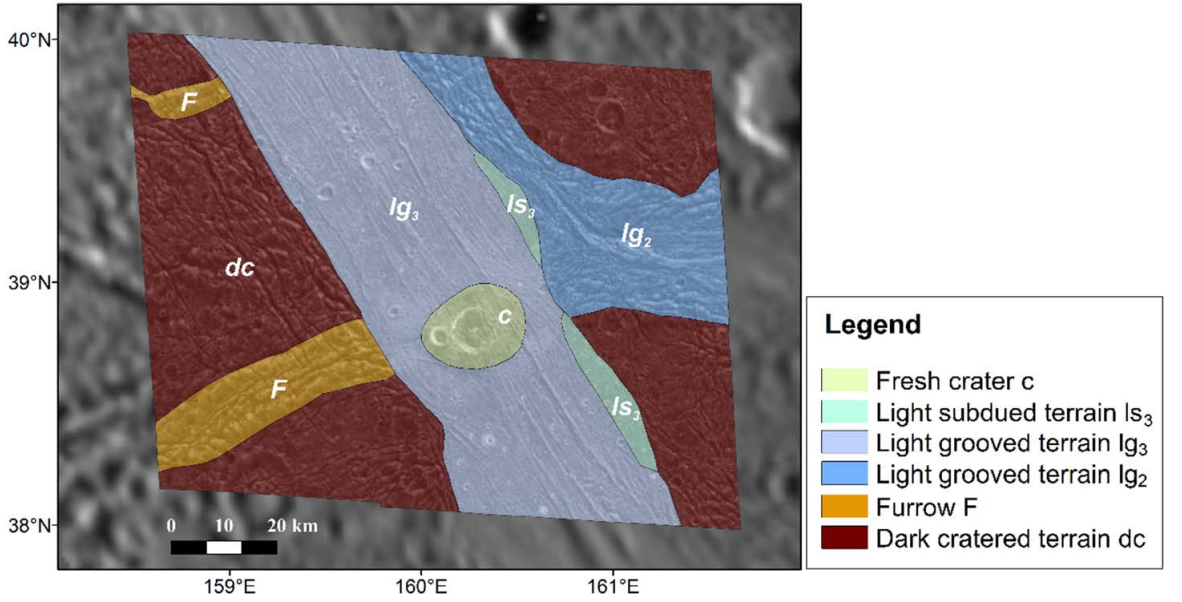
Byblus Sulcus is a narrow band of bright, grooved terrain located entirely within a dark, ancient region on Ganymede called Marius Regio. It is noticeably brighter and younger than the dark regio that surrounds it. Starting from Philus Sulcus to the northeast, Byblus Sulcus dissects the northernmost lobe of Marius Regio, running from the northwest towards the southeast. One third of the way across the Marius lobe, Byblus Sulcus splits into two like a fork; officially, the IAU and USGS consider these two halves as the same sulcus. A bright ray crater marks the spot where the split starts, although it is unnamed. The two branches then abruptly terminate after running one half of the way across the regio's lobe, with the northeastern branch terminating near the crater Anhur.
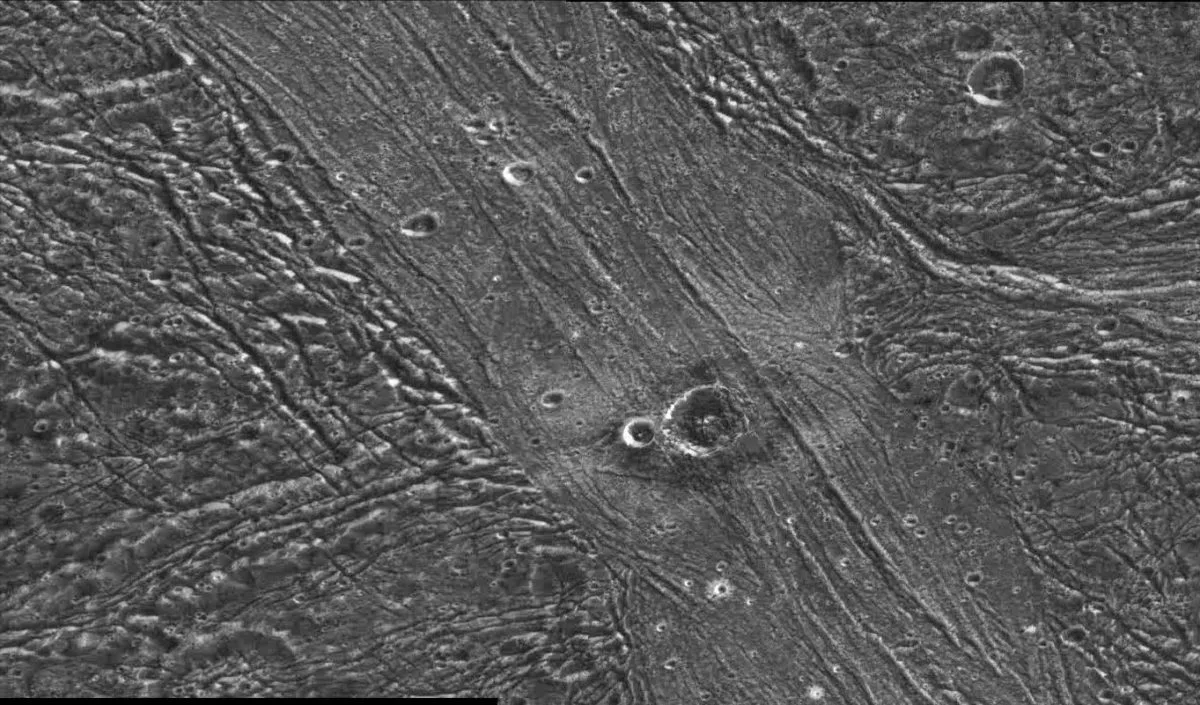
In the middle of the sulcus is the crater Nergal, considered to be the youngest feature within Byblus Sulcus. It has a satellite crater right beside it, suggesting it is a double impact crater created when an asteroid or comet that fragmented into two crashed into the same area at the same time. By law of superposition, after Byblus Sulcus was created on top of the older Marius Regio, Nergal was created on top of the younger sulcus. To the east, another sulcus, Akitu Sulcus, connects to the middle section of Byblus Sulcus, while two other unnamed sulci connect to the west.
The sulcus is densely packed with grooves and troughs that run parallel and semi-parallel to each other, rising up to 1 kilometer (0.62 miles) high in some places. The width of each trough can range from 1 kilometer (0.62 miles) to 3 kilometers (1.9 miles), becoming wider and thinner along different parts of the sulcus, while some expand to 5 kilometers (3.1 miles) wide, forming plateaus. The furrows on the dark regio on the western side of Byblus Sulcus don't seem to correspond to any features on the eastern side.
Reader's Guide
Byblus Sulcus is significant as a classic example of Ganymede's bright, grooved terrain, which is younger than the darker, ancient regions like Marius Regio. Its study helps reveal the age relationships between contrasting light and dark terrains on Ganymede, as younger grooves clearly cut across and overwrite older surfaces. This continual erasure and overprinting of ancient surfaces by newer tectonic activities is common across Ganymede and plays a major role in shaping its appearance. The sulcus's western edge cuts sharply through Marius Regio's older terrain, while on the eastern side it gradually blends into it, indicating different geological interactions. Using the crater count method, parts within Byblus's lg₃ area are younger than most other areas around it. The bright terrains on Ganymede are analogous to the dark Lunar maria on Earth's Moon in terms of age, as both are considered the youngest parts of their respective moons' surfaces. The Lunar lava flows' dark basalt composition is substituted with bright water ice on Ganymede. As of 2025, only Voyager 2 and Galileo have imaged Byblus Sulcus, with Galileo providing the first close-up images. The upcoming Juice mission, scheduled to arrive at Jupiter in July 2031, is expected to send the highest-resolution images yet, surpassing Galileo's quality.
Did You Know?
- Byblus Sulcus is named after the ancient Phoenician seaport city of Byblos, in line with the theme of naming Ganymede features after deities, heroes, or places from Ancient Middle Eastern mythologies.
- The crater Nergal, located in the middle of Byblus Sulcus, is considered the youngest feature within the sulcus and is a double impact crater created by a fragmented asteroid or comet.
- The European Space Agency's Juice probe, launched in April 2023, is scheduled to arrive at Jupiter in July 2031 and will settle into a low polar orbit around Ganymede at a distance of just 500 kilometers.
Geography and Structural Layout
Byblus Sulcus is a slender, bright band of grooved terrain that threads through the dark, ancient expanse of Marius Regio on Ganymede. Stretching roughly 645 kilometres from northwest to southeast, it carves across the northernmost lobe of this regio, beginning near Philus Sulcus to the northeast. About one-third of the way across the lobe, the sulcus forks into two branches, a split marked by an unnamed bright ray crater. The IAU and USGS officially treat both halves as a single feature. The two branches then abruptly end after traversing roughly half the lobe's width, with the northeastern arm terminating in the vicinity of the crater Anhur. At the sulcus's midpoint sits Nergal, the youngest feature within the terrain, accompanied by a satellite crater that together suggest a double impact from a fragmenting asteroid or comet. To the east, Akitu Sulcus links into the middle section, while two unnamed sulci connect from the west. The entire feature falls within the Philus quadrangle, designated Jg4.
Naming and Mythological Heritage
The International Astronomical Union bestowed the name Byblus Sulcus in 1997, drawing from the ancient Phoenician seaport of Byblos, once a thriving hub of maritime commerce. The naming follows Ganymede's established convention of honoring deities, heroes, and locations drawn from Ancient Middle Eastern mythologies, with Phoenician tradition holding particular prominence. The city of Byblos carries a remarkably layered mythological identity. In Phoenician tradition, as recorded by Philo of Byblos, it was the place where the goddess Astarte crowned herself with a bull's head as a symbol of sovereignty and from which she governed the Phoenician territories. Egyptian lore connected the city to the tragic fate of Osiris, whose body, sealed in a coffin by his jealous brother Set, drifted to its shores. Greek mythology, meanwhile, recognized Byblos as a sacred center of worship dedicated to Adonis. This convergence of three distinct cultural narratives in a single toponym makes the sulcus a small but rich intersection of ancient storytelling traditions.
Geological Character and Age Relationships
Byblus Sulcus exemplifies the bright, young terrain that characterizes much of Ganymede's resurfaced regions. Its surface is densely packed with parallel and semi-parallel grooves and troughs that rise as high as one kilometre in places. Individual troughs typically span one to three kilometres in width, though some broaden to five kilometres, forming plateau-like structures. A striking asymmetry defines the sulcus's boundaries: its western edge slices sharply through the older Marius Regio terrain, while the eastern margin fades gradually into the surrounding dark surface. Crater-counting analyses confirm that the interior of the sulcus is younger than the adjacent regio. This age contrast mirrors a broader pattern across Ganymede, where newer tectonic features repeatedly cut across and overwrite ancient surfaces. In a broader solar-system context, Ganymede's bright young terrains serve an analogous role to the Moon's dark basaltic maria, both representing the youngest surface material on their respective bodies, while Ganymede's dark ancient regions correspond to the Moon's older bright highlands. Here, however, the young material is bright water ice rather than dark volcanic basalt.
Exploration and Future Missions
Humanity's first glimpse of Byblus Sulcus came during Voyager 2's brief flyby of the Jovian system in July 1979. Because the spacecraft merely passed by Ganymede in a single quick transit, the resolution of those pioneering images was limited, and small features like this sulcus were barely resolved. Far superior views arrived with the Galileo orbiter, which circled Jupiter from December 1995 through September 2003. Galileo's repeated close passes over Ganymede yielded the first detailed close-up imagery of both Byblus Sulcus and the Nergal crater at its center, revealing the intricate grooved texture and the double-impact signature that earlier flyby data could not capture. Looking ahead, the European Space Agency's Jupiter Icy Moons Explorer, launched in April 2023, is on track to reach Jupiter in July 2031. After roughly three and a half years conducting flybys of Europa, Callisto, and Ganymede, JUICE will settle into a low polar orbit around Ganymede at an altitude of just 500 kilometres. From that vantage point, it is expected to deliver the highest-resolution images of Byblus Sulcus ever obtained, surpassing even Galileo's already impressive close-ups.
Gallery
Frequently Asked Questions
What is Byblus Sulcus?
Byblus Sulcus is a narrow, grooved trough on the surface of Ganymede, one of Jupiter's largest moons. It serves as a textbook example of the bright, young terrain on Ganymede, distinguished by multiple intersecting sets of ridges and grooves.
How long is Byblus Sulcus and how does its age compare to nearby terrain?
The trough stretches roughly 645 kilometers (about 401 miles) across Ganymede's surface. Its material is considered younger than the darker regions found elsewhere on the moon, making it a relatively recent geological feature.
Where exactly is Byblus Sulcus located on Ganymede?
It sits within the Philus quadrangle, designated as map sheet Jg4. The youngest feature found inside Byblus Sulcus is the crater Nergal.
What is Byblus Sulcus named after and when was the name approved?
The name references Byblos, an ancient Phoenician seaport city. The International Astronomical Union officially ratified the designation in 1997.
Which spacecraft have imaged Byblus Sulcus?
Both Voyager 2 and the Galileo probe captured imagery of this grooved terrain. Those flybys provided the primary observations used to study its ridge-and-groove structure in detail.
More in Moons of Jupiter, Part 3 1-24
Spotted an error? Know more?
Reader corrections go straight into our review queue. Suggest an edit · How this site is sourced