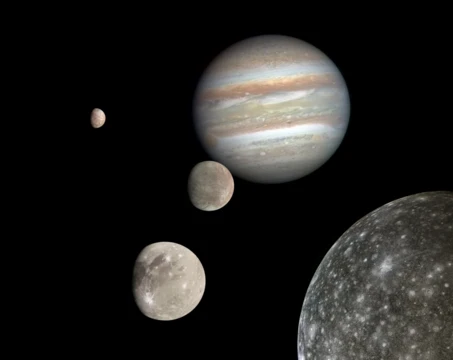
Chrysor and Aleyin (craters)
Dark-floored craters on Ganymede, named after Phoenician mythological figures.

Chrysor and Aleyin are a pair of small impact craters on Ganymede, the largest moon of Jupiter. Both craters are notable for their dark floors and knob-shaped rim peaks, and they are located within the bright region known as Memphis Facula, which lies in the darker Galileo Regio. They are among the surface features on Ganymede named after deities or heroes from Ancient Middle Eastern mythologies.
Quick Facts
- Diameter
- 7 km (Chrysor) 12.40 km (Aleyin)
- Eponym
- Chrysor and Aleyin
Facts from the source article.
Lore & Background
According to the source article, Chrysor is named after a heroic figure from Phoenician mythology who, according to the writer Sanchuniathon, invented the fishing hook, fishing line, and the fishing boat, and was later deified as Diamichius. Aleyin is named after a god of springs from Phoenician mythology, described by the IAU as a son of Ba'al, though the article notes that no other sources confirm Aleyin's identity. The IAU approved both names in 1997, following its rule that craters on Ganymede should be named after deities, heroes, or places from Ancient Middle Eastern mythologies.
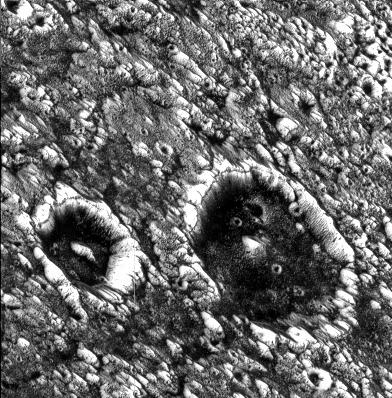
Both craters are considered impact craters based on classic features such as steep walls, relatively flat floors, and central peaks. Bright water ice is exposed on their walls, rims, and central peaks, while darker material covers the floors and appears to flow down the inner walls. The article states that most dark-floored craters in the outer regions are thought to have penetrated a thin layer of bright material to expose underlying dark material. Both craters are heavily degraded, with no visible ejecta blankets or secondary crater fields, indicating they are very old—probably hundreds of millions of years in age. A dark line near their rims may represent uplifted layered bedrock exposed by the impact.
Chrysor and Aleyin sit on Memphis Facula, a wider bright feature thought to have formed when a much larger ancient impact excavated bright subsurface water ice. The original diameter of Memphis Facula is estimated at approximately 245 km (152 mi), roughly corresponding to the location of Chrysor or just within Aleyin. Notably, while these two craters have dark floors, other nearby craters such as Hay-tau do not.
Reader's Guide
The significance of Chrysor and Aleyin lies in their role as examples of dark-floored impact craters on Ganymede, providing evidence for the moon's geological history and subsurface composition. Their dark floors, contrasting with the bright water ice on their walls and rims, suggest that the impacts penetrated a thin layer of bright material to expose underlying darker material, a process common in the outer regions of Ganymede. The craters' heavy degradation and lack of ejecta blankets indicate they are very old, likely hundreds of millions of years, offering a window into ancient impact processes. Their location within Memphis Facula, a bright feature formed by a much larger ancient impact, further contextualizes the region's complex geology. The naming of these craters after figures from Phoenician mythology reflects the IAU's systematic approach to naming Ganymede's surface features, though the article notes uncertainty regarding Aleyin's identity. The craters were first imaged by Voyager 2 in 1979 and later by the Galileo spacecraft in 1996 at high resolution, with the upcoming Juice mission expected to provide further study. A NASA webpage spells Aleyin as 'Aleyn,' indicating a minor naming discrepancy.
Did You Know?
- Chrysor and Aleyin are less than 10 km apart on Ganymede.
- Chrysor is named after a Phoenician hero who invented the fishing hook, line, and boat, later deified as Diamichius.
- The Galileo spacecraft imaged the craters in June 1996 from a distance of 2,850 km, resolving details as small as 59 meters.
The Governance of Solar System Topography
The naming of impact craters across the Solar System is not a casual or ad hoc affair; it falls under the formal jurisdiction of the International Astronomical Union's Working Group for Planetary System Nomenclature. By 2017, this body had sanctioned a total of 5,223 crater designations spread across forty distinct astronomical objects. That roster is remarkably broad in scope, encompassing full-fledged planets, their natural satellites, and a variety of minor planets including both asteroids and dwarf planets. What makes the governance structure particularly interesting is its deliberate boundary: while the WGPSN oversees every other body in the catalogue, the naming of geological features on Earth operates outside its purview. Earth's craters—numbering 190 in the compiled list—are included for completeness, yet their nomenclature follows a separate, non-IAU process. This carve-out underscores that the WGPSN's mandate is specifically extraterrestrial, treating our own planet as a reference point rather than a subject of its regulatory authority.
The Thematic Naming Philosophy
One of the most distinctive principles underlying the WGPSN's crater-naming programme is the requirement that every geological feature on a given body be drawn from a single, coherent thematic pool. A crater on one world and a crater on another are therefore almost never chosen from the same lexical universe. This thematic constraint means that the name of a crater is not merely a label but a small piece of cultural or historical storytelling tied to its host body. The rule applies across the board: whether the surface in question belongs to a gas-giant moon, a rocky dwarf planet, or a small asteroid, the same thematic discipline holds. The only notable exception in the entire catalogue is Earth, whose 190 listed craters are named through a process that the IAU's Working Group does not supervise. This exception highlights that the thematic framework is a specifically IAU-driven convention, a deliberate aesthetic and organizational choice that gives each body a unified naming identity rather than a random assortment of honorees.
The Vast and Uneven Landscape of Named Features
The distribution of officially named craters across the Solar System is strikingly lopsided, reflecting both the size of each body and the extent of observational and mission-based exploration. At the upper end, the Moon dominates with 1,624 named craters, followed by Mars at 1,092 and Venus at 900. Mercury contributes 397, while the large Galilean moons of Jupiter—Callisto with 141 and Ganymede with 131—show that substantial naming efforts extend well beyond the inner planets. Saturn's moons are well represented, with Rhea at 128, Dione at 73, and Tethys at 50. Even small bodies carry their own modest inventories: Gaspra lists 31 craters, Eros 37, and Mathilde 23. At the other extreme, several objects—Arrokoth, Proteus, and Thebe—have only a single named crater each. This wide range, from one to over sixteen hundred, illustrates how the catalogue grows in step with the quality and quantity of surface data available to the nomenclature committee.
Curation, Rejection, and the Living Gazetteer
The crater-naming process is not a one-time event but an ongoing editorial exercise in which proposals can be rejected, withdrawn, or revised. The existence of a dedicated subsection for dropped or not-approved names—visible, for instance, under Ganymede's entry—reveals that the WGPSN treats nomenclature as a living document subject to continuous review. A name that once seemed fitting may later fail to meet thematic, linguistic, or uniqueness criteria, and the committee retains the authority to strike it from the official record. The entire catalogue is anchored to the IAU's Gazetteer of Planetary Nomenclature, which serves as the authoritative external reference for every designation. Related compilations, such as a list of the largest craters in the Solar System, further extend the utility of the data. Together, these mechanisms ensure that the 5,223 names in the catalogue are not merely a static inventory but a carefully curated, evolving record of how humanity chooses to label the scars left by impacts across the Solar System.
Gallery
Frequently Asked Questions
What are Chrysor and Aleyin?
Chrysor and Aleyin are a pair of small impact craters on Ganymede, Jupiter's largest moon. They sit less than 10 kilometers apart in the western part of Memphis Facula, a bright patch embedded within the darker Galileo Regio terrain.
What do Chrysor and Aleyin look like?
Both craters are distinguished by their notably dark floors and distinctive knob-shaped peaks along their rims. These traits set them apart visually from many neighboring craters in the surrounding Galileo Regio.
Where exactly are Chrysor and Aleyin located on Ganymede?
The pair occupies the western section of Memphis Facula, a bright region nested inside the darker Galileo Regio. They fall within the Memphis Facula quadrangle, designated Jg7.
Which spacecraft have photographed Chrysor and Aleyin?
Voyager 2 first imaged the craters during its July 1979 flyby of Ganymede. The Galileo probe later captured them in June 1996 from 2,850 km away, resolving surface details as small as 59 meters.
Why are Chrysor and Aleyin named that way?
The names honor figures from Ancient Middle Eastern (Phoenician) mythology, consistent with the naming convention applied to Ganymede surface features. Both designations were officially approved in 1997.
More in Moons of Jupiter, Part 3 1-24
Spotted an error? Know more?
Reader corrections go straight into our review queue. Suggest an edit · How this site is sourced