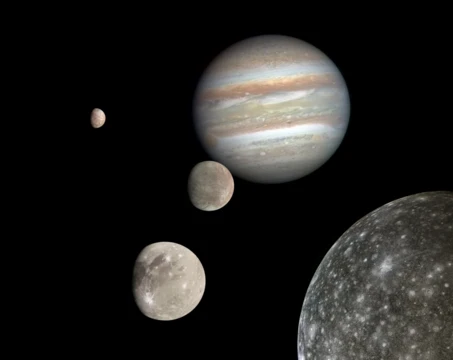
En-zu (crater)
Second-smallest named dark crater on Ganymede.

ESA/DLR/FU Berlin & NASA/JPL-Caltech/MSSS · CC BY-SA 3.0 igo
En-zu is a small impact crater on Ganymede, Jupiter’s largest moon, sitting just a few kilometers north of the moon’s equator. Its floor is coated in dark material, earning it the classification of a “dark crater.” The crater spans roughly 5 kilometers (3.1 miles) across and features a very modest central peak, making it the second-smallest named crater on Ganymede—only Anat is smaller.
**Naming** The name En-zu comes from the Akkadian name for the Babylonian god Sin. The International Astronomical Union (IAU) approved the name in 1997, following its convention of naming Ganymede’s craters after deities, heroes, and places from Ancient Near Eastern mythologies. En-zu is one of three craters on Ganymede named after this same deity; the others are Sin and Nanna. Another crater, Anzu, shares a homonymous name with En-zu.
**Geography and location** En-zu lies near Ganymede’s equator, a few kilometers north of it, within the smoother, grooved terrain called Uruk Sulcus. The crater is completely encircled by grooves. To the southeast sits the crater Mot, while to the northwest lies the Epigeus impact basin—one of the largest well-defined impact craters on Ganymede. The surrounding area is dotted with secondary impact craters, likely formed during the Epigeus impact event. En-zu is part of the Uruk Sulcus quadrangle (designated Jg8). Because Ganymede is in synchronous rotation, one hemisphere always faces Jupiter; En-zu is on the opposite hemisphere, so an observer there would never see Jupiter in the sky. Another dark-floor crater in Uruk Sulcus, Khensu, is located a few hundred kilometers to the southeast.
**Dark coloration** En-zu’s small size makes it otherwise unremarkable, but it stands out as one of the rare craters on Ganymede classified as a “dark crater” or “dark-floor crater.” Its floor appears covered in dark material, a feature seldom seen in other craters. The reason for this is not fully understood. Some studies suggest that natural deposition of dark material in low-lying areas—such as troughs, valleys, and crater floors—could explain En-zu’s appearance. Other research on similar dark craters proposes that the dark material might have come from beneath Ganymede’s surface, excavated during the impact, or from the impactor itself, which contaminated the surface.
Quick Facts
- Diameter
- 5 km
- Eponym
- Enzu
Facts from the source article.
Lore & Background
The name En-zu is derived from the Akkadian name of the Babylonian god Sin. Crater naming on Ganymede follows the International Astronomical Union's (IAU) convention of naming craters after deities, heroes, and places from Ancient Near Eastern mythologies. Enzu is a Mesopotamian god, which is why the IAU approved the name for En-zu in 1997. Two other craters on Ganymede, Sin and Nanna, are named after the same Babylonian deity as En-zu. Another crater on Ganymede called Anzu has a name that is homonymous with En-zu.
En-zu is located near Ganymede's equator, just a few kilometers to the north. It lies near the center of the smoother, grooved terrain known as Uruk Sulcus, where it is entirely surrounded by grooves. To the southeast of En-zu is the crater Mot, while to the northwest lies the Epigeus impact basin, one of the largest well-defined impact craters on Ganymede. The area around En-zu is peppered with secondary impact craters that were likely formed during the Epigeus impact event. En-zu is located within the Uruk Sulcus quadrangle (or section) of Ganymede (designated Jg8). Also, because Ganymede is in synchronous rotation as it orbits Jupiter, one hemisphere of the moon always faces the planet, while the opposite hemisphere never does. En-zu is located on the hemisphere that never faces Jupiter; therefore, an observer at the crater would never see Jupiter in the sky. Another prominent dark-floor crater within Uruk Sulcus is Khensu, which is located a few hundred kilometers to the southeast.
Reader's Guide
En-zu's small size makes it relatively unremarkable. However, it is one of the rare craters on Ganymede that is classified as a 'dark crater' or 'dark-floor crater.' This is because its crater floor appears to be covered by dark material, a feature rarely observed in other craters on the moon. The reason why some craters on Ganymede exhibit dark floors while others do not is not fully understood. Studies have suggested that the natural deposition of dark material in low-lying areas elsewhere on Ganymede, such as the floors of troughs, valleys, and impact craters, may explain the dark appearance of En-zu crater. According to studies of other dark craters, however, the dark material may instead have either originated from beneath Ganymede's surface after it has been excavated during the impact that formed the crater, or from the impactor itself, which contaminated the moon's surface. Other examples of dark floor on Ganymede are Antum, Nergal and Kittu.
Both Voyager 2 and the Galileo space probe took images of the area where En-zu is located. Voyager 2 flew by Ganymede first in July 1979, when it captured low-resolution images of En-zu crater and its surroundings. Galileo later imaged En-zu and the surrounding region again in June and September 1996 during its G1 and G2 orbits around Jupiter. The resolution of Galileo's images of En-zu was as high as 40 metres (130 ft) per pixel. Planetary scientists then combined and superimposed the newer, higher-resolution images taken by Galileo onto the older, less detailed images taken by Voyager decades earlier. Although En-zu crater is extremely small and therefore difficult to observe clearly, Galileo fortuitously flew as low as 260 kilometres (160 mi) above Ganymede's surface when it passed near the crater, allowing the probe to image it in excellent details.
The European Space Agency's (ESA) Jupiter Icy Moons Explorer (Juice) is on its way to the Jovian system. The probe is scheduled to arrive at Jupiter in July 2031 and its primary goal is to study the planet's icy moons. After orbiting around Jupiter and performing multiple flybys of the icy moons Europa, Callisto and Ganymede for approximately three and a half years, Juice will settle into a low polar orbit around Ganymede. Its close orbit around Ganymede could potentially allow planetary scientists to determine why En-zu's crater floor is so dark.
Did You Know?
- En-zu is the second-smallest named crater on Ganymede, with a diameter of only about 5 kilometres.
- The crater is located on the hemisphere of Ganymede that never faces Jupiter, so an observer there would never see Jupiter in the sky.
- The Galileo space probe flew as low as 260 kilometres above Ganymede's surface when it passed near En-zu, allowing high-resolution imaging.
Physical Profile and Classification
En-zu is a modest impact feature on Ganymede, measuring roughly five kilometres across, which places it as the second-smallest crater to receive an official name on Jupiter's largest moon. Only Anat, another tiny crater, is smaller. Despite its diminutive scale, En-zu stands out among its neighbours because its floor is blanketed in dark material, earning it the designation of a dark crater — a classification that is uncommon on Ganymede. The crater also possesses a very small central peak, a remnant of the rebound that follows a high-energy impact. Situated just a few kilometres north of Ganymede's equator, En-zu occupies a position within the smoother, grooved terrain of Uruk Sulcus, where it is entirely encircled by linear grooves. Its name, approved by the International Astronomical Union in 1997, honours the Akkadian form of the Babylonian moon god Sin, fitting within the IAU's convention of drawing crater names on Ganymede from Ancient Near Eastern mythologies. Two other craters, Sin and Nanna, share the same mythological origin, while Anzu presents a curious homonym.
Geographic Setting and Neighbourhood
En-zu sits near the centre of Uruk Sulcus, a region of Ganymede characterised by smoother, grooved terrain, and it is completely ringed by those grooves. The crater falls within the Uruk Sulcus quadrangle, designated Jg8 in planetary mapping. To its southeast lies the crater Mot, while to the northwest stretches the vast Epigeus impact basin, one of the most prominent well-defined craters on the entire moon. The terrain surrounding En-zu is scattered with numerous secondary impact craters, debris that scientists attribute to the enormous Epigeus event. Another dark-floor crater, Khensu, can be found a few hundred kilometres to the southeast, making the local area a small cluster of similar features. Because Ganymede is locked in synchronous rotation around Jupiter, one side of the moon is permanently turned toward the planet while the opposite side is forever hidden. En-zu resides on that far-facing hemisphere, meaning a hypothetical observer standing at the crater's rim would never catch a glimpse of Jupiter hanging in the sky above.
The Enigma of the Dark Floor
What makes En-zu scientifically interesting is not its size but the unusual darkness of its floor. On Ganymede, most impact craters do not display this trait, so En-zu belongs to a small group of so-called dark-floor craters that also includes Antum, Nergal, and Kittu. The precise mechanism behind the dark coating remains unresolved. One hypothesis, drawn from observations of dark material accumulating in troughs, valleys, and other depressions across the moon, suggests that dark substances naturally settle into low-lying areas such as crater floors over geological time. An alternative line of reasoning points to the impact event itself: the energy of the collision may have excavated dark material from deeper layers beneath Ganymede's crust and deposited it across the floor. A third possibility is that the impactor body carried dark material with it, contaminating the surface upon collision. Until future missions provide closer data, the true origin of En-zu's dark floor will remain an open question in planetary science.
Imaging History and the Promise of JUICE
En-zu has been photographed by two major spacecraft. Voyager 2 made the first pass in July 1979, capturing low-resolution images of the crater and its surroundings during its flyby of Ganymede. Decades later, the Galileo probe returned to the region in June and September 1996 during its G1 and G2 orbits, producing images with a resolution as fine as forty metres per pixel. In a fortunate encounter, Galileo dipped as close as 260 kilometres above the surface when it transited near En-zu, yielding exceptionally detailed views of the tiny feature. Planetary scientists subsequently overlaid the sharper Galileo imagery onto the older Voyager frames to build a more complete picture. Looking ahead, the European Space Agency's Jupiter Icy Moons Explorer is en route to the Jovian system, with arrival expected in July 2031. After roughly three and a half years of flybys of Europa, Callisto, and Ganymede, JUICE will settle into a low polar orbit around Ganymede, offering a chance to finally unravel why En-zu's floor is so dark.
Gallery
Frequently Asked Questions
What is En-zu?
En-zu is a small impact crater on Ganymede, Jupiter's largest moon. It is classified as a "dark crater" because its floor is covered in dark-toned material rather than the lighter surrounding terrain.
How big is En-zu?
The crater stretches roughly 5 kilometers (about 3.1 miles) across and has only a very modest central peak. At that size it is the second-smallest named crater on Ganymede, with only Anat measuring smaller.
Where on Ganymede can you find En-zu?
It sits just a few kilometers north of the moon's equator, placing it very close to Ganymede's midline. Its near-equatorial position makes it easy to spot in orbital imagery centered on the moon's belt region.
What does the "dark crater" classification mean for En-zu?
It means the crater floor is coated in darker material compared to the surrounding highlands, distinguishing it from lighter-floored craters. En-zu holds the distinction of being the second-smallest named dark crater on Ganymede.
How did En-zu get its name?
The name is the Akkadian form of the Babylonian moon god Sin, chosen to follow the IAU's practice of drawing Ganymede's crater names from Babylonian mythology. The International Astronomical Union officially approved the designation in 1997.
More in Moons of Jupiter, Part 3 1-24
Spotted an error? Know more?
Reader corrections go straight into our review queue. Suggest an edit · How this site is sourced