
Barnard Regio
Ancient dark region on Ganymede, split by bright sulci.

NASA/ JPL / USGS · Public domain
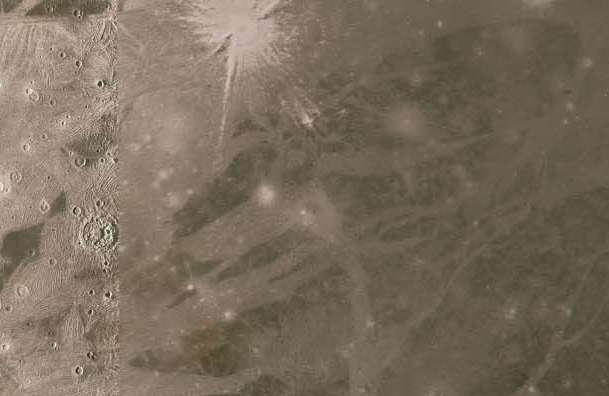
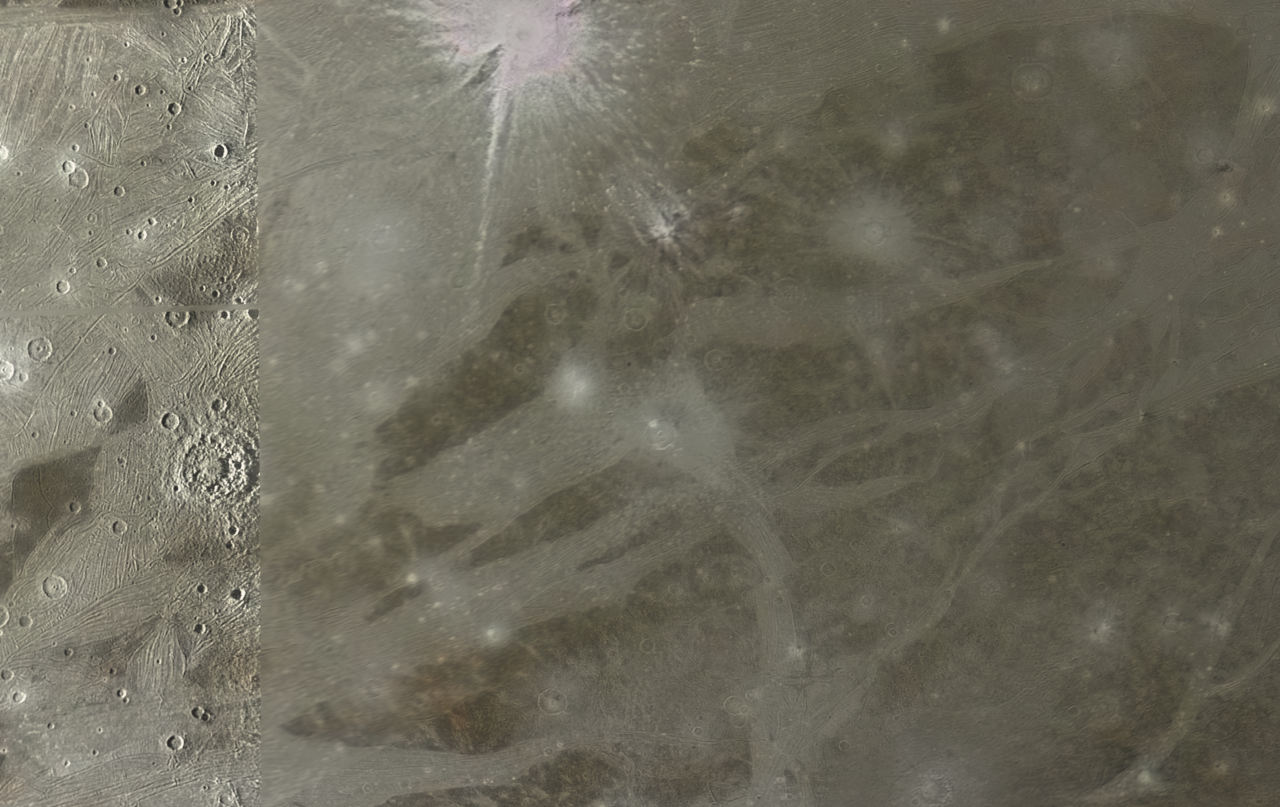
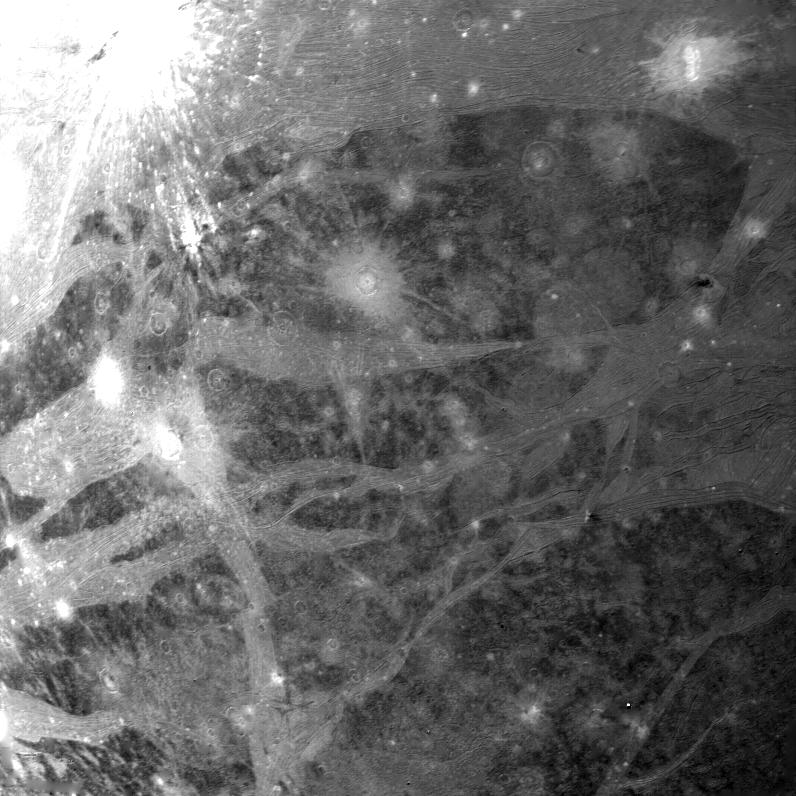
Barnard Regio is a dark, irregular patch on Ganymede, one of Jupiter’s moons. It is made up of several ancient, dark areas that are crossed by many younger, brighter grooves called sulci.
The dark regions on Ganymede, known as regiones, are named by the International Astronomical Union after astronomers who helped discover Jupiter’s moons. Barnard Regio honors Edward Emerson Barnard, the American astronomer who found Amalthea—Jupiter’s fifth-largest moon, its largest minor moon, and the first Jovian moon discovered since Galileo spotted the four Galilean moons almost 300 years earlier. The IAU approved the name in 1979.
This region covers most of the equatorial area on the side of Ganymede that always faces Jupiter. Like all dark areas on the moon, Barnard Regio is thought to be among the oldest parts of the surface. It is rugged and covered with ancient dark material, likely accumulated from dark fragments brought by impacting asteroids and comets.
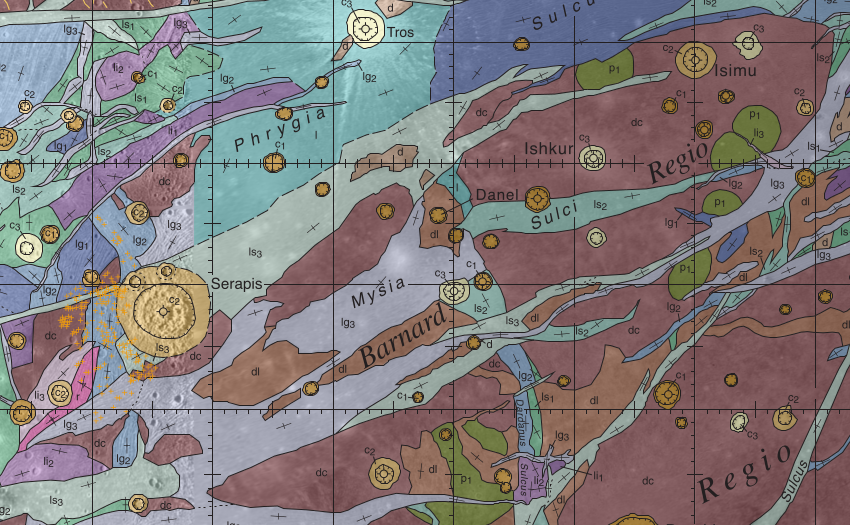
To the north, Phrygia Sulcus separates Barnard Regio from Perrine Regio. An unnamed narrow sulcus divides it from Nicholson Regio to the south. Dardanus Sulcus cuts through the southern half from north to south, splitting it in two. The more complex and chaotic Mysia Sulci run from the northeast to the southwest, breaking the region into many separate segments that look like islands.
A few craters lie inside and around Barnard Regio, but only a handful have names. Within the region, three craters are named: the bright ray crater Ishkur, and two fainter ones, Danel and Isimu. Craters without rays are generally older than those with rays. To the north sits the major ray crater Tros; to the west, the prominent dome crater Serapis; to the northwest, the bright crater chain Nanshe Catena; and to the east, the rayless crater Misharu and the dark-ray crater Kittu.
Barnard Regio lies within the Dardanus quadrangle (Jg6) and the Misharu quadrangle (Jg10) of Ganymede. A small part crosses into the Nabu quadrangle (Jg11) to the southwest. The region also contains the spot where Ganymede’s prime meridian—the line of 0° longitude that always points toward Jupiter because the moon rotates synchronously—meets its equator.
A 2020 study by Hirata, Suetsugu, and Ohtsuki suggests that Ganymede may have been hit by a huge impactor about 4 billion years ago.
Quick Facts
- Length
- 3200 km (irregularly shaped)
- Eponym
- Edward Emerson Barnard
Facts from the source article.
Lore & Background
Barnard Regio is an irregularly shaped area covering most of the equatorial region of Ganymede's Jupiter-facing hemisphere. It is a rugged area covered by ancient dark materials, probably accumulated from dark fragments brought by falling asteroids and comets. The regio is separated from Perrine Regio to the north by Phrygia Sulcus and from Nicholson Regio to the south by an unnamed narrow sulcus. Dardanus Sulcus divides the southern half from north to south, while the more complex Mysia Sulci run from northeast to southwest, splitting the regio into many separate segments like islands. Several craters lie within and around Barnard Regio, including the bright ray crater Ishkur and the fainter craters Danel and Isimu. To the north is the major ray crater Tros, to the west the dome crater Serapis, to the northwest the bright crater chain Nanshe Catena, and to the east the rayless crater Misharu and dark-ray crater Kittu. A 2020 study by Hirata, Suetsugu, and Ohtsuki suggests that Barnard Regio, along with Galileo, Marius, Nicholson, and Perrine Regiones, may be fragments of a single ancient giant impact basin, comparable to Callisto's Valhalla crater but on a far larger scale, broken apart by tectonic activity and resurfacing.
Reader's Guide
Barnard Regio holds significance as one of the oldest surviving surface features on Ganymede, providing a window into the moon's early history. Its dark materials, likely accumulated from asteroid and comet impacts, contrast with the younger, brighter sulci that crisscross it, illustrating the geological evolution of the moon. The regio's location at the intersection of Ganymede's prime meridian and equator makes it a key reference point for the moon's geography. The 2020 hypothesis that Barnard Regio is a remnant of a colossal ancient impact basin—potentially one of the largest in the Solar System—underscores its importance for understanding Ganymede's past. If confirmed by future missions like ESA's Juice, this impact would reshape knowledge of the moon's formation. The regio has been photographed by multiple spacecraft, including Voyager 1, Galileo, Cassini, New Horizons, and Juno, each providing different perspectives. Juice, scheduled to arrive at Jupiter in July 2031 and later enter low orbit around Ganymede, is expected to image Barnard Regio in greater detail than ever before, potentially resolving the basin hypothesis.
Did You Know?
- Barnard Regio is named after Edward Emerson Barnard, who discovered Amalthea, Jupiter's fifth largest moon.
- The regio contains the point where Ganymede's prime meridian meets its equator.
- A 2020 study suggests Barnard Regio may be a fragment of a giant ancient impact basin larger than any known in the Solar System.
- Voyager 2 could not see Barnard Regio because its trajectory viewed the opposite side of Ganymede.
A Bright Albedo Region on a Sulfur-Blanketed World
Barnard Regio belongs to a specific class of surface features on Io designated as a 'regio,' a term the International Astronomical Union reserves for named, bright albedo regions. These luminous patches stand out against a backdrop of extensive plains that carry a frosty coating of sulfur and sulfur dioxide, materials continuously deposited by the moon's prolific volcanic activity. Io's surface is painted in subtle shades of yellow, red, white, black, and green, largely owing to the various allotropes and compounds of sulfur that accumulate over time. As a bright albedo region, Barnard Regio reflects more sunlight than its surrounding terrain, making it a visually distinct landmark on an already colorful and ever-changing landscape. The underlying geology of Io is primarily silicate rock encircling a molten iron or iron sulfide core, a composition that sets it apart from the water-ice-dominated moons of the outer Solar System. The thin, patchy atmosphere that shrouds the moon is itself a product of volcanic ejecta, and the same materials that build up surface deposits like those seen in bright regions also feed the plasma torus encircling Jupiter.
Tidal Heating and the Engine of Surface Renewal
The geological forces responsible for shaping features across Io's surface, including its bright albedo regions, trace back to tidal heating generated by gravitational friction. As Io is stretched and compressed between Jupiter's immense pull and the gravitational influence of Europa and Ganymede, internal friction produces extraordinary heat. This energy drives more than four hundred active volcanoes, making Io the most geologically active body in the entire Solar System. Several of these eruptive sites launch plumes of sulfur and sulfur dioxide soaring up to five hundred kilometers above the surface. The resulting lava flows, some stretching beyond five hundred kilometers in length, repeatedly resurface the moon, erasing older terrain and depositing fresh material. More than one hundred mountains, some exceeding the height of Mount Everest, have been uplifted by compression at the base of the silicate crust. For a feature like Barnard Regio, this means the bright surface it presents is not static; it is perpetually subject to the same volcanic and tectonic processes that repaint the rest of Io in shifting hues and reshape its topography.
Naming the Inferno: Conventions and Classification
The naming of features on Io follows a carefully structured system approved by the International Astronomical Union, which has sanctioned two hundred and forty-nine names for the moon's volcanoes, mountains, plateaus, and large albedo features. The categories are drawn from Latin: patera for a volcanic depression, fluctus for a lava flow, vallis for a lava channel, and active eruptive center for sites where plume activity first signaled volcanic behavior. Mountains carry the term mons, plateaus use mensa, layered terrain is called planum, and shield volcanoes are designated tholus. Bright albedo regions, the category to which Barnard Regio belongs, are termed regio. The thematic source material for these names draws from the mythological story of Io, the priestess of Hera who became a lover of Zeus, as well as deities of fire, volcanoes, the Sun, and thunder from various world mythologies, and characters and places from Dante's Inferno. This mythological framework was originally proposed by Simon Marius in 1614, building on a suggestion from Johannes Kepler, and was not widely adopted until the mid-twentieth century, when the Roman numeral designations Galileo had introduced gradually gave way to the more evocative mythological names.
From Galileo's Padua Observatory to Modern Flybys
The first recorded observation of Io was made by Galileo Galilei on 7 January 1610, using a twenty-power refracting telescope at the University of Padua, though in that initial sighting he could not fully separate Io from Europa. The discovery of the Galilean moons played a pivotal role in advancing the Copernican model and Kepler's laws of planetary motion, and Io itself was later used for the first measurement of the speed of light. The modern understanding of Io's surface, including features like Barnard Regio, owes much to the 1979 Voyager missions, which revealed the moon to be a geologically active world with numerous volcanic features, large mountains, and a young surface lacking obvious impact craters. The Galileo spacecraft then performed several close flybys during the 1990s and early 2000s, gathering data on Io's interior structure and surface composition, and uncovering the relationship between the moon and Jupiter's magnetosphere, including a belt of high-energy radiation centered on Io's orbit. Subsequent observations by Cassini-Huygens in 2000, New Horizons in 2007, and Juno from 2017 onward, along with Earth-based telescopes and the Hubble Space Telescope, have continued to refine our picture of this dynamic world and the bright regions that dot its surface.
Gallery
Frequently Asked Questions
What is Barnard Regio?
Barnard Regio is a dark, irregularly shaped terrain feature on the surface of Ganymede, one of Jupiter's four largest moons. It is composed of several ancient, dark patches that have been fractured and crossed by numerous younger, brighter grooves called sulci.
Who is Barnard Regio named after?
The region honors Edward Emerson Barnard, an American astronomer who in 1892 discovered Amalthea, Jupiter's fifth-largest moon and its biggest minor satellite. Amalthea was the first newly detected Jovian moon since Galileo identified the four Galilean moons roughly three centuries earlier.
Where exactly is Barnard Regio located on Ganymede?
It lies in the equatorial zone of Ganymede's permanently Jupiter-facing hemisphere. The feature stretches across portions of three IAU-mapped quadrangles: Dardanus (Jg6), Misharu (Jg10), and Nabu (Jg11).
What makes Barnard Regio visually distinctive?
The ancient, dark surface of the regio is crisscrossed by many younger, bright sulci, producing a stark contrast between the old dark material and the newer light grooves. This layered pattern indicates the area has experienced multiple geological episodes over billions of years.
Which spacecraft have photographed Barnard Regio?
Imagery of the region has been returned by Voyager 1, Galileo, Cassini, New Horizons, and Juno. The IAU formally approved the name in 1979 under its convention of titling Ganymede's dark regiones after astronomers linked to the discovery of Jovian satellites.
More in Moons of Jupiter, Part 3 1-24
Spotted an error? Know more?
Reader corrections go straight into our review queue. Suggest an edit · How this site is sourced