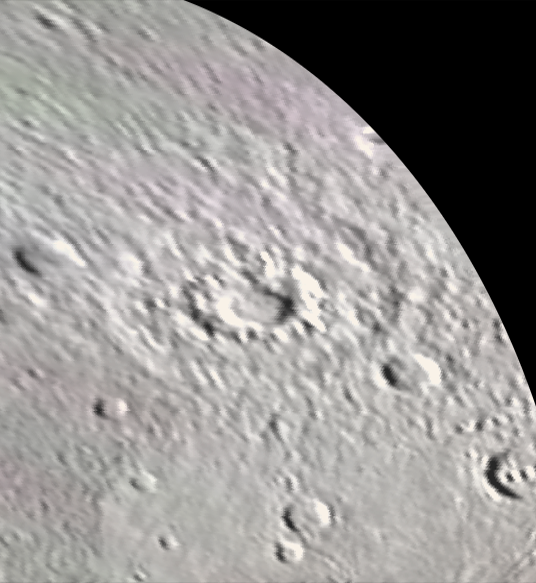
Anzu (crater)
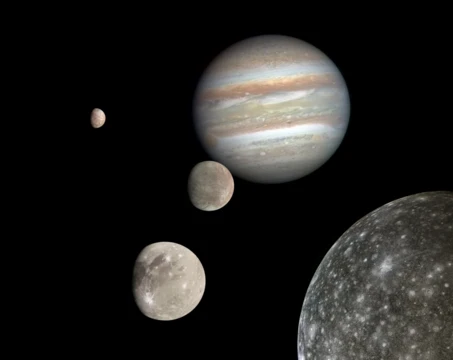
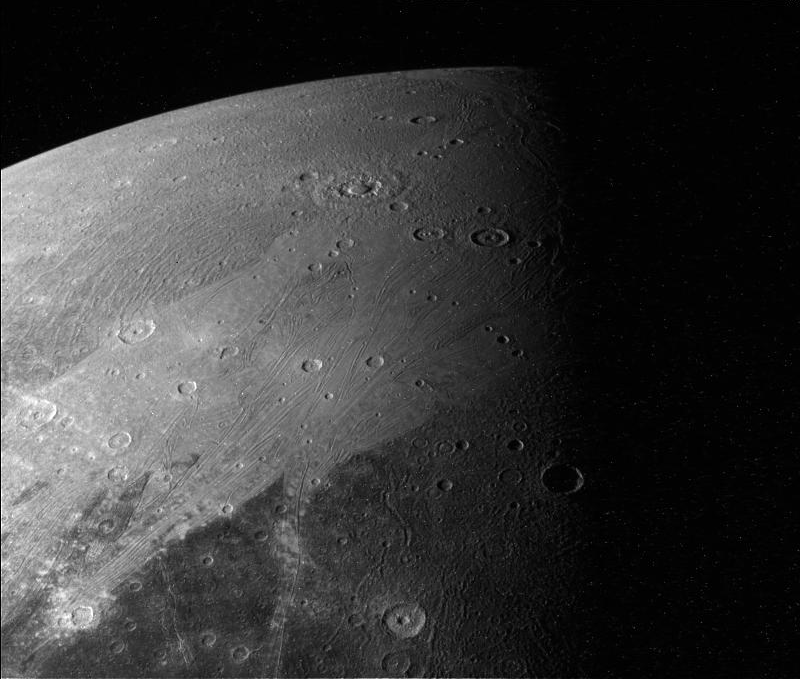
An uplifted dome crater on Ganymede, named after a Mesopotamian mythic creature.

Tadek Kurpaski from Pittsburgh,PA, USA · CC BY 2.0
Anzu is an impact crater on Ganymede, Jupiter’s largest moon, that has been pushed upward and deformed by geological forces. It measures about 210 kilometers (130 miles) across.
**Naming** The crater takes its name from the Anzû (also called Zu or Imdugud), a creature in Mesopotamian mythology with an eagle’s body and wings and a lion’s head. This being is known for stealing the Tablet of Destinies—a sacred clay tablet that grants its owner supreme power—from Enlil, the chief god of the Mesopotamian pantheon. The gods eventually killed Anzû and recovered the tablet. The International Astronomical Union (IAU) approved the name in 2000, following the convention that features on Ganymede are named after deities, figures, and places from ancient Middle Eastern mythologies, including Mesopotamian stories. A large furrow on Ganymede called Zu Fossae is also named after this character. Additionally, another Ganymede crater, En-zu, has a name that sounds the same as Anzu.
**Location** Anzu sits in the far northern hemisphere of Ganymede, on the northwestern side of a bright, grooved region called Xibalba Sulcus. To its southeast lie the craters Ninkasi and Sapas. It lies within the northern edge of the Perrine Regio quadrangle (designated Jg2) on Ganymede’s Jovian-facing hemisphere—the side that always faces Jupiter because the moon rotates synchronously. From inside Anzu, Jupiter would appear fixed in the same spot in the sky at all times.
**Morphology and formation** Anzu is a penedome crater, featuring a central dome and a donut-shaped uplifted area around it that contains the rest of the crater floor. Unusually, it rises above the surrounding plains of Xibalba Sulcus, the opposite of most craters. Such penedome-pedestal craters are common on icy moons like Ganymede but rare on rocky bodies such as Earth’s Moon or Mercury. According to a study by Dr. Oliver White, the icy Galilean moons Ganymede and Callisto show a wide variety of impact crater shapes that differ greatly from those on rocky bodies. These differences come from variations in impactor size and the physical structure of the moons’ ice shells at the time of impact—including a cold, rigid surface layer of water ice, warmer and more ductile ice deeper down, and sometimes subsurface liquid water.
Quick Facts
- Diameter
- 210 km
- Eponym
- Anzû
Facts from the source article.
Lore & Background
Anzu is named after the Anzû, a creature from Mesopotamian mythology with the body and wings of an eagle and the head of a lion, famous for stealing the Tablet of Destinies from the god Enlil. The International Astronomical Union (IAU) chose this name in 2000, following the convention that surface features on Ganymede are named after deities, figures, and places from ancient Middle Eastern mythologies. The massive furrow feature Zu Fossae and another crater called En-zu are also named after the same mythological character.
Anzu is located in the far northern hemisphere of Ganymede, on the northwestern side of the bright grooved terrain known as Xibalba Sulcus. To its southeast are the neighboring craters Ninkasi and Sapas. It lies on the Jovian-facing hemisphere, which permanently faces Jupiter due to Ganymede's synchronous rotation, meaning an observer within Anzu would see Jupiter remain fixed in the sky.
Morphologically, Anzu is a penedome crater with a central dome and a donut-shaped uplifted surface surrounding it, elevated above the surrounding plains. Such craters are common on icy moons like Ganymede but rare on rocky bodies. According to a study by Dr. Oliver White, anomalous dome craters like Anzu formed when impacts penetrated through cold surface ice into a mechanically weak subsurface layer of warm, ductile ice. Dome features resulted from meltwater accumulating beneath the crater, refreezing, and expanding, which uplifted the center into an icy dome.
Reader's Guide
Anzu is significant as an example of an anomalous dome crater on an icy moon, a morphology rare on rocky bodies like Earth's Moon or Mercury. Its formation is attributed to impacts penetrating through a cold, rigid surface ice layer into warmer, ductile ice below, with impact melt playing a secondary role. The dome formed when meltwater refroze, expanded, and uplifted the crater's center. Such dome craters generally occur only in craters with diameters greater than approximately 60 kilometres. Anzu's study helps scientists understand the physical structure of Ganymede's ice shell at the time of impact. As of 2026, only the Galileo spacecraft has imaged Anzu, during its June 1997 flyby. The European Space Agency's Juice probe, arriving at Jupiter in July 2031 and entering low orbit around Ganymede in July 2034, is expected to return higher-resolution close-up images of the crater, potentially revealing more about its geology and the moon's subsurface.
Did You Know?
- Anzu is approximately 210 kilometres (130 mi) wide.
- It is a penedome-pedestal crater elevated above the surrounding plains, the opposite of most craters.
- The crater is named after the Mesopotamian creature Anzû, which stole the Tablet of Destinies.
- Only the Galileo spacecraft has imaged Anzu, as of 2026.
Place Within the Official Nomenclature
Anzu exists as one entry within a vast, carefully maintained registry of impact features catalogued across the Solar System. The International Astronomical Union's Working Group for Planetary System Nomenclature is the sole authority responsible for assigning official designations to geological features on celestial bodies other than Earth. As of the 2017 count, this registry encompassed 5,223 individually named craters distributed across forty distinct astronomical bodies. These bodies span an extraordinary range of objects: full-sized planets, natural satellites orbiting them, dwarf planets, and minor planets including asteroids. Anzu's inclusion in this list means it has passed through the formal review and approval process of the WGPSN, distinguishing it from countless unnamed depressions that dot the surfaces of airless worlds. Its designation is not merely a label but a recognized entry in the Gazetteer of Planetary Nomenclature, the IAU's authoritative reference for planetary feature names.
Thematic Naming Conventions
A defining principle of the Solar System nomenclature system is that every geological feature on a given body, craters included, must follow a single, coherent thematic rule. This means that the name Anzu was not chosen in isolation or at random; rather, it was selected to conform with the established naming theme for whichever body hosts it. The IAU's framework requires that all features on a particular world share a unifying conceptual thread, whether that theme draws from mythology, literature, geography, or another agreed-upon source. This thematic constraint ensures internal consistency on each body's surface map. The rule applies uniformly across the entire catalogue, from the single named crater on Arrokoth to the 1,624 craters catalogued on Earth's Moon. For Anzu specifically, its name reflects adherence to this body-level convention, binding it to a broader family of similarly themed designations that together paint a coherent picture of the surface nomenclature.
Scale of the Solar System Crater Census
The context in which Anzu is recorded is one of remarkable breadth and unevenness. The forty bodies carrying officially named craters range from objects with just a single designated impact feature—Arrokoth, Proteus, and Thebe each host exactly one—to the Moon, which carries 1,624 named craters, and Mars with 1,092. Venus contributes 900, while Mercury accounts for 397. The catalogue also includes smaller worlds: Ceres and Vesta each hold 90, Callisto 141, Ganymede 131, and Rhea 128. Minor planets such as Eros (37), Gaspra (31), and Ida (21) round out the list, demonstrating that even small asteroids receive formal nomenclature treatment. Anzu occupies one position within this spectrum of hundreds or thousands of named features on its host body, part of a collective inventory that the IAU has painstakingly assembled and maintained over decades of planetary exploration and observation.
Governance and Administrative Boundaries
The administrative architecture surrounding Anzu's name involves several layers of oversight and exception. The WGPSN governs naming for all bodies in the registry except Earth, whose 190 listed craters fall outside the group's jurisdiction and follow a separate nomenclature process. This distinction highlights that the IAU framework, while comprehensive, deliberately carves out an exception for our home planet. Additionally, the system is not static: the catalogue acknowledges that some proposed names are dropped or never approved, a category explicitly noted in the Ganymede section of the registry. This implies a review process in which candidate names can be rejected or withdrawn after initial suggestion. The Gazetteer of Planetary Nomenclature serves as the public-facing reference where approved designations, including Anzu, are formally recorded. Together, these governance mechanisms ensure that the 5,223-entry registry remains a curated, authoritative document rather than an open-ended collection of informal labels.
Gallery


Frequently Asked Questions
What is Anzu (crater)?
Anzu is an uplifted impact crater on Ganymede, the largest of Jupiter's moons. Unlike a typical bowl-shaped crater, it has been pushed upward and warped by tectonic forces, giving it a distinctive dome-like profile.
Where exactly is Anzu located on Ganymede?
It sits in the far northern hemisphere of the moon, on the northwestern flank of the Xibalba Sulcus groove system. Administratively it falls within the Perrine Regio quadrangle, designated Jg2.
How large is the Anzu crater?
The crater spans roughly 210 kilometres (about 130 miles) in diameter, making it one of the more prominent features in Ganymede's northern terrain.
Why is it called Anzu and who is it named after?
The name honours Anzû (also rendered Zu or Imdugud), a hybrid creature from Mesopotamian myth described as having an eagle's body and a lion's head. In the legend, Anzû snatches the Tablet of Destinies from the god Enlil before the other gods slay it and reclaim the tablet. The International Astronomical Union approved the name in 2000.
Which spacecraft first imaged Anzu, and when?
NASA's Galileo probe captured the first close-up views during its June 1997 flyby of Ganymede, revealing the crater's deformed, uplifted structure in detail.
More in Moons of Jupiter, Part 3 1-24
Spotted an error? Know more?
Reader corrections go straight into our review queue. Suggest an edit · How this site is sourced