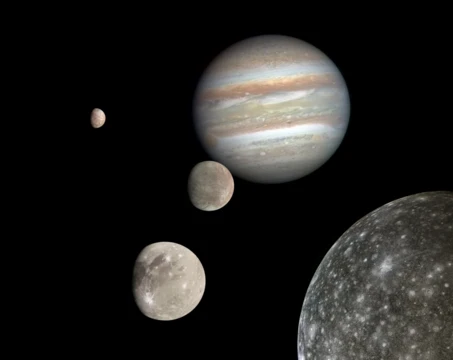
El (crater)
A Ganymede crater with a central pit, named after a supreme deity.

NASA / Goddard Space Flight Center / Arizona State University · Public domain
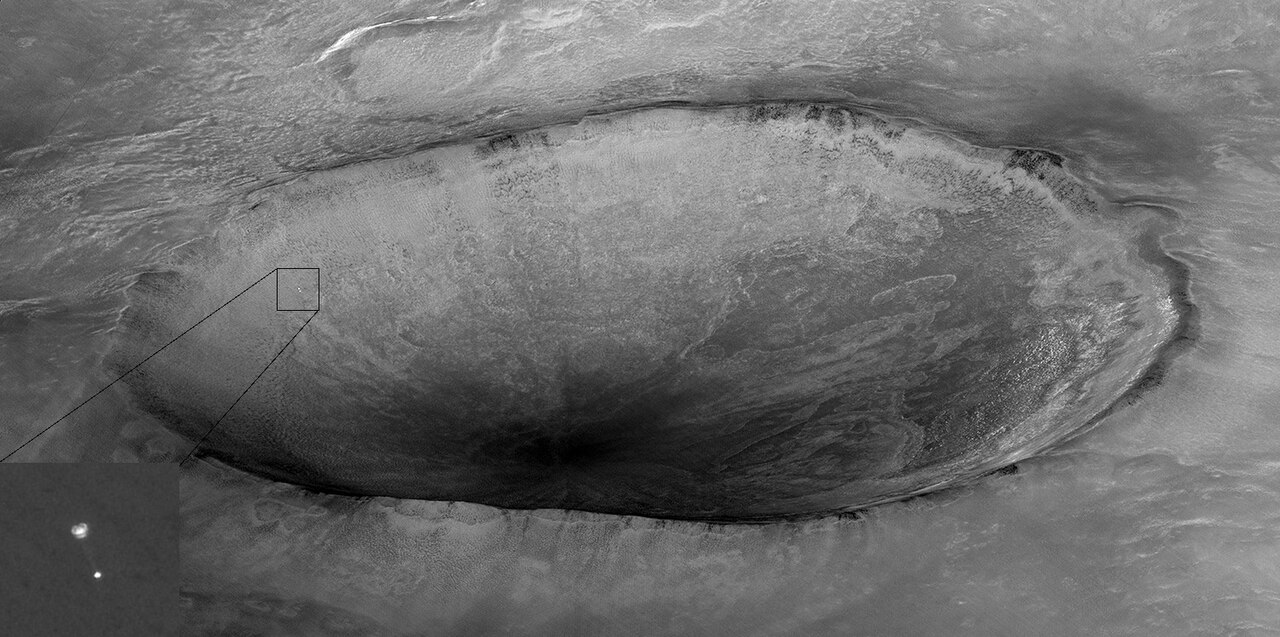
El, a crater found on Ganymede, features a small pit at its center. This type of central-pit crater is widespread on the moon, and scientists find them particularly interesting because they could offer clues about the structure of Ganymede’s shallow subsurface.
Quick Facts
- Diameter
- 55 km
- Eponym
- El
Facts from the source article.
Lore & Background
El is a crater located entirely within Uruk Sulcus on Ganymede. To its west lies the dark-ray crater Khensu, while to its northeast is the dark region Galileo Regio and to its southwest is another massive dark region called Marius Regio. The crater is situated in the Uruk quadrangle, designated Jg8.
The crater features a small 'pit' at its center. Craters with such a central pit are common across Ganymede and are considered especially intriguing because they may reveal secrets about the structure of the satellite's shallow subsurface.
The name 'El' was chosen by the International Astronomical Union (IAU) in 1997, following the theme that craters on Ganymede be named after deities, figures and places from Ancient Middle Eastern mythologies. El is the supreme deity and 'father of all gods and goddesses' in many Middle Eastern mythologies, including Canaanite, Ugaritic, Hittite, and Hebrew mythologies. His name is also the generic term for 'god' or 'deity' in many Semitic and Anatolian languages, though its pronunciation and rendering vary across cultures. El assumed several different roles in mythology, ranging from a storm god to a sky god.
Reader's Guide
El crater's significance lies primarily in its central pit, a feature common on Ganymede but not fully understood. Such pits are especially intriguing because they may reveal secrets about the structure of the satellite's shallow subsurface, offering clues to the geological processes that shaped Ganymede. The crater's location within Uruk Sulcus, a bright grooved terrain, and its proximity to dark regions like Galileo Regio and Marius Regio, as well as the dark-ray crater Khensu, provide context for studying the interplay between different surface types on Ganymede. The naming of El follows the IAU convention for Ganymede craters, drawing from Ancient Middle Eastern mythologies. El's role as a supreme deity and father of gods and goddesses across multiple cultures, and his name's use as a generic term for 'god' in many languages, reflects the cultural breadth of the naming theme. The approval of the name in 1997 adds a chronological marker to the crater's formal recognition.
Did You Know?
- El crater has a small 'pit' in its center.
- Craters with central pits are common across Ganymede and may reveal secrets about the satellite's shallow subsurface.
- The name 'El' was approved by the International Astronomical Union in 1997.
Gallery
Frequently Asked Questions
What is El (crater)?
El is a small-pit crater on Jupiter's moon Ganymede, sitting entirely within the Uruk Sulcus region of the Uruk quadrangle (Jg8). Its defining feature is a tiny pit at the center of the crater floor.
Why is the crater called El?
The name honors El, the supreme god described as the 'father of all gods and goddesses' in Canaanite, Ugaritic, Hittite, and Hebrew mythologies. This fits Ganymede's broader naming convention of drawing from Ancient Middle Eastern deities and figures.
What makes El's central pit scientifically interesting?
Central-pit craters like El are found across Ganymede's surface, and researchers believe studying them could reveal details about the moon's shallow subsurface structure.
What's around El (crater) on Ganymede?
The dark-ray crater Khensu lies to the west, while the dark regions Galileo Regio and Marius Regio sit to the northeast and southwest respectively. All of these features share the same Uruk quadrangle neighborhood.
When did the IAU officially approve the name El?
The International Astronomical Union approved the designation in 1997, consistent with Ganymede's established naming theme of Ancient Middle Eastern mythological references.
More in Moons of Jupiter, Part 3 1-24
Spotted an error? Know more?
Reader corrections go straight into our review queue. Suggest an edit · How this site is sourced