
Arbela Sulcus
A bright, grooved trough splitting Ganymede's dark Nicholson Regio.

NASA/JPL · Public domain
Arbela Sulcus is a long, grooved terrain on Jupiter's largest moon Ganymede. It is a major trough that runs for approximately 3,850 kilometres (2,390 mi), with a surface that is younger and smoother than the darker materials surrounding it. The sulcus is notable for its possible formation through lithospheric separation and strike-slip faulting, making it distinct from many other sulci on Ganymede.
Quick Facts
- Length
- 3850 km
- Eponym
- Arbela, modern Iraq
Facts from the source article.
Lore & Background
Arbela Sulcus is entirely located within the darker, ancient region called Nicholson Regio. The brighter sulcus snakes its way into the middle of Nicholson Regio, beginning from the northeast near a crater called Misharu, extending towards the southwest and roughly bisecting the dark terrain diagonally. It then encounters another sulcus called Dardanus Sulcus approximately midway along its length before crossing over and continuing its westward course, terminating at Nicholson Regio's south-westernmost point near a dark-ray crater called Humbaba. The entire length of Arbela Sulcus is located on the side of Ganymede that always faces Jupiter due to the moon's synchronous rotation.
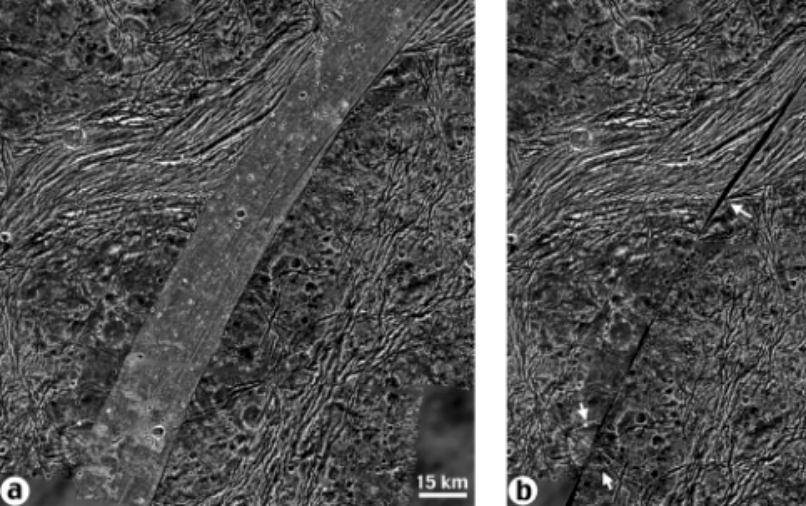
Like many of Ganymede's bright regions, Arbela Sulcus is a relatively brighter terrain characterized by multiple sets of ridges and grooves mostly running parallel to each other. According to a study by Collins, Head, Pappalardo, Nixon, Giese, Wagner and the Galileo SSI team, it is possible that Arbela Sulcus marks a zone where Ganymede's surface is progressively splitting apart the older and darker original crust before replacing it with a newer surface. Simulations and reconstruction suggest it likely formed through horizontal splitting of Nicholson Regio, followed by diagonal shear that displaced features by as much as 65 kilometres (40 mi), strongly indicating strike-slip faulting played a significant role. However, this reconstruction is not perfect, leaving conclusions regarding spreading still ambiguous.
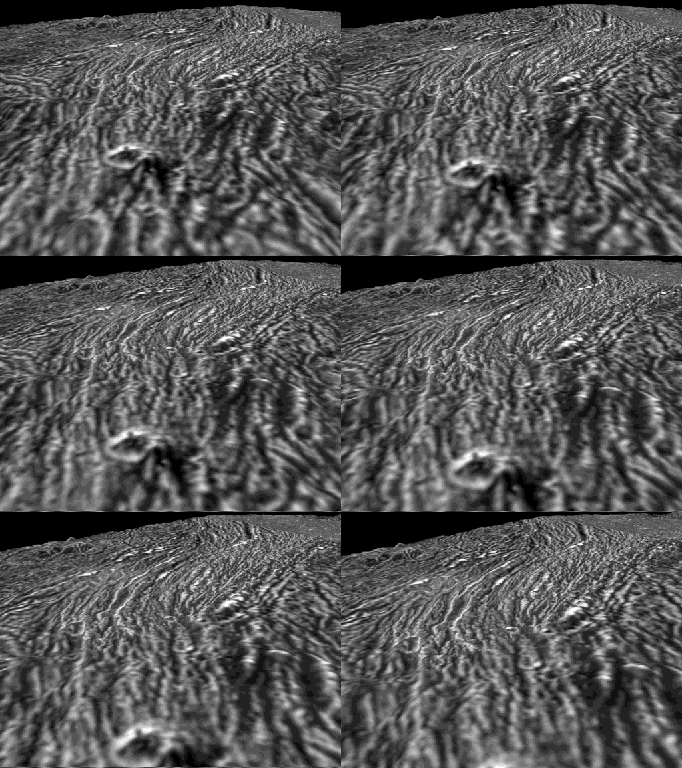
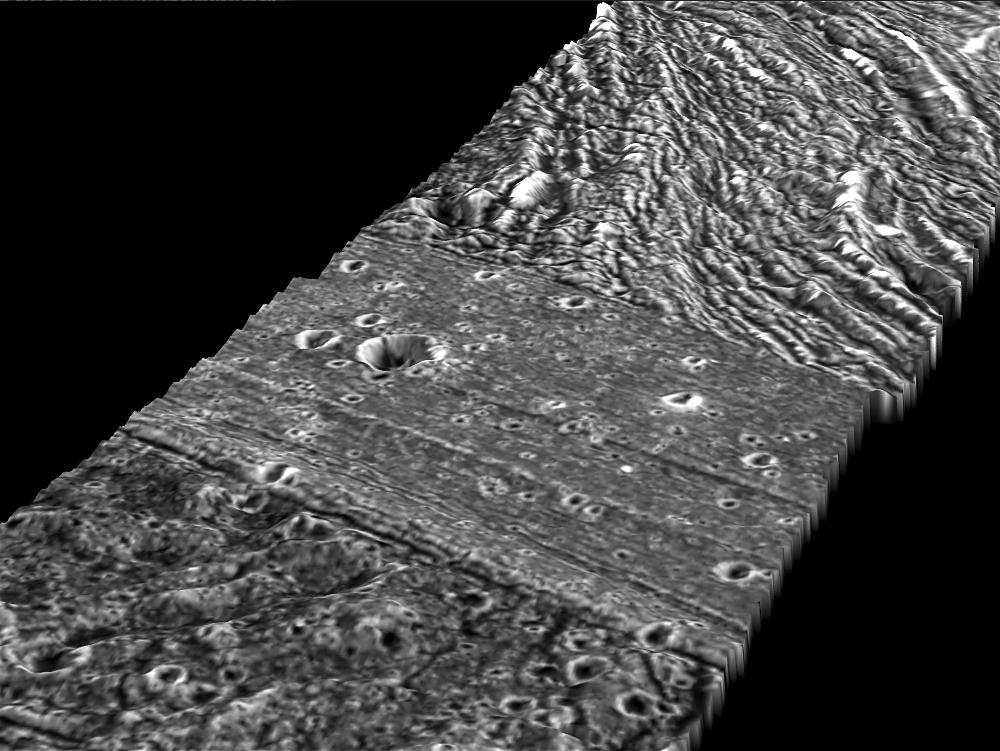
High-resolution stereo imaging reveals Arbela Sulcus has a sigmoid shape composed of differently oriented segments, with a smooth, north-northeast-trending plank that crosscuts older, east-northeast-trending grooved terrain. The plank surface displays subdued ridges and troughs at 100–200 m scales and stands at a higher elevation than adjacent dark terrain. These characteristics suggest that if Arbela Sulcus originally formed through volcanic flooding, later tectonic processes must have modified its present appearance.
Reader's Guide
Arbela Sulcus is significant as a key example of tectonic resurfacing on Ganymede, where younger, sinuous grooves cut across older surfaces, pushing apart the dark terrain of Nicholson Regio. Its formation through lithospheric separation and strike-slip faulting distinguishes it from most other sulci on the moon. The sulcus was of particular interest to astrogeologists because of the possibility that its tectonic activity is an analogue of tectonic activity on Europa, another moon of Jupiter that planetary scientists are greatly interested in studying due to its noteworthy geological processes and potential to harbor life.
Explored by Voyager 1 in March 1979, which sent back clear images but could not image the western end, Arbela Sulcus was later the subject of many stereo images taken by the Galileo probe from December 1995 to September 2003. Galileo flew as low as 3,350 km from Ganymede's surface in May 2000, allowing details as small as 70 meters to be seen. As of 2025, Galileo's images remain the only close-up images of Arbela Sulcus. The Cassini probe imaged it in low resolution in December 2000, and New Horizons imaged only its western terminus in February 2007. The European Space Agency's Juice orbiter, scheduled to arrive at Jupiter in July 2031, is expected to settle into a low polar orbit around Ganymede as low as 500 km, which will allow the most detailed images of Arbela Sulcus before eventually crashing into the moon.
Did You Know?
- Arbela Sulcus is named after an ancient Middle Eastern city, Arbela (modern-day Erbil, Iraq), a major center of worship for the Babylonian goddess Ishtar.
- The sulcus runs for approximately 3,850 kilometres (2,390 mi) and is entirely located within the darker region called Nicholson Regio.
- Strike-slip faulting displaced features along Arbela Sulcus by as much as 65 kilometres (40 mi).
- As of 2025, the only close-up images of Arbela Sulcus are from the Galileo probe.
Geological Formation and Physical Character
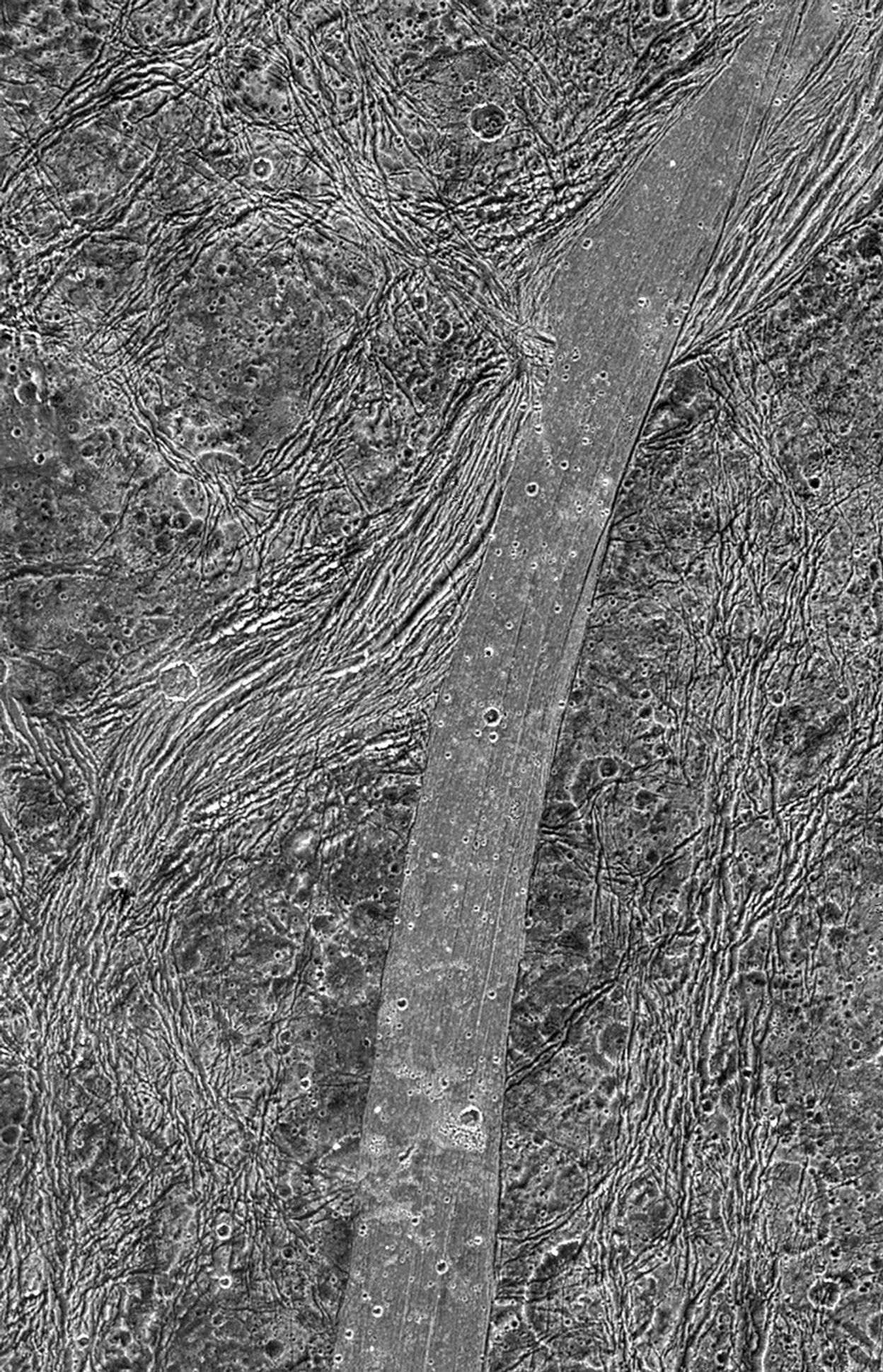
Arbela Sulcus is a long, sinuous groove that threads through the heart of Nicholson Regio on Ganymede, stretching for thousands of kilometers across the moon's surface. Unlike the ancient, heavily fractured dark terrain that surrounds it, the sulcus presents a remarkably smooth and uniform surface. This stark textural contrast makes it one of the most visually prominent features in imagery of the region, standing out sharply against the rugged plains crisscrossed by scarps and tectonic disruptions. Geological interpretation suggests the sulcus formed as the moon's icy crust was stretched and fractured by extensional forces, a process that pulled the surface apart and produced a linear channel filled with younger material. Because it postdates the dark, ancient terrain of Nicholson Regio, the sulcus represents a later chapter in the moon's geological story—a period of crustal extension that carved new pathways through the oldest surfaces. Its smoothness, relative to the billions of years of accumulated buckling and deformation in the surrounding regio, underscores just how much younger this feature is, even by Ganymede's own geological standards.
Spatial Division and Regional Boundaries
Arbela Sulcus plays a critical role in structuring the geography of Nicholson Regio. Running from the southwest toward the northeast, it slices through the massive dark feature and, together with Dardanus Sulcus, partitions the regio's dark terrain into three broad segments. Within the eastern lobe specifically, the sulcus acts as a dividing line, separating a northeastern portion from a southeastern portion. It also serves as the southwestern boundary of Nicholson Regio itself, defining where the dark regio ends. Because Nicholson Regio is so vast that it spans four of Ganymede's mapped quadrangles—Dardanus, Misharu, Nabu, and Namtar, designated Jg6, Jg10, Jg11, and Jg14—Arbela Sulcus necessarily traverses multiple quadrangle boundaries as well. Its path is not a straight line but rather a meandering course that winds through the center of the regio, making it a dominant linear landmark in an otherwise complex and heavily deformed landscape. The sulcus thus functions simultaneously as an internal divider and an external boundary, shaping how geologists delineate and study the various sub-regions of this ancient terrain.
Place in Ganymede's Geological Timeline
The dark, ancient terrain of Nicholson Regio dates to the Nicholsonian Period, the earliest recognized era in Ganymede's history, when the moon's originally bright icy surface became darkened by non-ice material. Arbela Sulcus, by contrast, belongs to a much later phase of geological activity. The USGS identifies Nicholson Regio as containing the oldest surface on Ganymede, and the sulcus is explicitly described as younger and smoother than that ancient terrain. This places Arbela Sulcus within the broader sequence of resurfacing events that followed the Nicholsonian Period—events during which extensional forces stretched the crust and created the grooved sulci terrain that now dissects the older dark regions. In this framework, the sulcus is not merely a random crack but a record of a specific tectonic episode: the moon's icy shell was pulled apart, and the resulting faulting carved a smooth channel through terrain that had already accumulated billions of years of buckling and deformation. The fact that such young, smooth features cut across the oldest surfaces on Ganymede highlights the extraordinary span of geological time preserved in a single region of this moon.
Location and Observational Setting
Arbela Sulcus lies on the Jupiter-facing hemisphere of Ganymede, the side that perpetually turns toward the giant planet due to the moon's synchronous rotation. This means that any observer standing on the sulcus would see Jupiter hanging fixed in the sky above Nicholson Regio at all times. The feature occupies a position of considerable geographic significance: it threads through the eastern lobe of Nicholson Regio, a region that borders Harpagia Sulcus to the east and is adjacent to named craters including Damkina, Khumba, Saltu, and Seker. The nearby ray crater Enkidu, one of the brightest features in the area, straddles the boundary between the dark regio and the lighter terrain beyond. Because the sulcus is so smooth relative to the surrounding rugged, fractured plains, it stands out prominently in enhanced imagery, making it one of the most easily identifiable linear features in this part of Ganymede. Its position within the vast Nicholson Regio—spanning four quadrangles and covering most of the southern Jupiter-facing hemisphere—places it at the intersection of some of the moon's most geologically important and visually striking terrain.
Gallery
Frequently Asked Questions
What is Arbela Sulcus?
Arbela Sulcus is a major grooved trough on Ganymede, Jupiter's largest moon, that slices through the darker terrain of Nicholson Regio. Its surface is noticeably younger and smoother than the surrounding dark material, making it stand out visually in orbital imagery.
How long is Arbela Sulcus?
The trough stretches roughly 3,850 kilometres (about 2,390 miles) across Ganymede's surface. It spans three named quadrangles: Misharu (Jg10), Nabu (Jg11), and Namtar (Jg14).
How did Arbela Sulcus likely form?
Scientists believe it was created by lithospheric separation combined with strike-slip faulting, a mechanism that sets it apart from many other grooved terrains on Ganymede. This dual-process origin makes its geological history distinct from simpler extensional sulci found elsewhere on the moon.
Where is Arbela Sulcus located and where does the name come from?
It sits within Nicholson Regio, one of Ganymede's darker, older regions, and crosses the Misharu, Nabu, and Namtar quadrangles. The name, approved by the IAU in 1985, references Arbela, the ancient name for the city of Erbil in modern-day Iraq.
What is the closest spacecraft flyby of Arbela Sulcus?
NASA's Galileo probe came within about 3,350 kilometres (2,080 miles) of the surface during a May 2000 pass, providing the best close-range imagery we have of the feature. No other mission has come closer to this particular trough.
More in Moons of Jupiter, Part 3 1-24
Spotted an error? Know more?
Reader corrections go straight into our review queue. Suggest an edit · How this site is sourced