Buto Facula
A ghost crater on Ganymede, named after an Egyptian shrine city.

NASA / JPL · Public domain
Buto Facula is a palimpsest—a "ghost crater"—located on Ganymede, Jupiter’s largest moon. Its name comes from an ancient shrine city in Lower Egypt. In Egyptian mythology, that city marks where the goddess Isis hid her husband Osiris’s body in the Nile swamps after his brother Set murdered him. It was also the home of Wadjet, the cobra goddess often shown on pharaohs’ crowns, representing Lower Egypt. The International Astronomical Union (IAU) requires that faculae on Ganymede be named after places from Egyptian mythology—specifically, important ancient Egyptian worship sites. Buto was the center of Wadjet’s cult and held shrines honoring where Isis hid Osiris and their son Horus. The IAU approved the name in 1985.
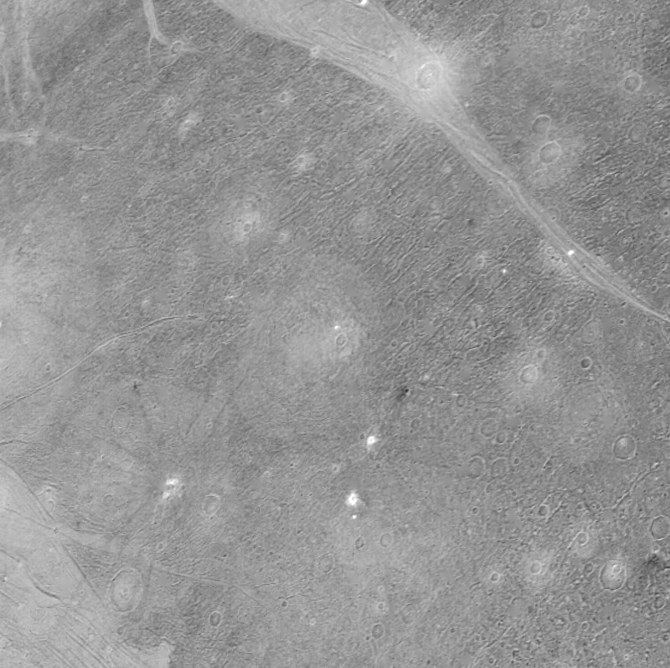
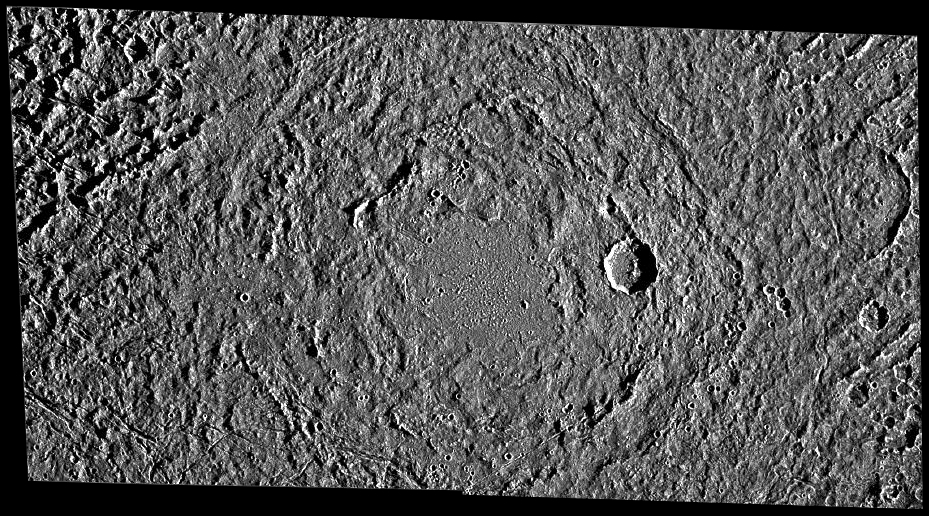
Buto Facula is about 245 km (152 mi) wide. It sits on the northwestern side of a large, dark region called Marius Regio. Nearby are other faculae (Busiris, Akhmin, Coptos, Hermopolis, and Thebes) and many sulci. Moving outward from its center, the palimpsest shows several morphological zones. The central area, roughly 40–50 km (25–31 mi) across, is relatively smooth with only a few isolated small hills. Its outline is generally elliptical, though some parts are petal-shaped. Along parts of this inner zone’s outer edge, inward-facing scarps appear. Surrounding this is a second zone with much rougher terrain and two to three nearly circular ridges. These ridges are not complete rings but concentric arcs spaced about 40 km (25 mi) apart. The outermost zone is smoother than the ridge-arc zone and preserves traces of older topography, similar to the dark, rugged furrows in Marius Regio. To the northeast, the facula overlies about half of an older crater. The external boundary, spanning about 290 km (180 mi), is marked by a clear brightness contrast in high-sun-angle images. Images also show chains of likely secondary craters just outside this boundary. These observations strongly support Buto Facula being an impact structure. A smaller, younger crater 19 km (12 mi) wide lies on its eastern side.
As of 2025, Buto Facula is among the most well-photographed faculae on Ganymede, thanks to the Galileo space probe. Voyager 2 captured it in reasonable detail during its July 1979 Jupiter flyby, but the facula was hard to see because it is so degraded—Voyager’s resolution wasn’t high enough to pick out details.
Quick Facts
- Diameter
- 245 km
- Eponym
- Buto, Egypt
Facts from the source article.
Lore & Background
Buto Facula is named after an ancient shrine city in Lower Ancient Egypt. According to Egyptian mythology, this city marks the sacred spot where the goddess Isis hid the body of her husband Osiris in the Nile swamps after he was murdered by his brother Set. Buto is also believed to be the home of Wadjet, the cobra goddess representing Lower Egypt. The International Astronomical Union's naming convention states that faculae on Ganymede should be after places from Egyptian mythology, specifically important sacred places of worship in Ancient Egypt. The name was approved by the IAU in 1985.
Geographically, Buto Facula is about 245 km wide and located on the northwestern side of a massive, dark region called Marius Regio. It is surrounded by other faculae such as Busiris Facula, Akhmin Facula, Coptos Facula, Hermopolis Facula, and Thebes Facula, and by many sulci. The facula exhibits several morphological zones: a central smooth area roughly 40–50 km across with a few isolated small hills and an elliptical outline, some sections taking on a petal-like shape with inward-facing scarps. Surrounding this is a second zone with rougher terrain and two to three nearly circular ridges spaced about 40 km apart, appearing as concentric arcs. The outermost zone is smoother and preserves traces of older topography similar to the dark furrows of Marius Regio. To the northeast, the facula overlies approximately half of an older crater. The external boundary spans about 290 km and is defined by a distinct brightness contrast in high-sun-angle images, with chains of likely secondary craters just outside. A smaller, more recent 19 km crater occupies the eastern side.
Reader's Guide
Buto Facula is significant as a well-studied palimpsest on Ganymede, providing insight into impact processes on icy moons. Its morphology—with concentric ridges, a smooth central zone, and secondary crater chains—strongly supports its interpretation as an impact structure. The facula was difficult to see in Voyager 2 images due to its degradation and limited resolution, but the Galileo space probe, orbiting Jupiter from December 1995 to September 2003, resolved details as small as 360 meters, allowing planetary scientists to understand its terrain in detail and form hypotheses about its formation and age. As of 2025, it remains one of the most well-photographed faculae on Ganymede. The upcoming European Space Agency's Juice spacecraft, expected to arrive at Jupiter in July 2031 and settle into a low orbit around Ganymede in 2034 at a distance of just 500 km, is anticipated to reveal more details, enabling scientists to determine a more definitive history and age of this ghost crater.
Did You Know?
- Buto Facula is a palimpsest, or 'ghost crater', on Ganymede.
- It is named after an ancient shrine city in Lower Ancient Egypt, the center of worship of the cobra goddess Wadjet.
- The facula's external boundary spans about 290 km (180 mi).
- A smaller, more recent 19 km (12 mi) crater occupies the eastern side of Buto Facula.
The Vanishing Crater: Nidaba's Geological Identity
Nidaba stands as a striking example of geological erasure on Jupiter's largest moon. Measuring roughly 199 kilometres across, this ancient impact structure is classified as a penepalimpsest — a crater caught mid-fade, still retaining concentric ridges and hills that its more ghostly counterparts, such as Memphis Facula and Buto Facula, have already lost. The boundary between a penepalimpsest and a fully erased palimpsest remains somewhat blurred in practice, and the two are occasionally lumped together. Nestled inside Nidaba's broad basin is a smaller, younger pit crater in noticeably better condition, though it has not yet been granted a formal name. Scientists attribute the slow disappearance of such features to two intertwined mechanisms. First, Ganymede's sluggish tectonic activity allows fresh water ice to well up from below, blanketing older terrain and dark regions like Galileo Regio. Second, viscous relaxation causes the icy surface to flow over geologic time, lifting crater floors while rims gradually slump. Nidaba, sitting within the moon's dark terrain, is likely a victim of both processes.
A Corner of Ancient Dark Terrain
Nidaba occupies the southwestern reaches of Galileo Regio, one of Ganymede's vast, dark, and ancient terrain regions. The surrounding landscape is a crowded mosaic of impact features — craters, palimpsests, and suspected penepalimpsests — a testament to the region's considerable age. To the west stretches the broad palimpsest Memphis Facula, alongside one of the most thoroughly studied ghost craters in the entire Solar System. The eastern neighbor is Selket, a crater distinguished by its bright floor, while to the southwest sits Ninlil, a pit crater in noticeably better preservation. Administratively, Nidaba falls within the Memphis Facula quadrangle, designated Jg7, which takes its name from the nearby ghost crater rather than from Nidaba itself. Perhaps most strikingly, Nidaba rests on the hemisphere of Ganymede that perpetually turns away from Jupiter. Because the moon is tidally locked in its orbit, an observer standing on Nidaba's surface would look up at a sky in which Jupiter simply never appears.
Named for a Goddess of Grain and Writing
The name Nidaba honours a figure from Sumerian mythology: the goddess of grains, cereals, and reeds, also known as Nisaba. In ancient Mesopotamian culture, reeds served as the primary writing implements, which extended the goddess's domain to encompass accounting and the act of writing itself. The choice of a Sumerian deity aligns with the naming convention established by the International Astronomical Union for Ganymede's craters, which calls for names drawn from deities, heroes, or places in Ancient Middle Eastern mythology. Sumerian tradition falls squarely within that category. The IAU formally approved the designation in 1985, cementing the link between a four-thousand-year-old goddess of harvest and a slowly vanishing scar on the surface of Jupiter's largest moon. The naming thus serves as a small bridge between ancient human storytelling and modern planetary science, embedding cultural memory into the cartography of a world no human has yet walked upon.
From Voyager's Glimpse to JUICE's Promise
Human eyes have only ever seen Nidaba through the cameras of robotic spacecraft, and the record of those encounters is patchy. Voyager 1, during its February 1979 approach, captured the first usable images of Ganymede, including a distant view of Nidaba, but the spacecraft was still millions of kilometres away, so resolution was poor. By the time of its closest approach on 5 March 1979, the crater had already rotated onto the moon's dark, unilluminated side. Voyager 2, flying by in July 1979, became the first probe to clearly photograph the Jupiter-far hemisphere and managed to image both Galileo Regio and Nidaba. The Galileo orbiter, which studied Jupiter from December 1995 through September 2003, obtained medium-resolution views of the crater. During its June 1996 close pass over Galileo Regio, however, the spacecraft pointed its camera at the nearby Memphis Facula, leaving Nidaba without a high-resolution image. That gap is expected to close when ESA's Juice mission enters a low orbit around Ganymede at roughly 500 kilometres altitude in July 2034, after arriving at Jupiter in July 2031.
Gallery
Frequently Asked Questions
What is Buto Facula?
Buto Facula is a palimpsest, or 'ghost crater,' on Ganymede, Jupiter's largest moon. It lies on the northwestern side of the Marius Regio terrain and received its official IAU designation in 1985.
Why is Buto Facula called a 'ghost crater'?
The term 'palimpsest' describes a crater whose original rim has been largely erased or buried by later geological processes, leaving only faint structural traces. Buto Facula's outer boundary stretches roughly 290 km, yet its central zone is only about 40 to 50 km wide, indicating the original crater form has been heavily degraded over time.
How large is Buto Facula?
The feature measures about 245 km (152 mi) in diameter, with an external boundary span of roughly 290 km (180 mi). Its central zone is approximately 40 to 50 km (25 to 31 mi) across.
Why is it named 'Buto'?
The name honors an ancient shrine city in Lower Egypt that was a major center of worship for Wadjet, the cobra goddess depicted on pharaohs' crowns. The IAU requires that faculae on Ganymede be drawn from significant Egyptian mythological sites, and Buto meets that criterion.
What mythological story is behind the name Buto?
In Egyptian legend, Buto marks the stretch of Nile swamps where the goddess Isis hid the body of her murdered husband Osiris after his brother Set killed him. The city was also the sacred home of Wadjet, the protective cobra deity of Lower Egypt.
More in Moons of Jupiter, Part 3 1-24
Spotted an error? Know more?
Reader corrections go straight into our review queue. Suggest an edit · How this site is sourced