Nicholson Regio
Dark, ancient region on Ganymede with the moon's oldest surface.

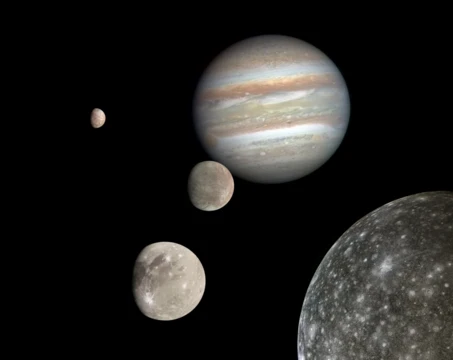
Nicholson Regio is a large, dark, oval-shaped feature on Jupiter’s moon Ganymede. It is made up of several ancient, dark areas that have been cut through or broken apart by younger grooves called sulci. Geological studies indicate that Nicholson Regio holds the oldest surface found anywhere on Ganymede.
**Naming** Dark regions on Ganymede are named by the International Astronomical Union (IAU) after astronomers who made important discoveries related to Jupiter’s moons. Nicholson Regio is named for Seth Barnes Nicholson, an American astronomer who discovered four of Jupiter’s smaller moons: Sinope, Lysithea, Carme, and Ananke. The IAU approved the name in 1979.
**Location** Nicholson Regio is a large, bean-shaped area that covers most of the southern part of the hemisphere of Ganymede that always faces Jupiter. The dark region is split into three rough sections by two sulci: Arbela Sulcus cuts across it from southwest to northeast, and Dardanus Sulcus cuts from the north toward the southeast. A narrow, unnamed sulcus separates Nicholson Regio from Barnard Regio to the north, while Harpagia Sulcus separates it from Melotte Regio to the east. Borsippa Sulcus marks the northeastern boundary, and the rest of Arbela Sulcus marks the southwestern boundary. The dark areas southeast of the regio are officially not part of Nicholson Regio. Because of its size, Nicholson Regio lies within four of Ganymede’s quadrangles: Dardanus (Jg6), Misharu (Jg10), Nabu (Jg11), and Namtar (Jg14). Since Ganymede is tidally locked, Nicholson Regio always faces Jupiter, meaning an observer there would always see the planet overhead.
**Age** According to the United States Geological Survey (USGS), Nicholson Regio is thought to be the oldest surface feature on Ganymede. The earliest period of Ganymede’s history is called the Nicholsonian Period, a very ancient time when the moon’s originally bright, icy surface became contaminated with dark, non-ice material, darkening it in a way similar to what is seen in Nicholson Regio. The Nicholsonian Period was followed by the Harpagian Period, during which extensive resurfacing events largely erased the earlier dark surface and replaced it with brighter material. Nicholson Regio is one of the last surviving pieces of Ganymede’s older, dark surface.
Quick Facts
- Length
- 3900 km
- Eponym
- Seth Barnes Nicholson
Facts from the source article.
Lore & Background
Nicholson Regio is a massive, bean-shaped area covering most of the southern portion of Ganymede's Jupiter-facing hemisphere. It is divided into three rough segments by the Arbela Sulcus and Dardanus Sulcus. The dark areas are dominated by extremely rough terrains, cut by thousands of fractures, scarps, and tectonic disruptions. The western part contains the darkest sections, with a brownish-black color in enhanced images, and is saturated with many ray craters, halo craters, and regular craters. The eastern part is lighter in color, suggesting partial erasure by brighter, newer materials, and contains named craters including Damkina, Khumba, Saltu, and Seker.
According to the USGS, Nicholson Regio is believed to be the oldest surface feature on Ganymede. The earliest period of Ganymede's history is called the Nicholsonian Period, when the moon's originally bright, icy surface became contaminated with dark, non-ice material. Nicholson Regio represents one of the last remnants of this ancient dark surface. A 2020 study by Hirata, Suetsugu, and Ohtsuki suggests that Nicholson Regio, along with several other dark regiones, may be remnants of a single ancient impact basin created by a massive asteroid or comet approximately 4 billion years ago, analogous to Callisto's multi-ring basins but even larger.
Reader's Guide
Nicholson Regio is one of the most studied and photographed parts of Ganymede, visible even from Earth-based telescopes such as the Hubble Space Telescope. Its significance lies in preserving the oldest known surface on Ganymede, offering a window into the moon's earliest history. The feature's dark, rugged terrain, cut by younger sulci like Arbela and Dardanus, records billions of years of tectonic activity and resurfacing. The 2020 study proposing that Nicholson Regio is part of a colossal ancient impact basin—if confirmed—would rank among the largest known impacts in the Solar System. Exploration by Voyager 1, Galileo, Cassini, New Horizons, and Juno has provided varying resolution images, with Galileo providing the highest resolution as of 2025. The upcoming Juice mission, expected to enter low orbit around Ganymede in December 2034, is anticipated to capture even more detailed images of Nicholson Regio.
Did You Know?
- Nicholson Regio is named after Seth Barnes Nicholson, who discovered four of Jupiter's minor moons: Sinope, Lysithea, Carme, and Ananke.
- The dark areas of Nicholson Regio are divided into three segments by the Arbela Sulcus and Dardanus Sulcus.
- A 2020 study suggests Nicholson Regio may be part of a massive ancient impact basin, possibly larger than Callisto's Valhalla or Asgard.
More in Moons of Jupiter, Part 3 1-24
Spotted an error? Know more?
Reader corrections go straight into our review queue. Suggest an edit · How this site is sourced