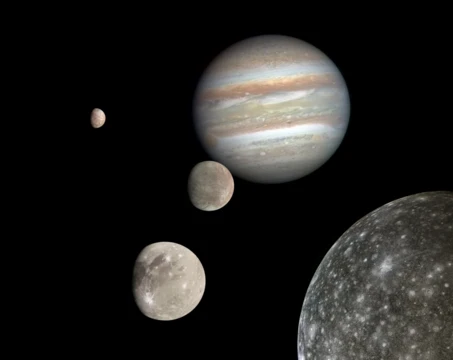
Galileo Regio
Ancient dark region on Ganymede, named after Galileo Galilei.

Galileo Regio is a vast, dark patch on Ganymede, one of Jupiter’s moons. It ranks among the oldest and biggest features on that world, stretching roughly 4,500 kilometers (2,800 miles) across.
The International Astronomical Union gave it the name of Galileo Galilei, the Italian astronomer who pioneered telescopic sky study and, in 1610, spotted Jupiter’s four largest moons—Io, Europa, Ganymede, and Callisto. The IAU’s rule for Ganymede’s dark regions is to name them after moon-discovering astronomers, and Galileo fits that bill. The name was officially approved in 1979.
This ancient dark zone sits in Ganymede’s northern hemisphere, shaped like an oval. It is so enormous that it reaches from near the north pole down past the equator. Younger, brighter sulci (grooved terrain) have broken it apart, giving it a bumpy outline. On the west, Philae Sulcus and Ur Sulcus mark its edge. To the southwest, Uruk Sulcus and Nippur Sulcus separate it from another dark region, Marius Regio. To the east, Xibalba Sulcus divides it from Perrine Regio. Its northern part lies very close to Ganymede’s north pole.
Ganymede’s surface is mapped into 15 quadrangles. Most of Galileo Regio falls within the quadrangle named after it (Jg3), but its size spills into several others: Etana (Jg1) to the north, Perrine (Jg2) to the east, Memphis Facula (Jg7) to the southeast, and Uruk (Jg8) to the southwest.
Because Ganymede always shows the same face to Jupiter (synchronous rotation), the westernmost point of Galileo Regio sits at 180° longitude, directly opposite the Jupiter-facing side. An observer there would never see Jupiter. Yet the region is so wide that on its eastern side, Jupiter hangs low on the horizon at all times.
Like other dark areas on Ganymede, Galileo Regio is among the moon’s most ancient surfaces—roughly 4 billion years old. It is rugged and heavily cratered, covered with dark material likely left by meteor and comet impacts. Its age is suggested by its rough, crater-filled look compared to smoother, younger terrain. The region is also full of palimpsests (ghost craters) and oval features called faculae. One such facula, Memphis Facula, is a ghost crater whose walls have slumped and floor flattened. Hundreds of bright ray craters, rayless craters, and other faculae pockmark the dark surface.
Quick Facts
- Diameter
- 4439 km
- Eponym
- Galileo Galilei
Facts from the source article.
Lore & Background
Galileo Regio is a large oval-shaped region of ancient dark material in Ganymede's northern hemisphere. It is one of the oldest parts of the moon's surface, thought to be some 4 billion years old, and is heavily cratered and palimpsested—full of ghost craters. The dark material likely accumulated from fragments brought by falling meteors and comets. The region has been broken apart by younger, brighter sulci, giving it a bumpy oval shape. Its western boundary is marked by Philae Sulcus and Ur Sulcus; to the southwest, Uruk Sulcus and Nippur Sulcus separate it from Marius Regio; to the east, Xibalba Sulcus separates it from Perrine Regio. The northern part lies very close to Ganymede's north pole.
The regio is so vast that it crosses into several quadrangles, including Etana (Jg1) to the north, Perrine (Jg2) to the east, Memphis Facula (Jg7) to the southeast, and Uruk (Jg8) to the southwest. Due to Ganymede's synchronous rotation, the westernmost point of Galileo Regio (at 180° longitude) is opposite the Jupiter-facing side, so an observer there would never see Jupiter; on the eastern side, Jupiter hangs low on the horizon at all times. The region contains hundreds of bright ray craters, rayless craters, and faculae, with bright craters indicating that impactors excavated fresh water ice from beneath the surface. The northern and northeast sides are covered with a whitish blanket of bright materials, possibly condensate from charged-particle sputtering and redistribution of water ice under Ganymede's magnetic field.
Galileo Regio is surrounded on all sides by sulci except to the north. These sulci are younger and smoother, formed by tectonic activity after the regio, erasing dark surface and replacing it with brighter material. The furrow systems and smooth terrain distribution suggest the ancient crust was thinner near the equator and thicker toward the poles. A speculative explanation is that the feature formed through crustal uplift driven by a plume-like convection cell in a fluid mantle beneath a thin outer crust. A 2020 study by Hirata, Suetsugu and Ohtsuki suggested that Ganymede was probably hit by a massive asteroid 4 billion years ago, an impact so violent it may have shifted the moon's axis, based on analysis of furrow system images.
Reader's Guide
Galileo Regio is significant as one of the most ancient and largest surface features on Ganymede, providing key insights into the moon's early history. Its heavily cratered and palimpsested terrain indicates a surface roughly 4 billion years old, making it a window into the early solar system. The region's dark material, likely from meteoritic and cometary fragments, contrasts with younger, brighter sulci that formed through later tectonic activity, revealing a complex geological evolution. The distribution of furrows and smooth terrain has sparked conflicting speculation about its origin, with a 2020 study suggesting a massive asteroid impact may have shifted Ganymede's axis. Exploration by spacecraft such as Voyager 2 (which sent the first clear images in July 1979) and the Galileo probe (which took the clearest images from as low as 750 km in September 1996) has been crucial. The upcoming Juice mission (arriving at Jupiter in July 2031) is expected to photograph the terrain with even higher resolution. Galileo Regio's immense size and dark shade make it observable even with amateur telescopes, and it remains a focal point for understanding Ganymede's crustal structure and impact history.
Did You Know?
- Galileo Regio spans up to 4,500 km (2,800 mi) across, making it one of the largest surface features on Ganymede.
- The region is named after Galileo Galilei, who discovered Jupiter's four largest moons in 1610.
- The westernmost point of Galileo Regio lies at 180° longitude, directly opposite the side of Ganymede that always faces Jupiter, so an observer there would never see Jupiter.
- A 2020 study suggested that a massive asteroid impact 4 billion years ago may have shifted Ganymede's axis, based on analysis of furrow systems in Galileo Regio.
More in Moons of Jupiter, Part 3 1-24
Spotted an error? Know more?
Reader corrections go straight into our review queue. Suggest an edit · How this site is sourced