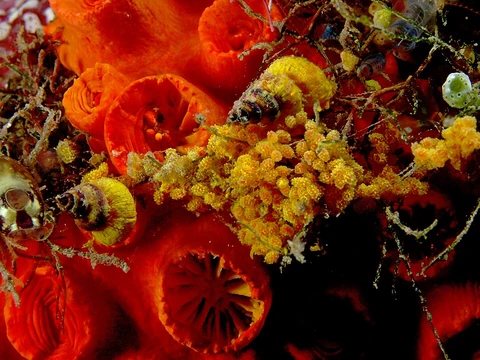
Vanitrochus
A genus of very small marine top snails.

Vanitrochus is a genus of marine gastropod mollusks, specifically sea snails, belonging to the top snail family Trochidae. Its shell is very small—up to 3.0 mm in height—and has an elevated, turbiniform shape, with whorls that are rounded or only weakly shouldered. The shell’s sculpture combines spiral cords and axial riblets, creating a fine, regular cancellate pattern. The umbilicus is open with a rounded margin and lacks a funicle; the outer lip is simple and smooth inside. The operculum is corneous and multispiral, with relatively broad outer whorls and a long growing margin. Its peripheral fringe is broad and shows well-developed radial striation, while the surface has distinct spiral microsculpture. In the radula, the rachidian and lateral teeth have laterally rounded base-plates that overlap extensively. The inner marginal tooth is transitional and lacks a cusp. Marginal teeth 2–5 bear large, somewhat palmate cusps, each with about five slender, acuminate denticles; the middle denticle is slightly larger than the others. This genus occurs in the Gulf of Oman, the Persian Gulf, and the Indian Ocean off Pakistan and Sri Lanka, as well as in the Pacific Ocean off the Loyalty Islands, Tuvalu, New Caledonia, and Australia (Queensland). Species include *Vanitrochus geertsi*, *V. padangensis*, *V. semiustus*, †*V. suryai*, and *V. tragema*. One former species, *Vanitrochus holdsworthiana*, is now considered a synonym of *Pseudominolia musiva*.
Quick Facts
- Taxon
- Vanitrochus
- Type Species
- Solariella tragema
- Type Species Authority
- Melvill & Standen, 1896
Facts from the source article.
Lore & Background
The shell of Vanitrochus is very small, reaching a height of up to 3.0 mm, and is elevated-turbiniform with whorls that are rounded or only weakly shouldered. Its sculpture consists of spiral cords crossed by axial riblets, producing a fine, regular cancellate pattern. The umbilicus is open with a rounded margin, and a funicle is lacking. The outer lip is simple, and its interior is smooth.
The operculum is corneous and multispiral, with relatively broad outer whorls and a long growing margin. The peripheral fringe is broad and shows well-developed radial striation, while the surface carries distinct spiral microsculpture. In the radula, the rachidian and lateral teeth have laterally rounded base-plates that overlap extensively. The inner marginal tooth is transitional and lacks a cusp. The cusps of marginal teeth 2–5 are large and somewhat palmate, each bearing about five slender, acuminate denticles, with the middle denticle slightly larger than the others.
This marine genus occurs in the Gulf of Oman, Persian Gulf; in the Indian Ocean off Pakistan, Sri Lanka; in the Pacific Ocean off the Loyalty Islands, Tuvalu, New Caledonia and off Australia (Queensland).
Reader's Guide
Vanitrochus is a genus of sea snails in the family Trochidae, documented primarily through its shell morphology, radula, and operculum. The genus was originally named Conotrochus by Pilsbry in 1889, but that name was invalid as a junior homonym of Conotrochus Schröter, 1863 (a cnidarian). Iredale in 1929 used Vanitrochus as a substitute name, though Solariella tragema Melvill & Standen, 1896 was not a species originally included in Conotrochus. The genus includes several extant species such as Vanitrochus geertsi, Vanitrochus padangensis, Vanitrochus semiustus, and Vanitrochus tragema, as well as the fossil species Vanitrochus suryai. One species, Vanitrochus holdsworthiana, has been brought into synonymy with Pseudominolia musiva. The genus is distributed across the Indian and Pacific Oceans, from the Persian Gulf to Australia. Its significance lies in its detailed anatomical features—particularly the radula with overlapping base-plates and palmate marginal teeth—and its small, cancellate shell, which distinguish it within the Trochidae.
Did You Know?
- The shell of Vanitrochus reaches a maximum height of only 3.0 mm.
- The operculum is corneous and multispiral with a broad peripheral fringe showing radial striation.
- The radula has marginal teeth 2–5 with large, palmate cusps each bearing about five slender denticles.
- The genus occurs in the Gulf of Oman, Persian Gulf, Indian Ocean, and Pacific Ocean off several island groups and Australia.
More in Marine Snails 1-24
Spotted an error? Know more?
Reader corrections go straight into our review queue. Suggest an edit · How this site is sourced