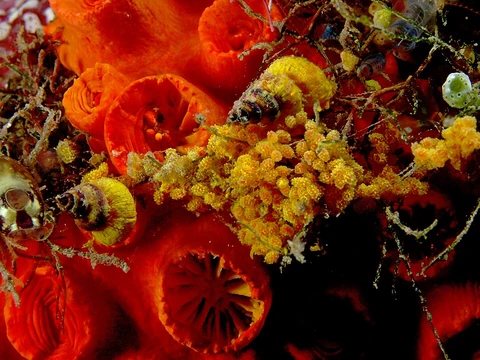
Clelandella
A genus of marine gastropod mollusks in the family Trochidae.

Marie Hennion · CC BY 4.0
Clelandella is a genus of marine gastropod mollusks, specifically sea snails belonging to the top snail family, Trochidae. The genus contains a number of recognized species, including *Clelandella artilesi*, *C. azorica*, *C. dautzenbergi*, *C. madeirensis*, *C. miliaris*, *C. myriamae*, and *C. perforata*. Two former species, *Clelandella clelandi* and *C. infuscata*, have since been reclassified as synonyms of other species.
Quick Facts
- Taxon
- Clelandella
- Type Species
- Clelandella clelandi
- Type Species Authority
- W. Wood, 1828
Facts from the source article.
Lore & Background
The genus Clelandella belongs to the family Trochidae, commonly known as top snails. The article lists seven accepted species within the genus, including Clelandella artilesi, Clelandella azorica, Clelandella dautzenbergi, Clelandella madeirensis, Clelandella miliaris, Clelandella myriamae, and Clelandella perforata. Two additional species have been brought into synonymy: Clelandella clelandi is considered a synonym of Clelandella miliaris, and Clelandella infuscata is now recognized as Kanekotrochus infuscatus. The species were described by various authors, including Vilvens, Swinnen & Deniz, and Gofas, with dates of description ranging from 1814 to 2011.
Reader's Guide
The significance of Clelandella lies in its representation within the diverse family Trochidae, a group of marine snails known for their conical shells. The genus includes species described from different regions, such as the Atlantic (e.g., Clelandella azorica, Clelandella madeirensis) and the Mediterranean or nearby areas. The synonymy of Clelandella clelandi under Clelandella miliaris and Clelandella infuscata under Kanekotrochus infuscatus reflects taxonomic revisions that clarify relationships within the group. The article's references, including works by Gofas and others, provide a foundation for understanding the genus's classification and distribution. The legacy of Clelandella is tied to ongoing taxonomic research, as evidenced by the 2011 description of a new species from Western Sahara, highlighting the continued discovery and refinement of marine snail biodiversity.
Did You Know?
- Clelandella is a genus of sea snails in the family Trochidae.
- Seven species are currently accepted within the genus Clelandella.
- Clelandella clelandi is a synonym of Clelandella miliaris.
- Clelandella infuscata is now considered Kanekotrochus infuscatus.
Taxonomic Identity & Classification
Clelandella azorica is a marine gastropod mollusk, a sea snail that occupies a defined place within the family Trochidae, the group commonly referred to as top snails. Its genus, Clelandella, links it to a small assemblage of related species, while the specific epithet azorica anchors it geographically to the Azores region of the mid-Atlantic. As a gastropod, it is a soft-bodied invertebrate encased in a hard calcareous shell, adapted entirely to saltwater life. Its membership in Trochidae connects it to a wider radiation of top snails distributed across the world's oceans, sharing general body plans and ecological roles with relatives in other basins. The species name itself signals the taxonomist's recognition that this particular lineage is tied to the Azores archipelago, distinguishing it from congeners found elsewhere in the northeastern Atlantic. Within the broader tree of molluscan diversity, it represents one of the many small, deep-water species that contribute to the understudied fauna of oceanic island environments.
Shell Morphology & Coloration
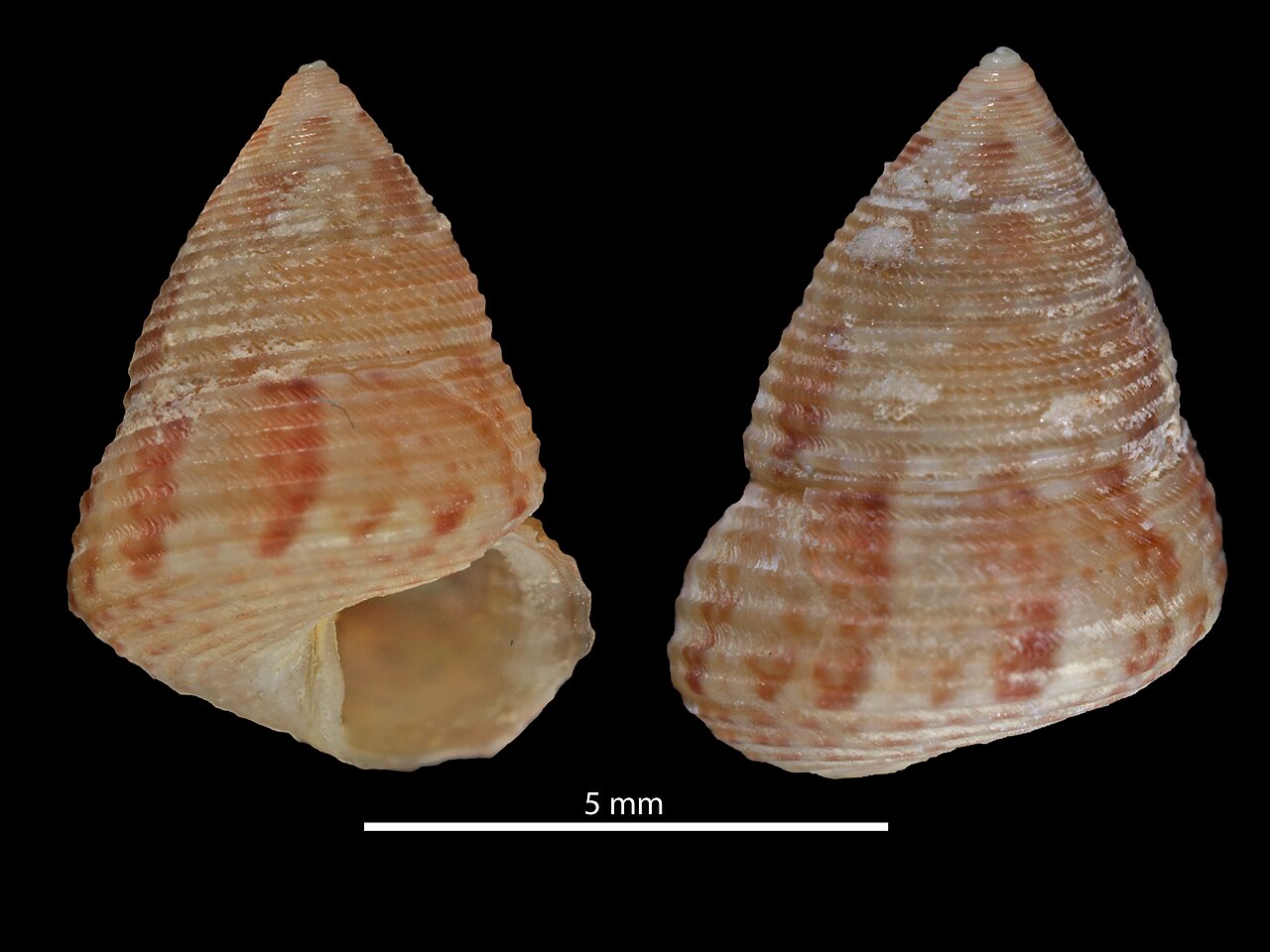
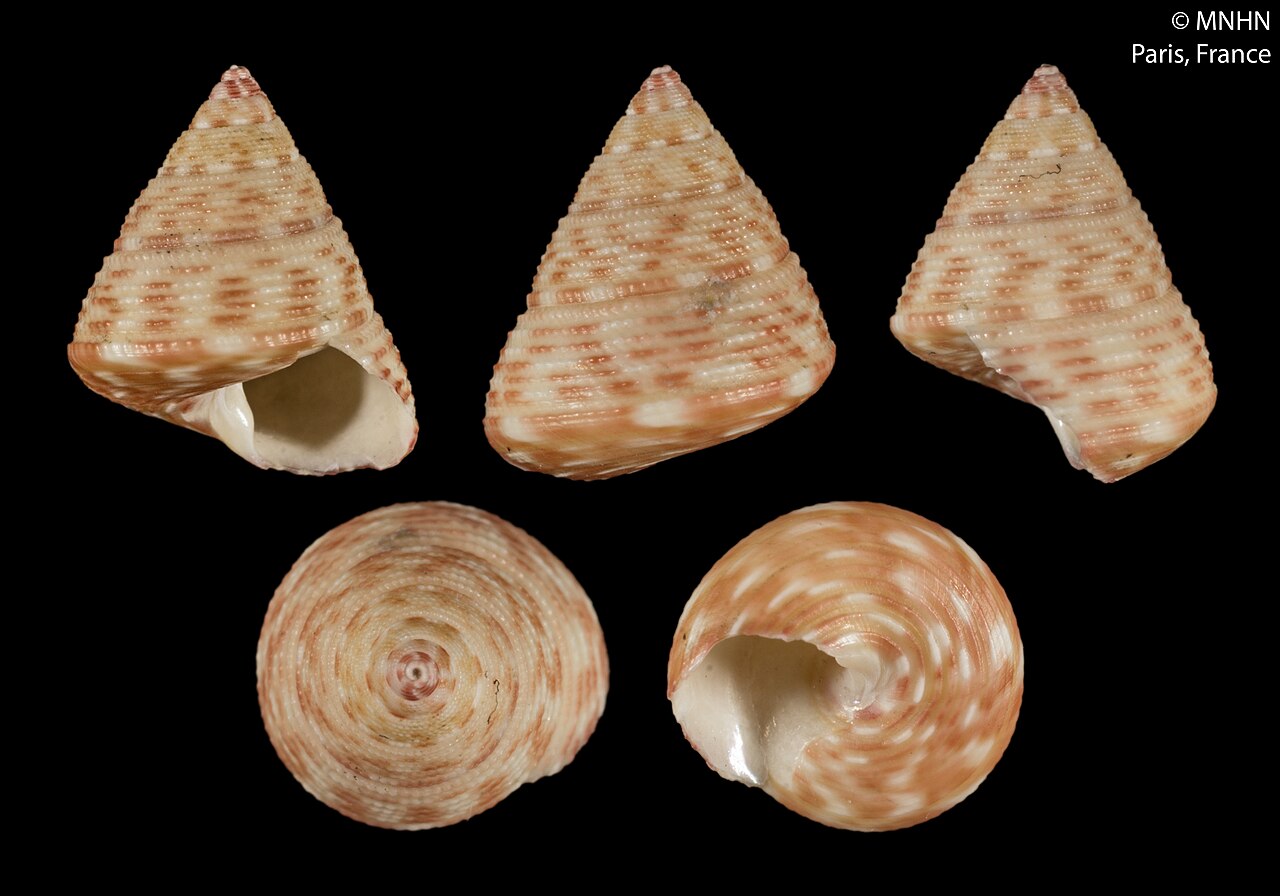
The shell of Clelandella azorica is modest in scale, measuring between 9 and 12.5 millimetres, which places it firmly among the smaller members of the gastropod world. Its surface colouration is notably variable and layered. The underlying ground tone shifts from a pale whitish cast to a warmer yellowish base. Superimposed on this lighter canvas are brownish markings that may appear as bold flame-like streaks or larger irregular blotches, or alternatively as smaller, more discrete spots. These brownish elements do not scatter randomly; rather, they tend to organise themselves into an articulated pattern that tracks along the cords of the shell, lending the surface a structured, almost geometric rhythm. The range from dramatic flame patterns to delicate spot arrangements hints at individual or population-level variation in pigmentation. Despite its small size, this ornamental complexity makes the shell a point of interest for malacologists documenting the morphological diversity of top snails in the northeastern Atlantic.
Habitat & Geographic Distribution
Clelandella azorica is known exclusively from the Atlantic Ocean, specifically the waters encircling the Azores archipelago. This volcanic island chain, situated in the northeastern portion of the ocean basin, constitutes the entire documented range of the species. Unlike many familiar snails that inhabit shallow, sunlit coastal zones, Clelandella azorica lives at substantial depth, between 190 and 465 metres below the surface. This places it in the upper mesopelagic to upper bathypelagic zone, an environment characterised by dim or absent light and cooler temperatures. Its confinement to the Azores region, combined with this depth preference, points to a relatively narrow ecological niche tied to the specific oceanographic conditions around these mid-Atlantic islands. It is not a species of continental shelves or tropical reefs but of deeper, open-ocean waters near oceanic islands. This restricted distribution makes it a useful subject for examining how isolation and depth shape the biogeography of small marine invertebrates in the northeastern Atlantic.
Scientific Context & Taxonomic Research
The study of Clelandella azorica sits within a broader programme of taxonomic and biogeographic work on the genus Clelandella across the northeastern Atlantic. A key contribution to this field is the 2005 paper by Gofas, published in the Journal of Molluscan Studies, which investigated how populations of Clelandella diverge geographically throughout the northeastern Atlantic. Within that publication, Clelandella azorica is specifically addressed on pages 139 and 140, indicating its inclusion in analyses of how isolation and regional variation produce distinct lineages within a single genus. The species is also catalogued on Gastropods.com, a widely used reference resource for mollusc taxonomy, where its entry was accessible as of January 2019. Together, these sources reflect an ongoing scientific effort to delineate the boundaries between closely related top snail species and to understand how the unique conditions of oceanic islands like the Azores drive the formation of geographically restricted lineages within a genus that spans a wider area of the Atlantic.
Gallery

Frequently Asked Questions
What is Clelandella?
Clelandella is a genus of marine sea snails classified within the top snail family, Trochidae. It represents a small group of gastropod mollusks that inhabit ocean environments.
How many species are currently recognized in Clelandella?
Seven species are presently accepted in the genus, including C. artilesi, C. azorica, C. dautzenbergi, C. madeirensis, C. miliaris, C. myriamae, and C. perforata.
What family does Clelandella belong to?
Clelandella is a member of Trochidae, the top snail family. This places it squarely among the gastropod mollusks rather than in any other broader snail grouping.
Were any species ever removed from the genus Clelandella?
Yes. Clelandella clelandi was synonymized under C. miliaris, and C. infuscata was transferred to the genus Kanekotrochus, leaving seven valid species in Clelandella.
Can you name a few well-known Clelandella species?
Some frequently cited examples are C. perforata, C. miliaris, and C. madeirensis. Together with the other four species, they make up the full set of currently valid members of the genus.
More in Marine Snails 1-24
Spotted an error? Know more?
Reader corrections go straight into our review queue. Suggest an edit · How this site is sourced