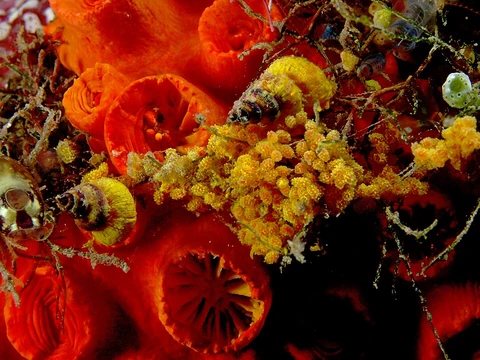
Clanculus
A worldwide genus of top shells with beaded sculpture.

Marie HENNION · CC BY 4.0
Clanculus is a genus of sea snails, marine gastropod mollusks belonging to the top shell family, Trochidae. This is an ancient genus; fossils of several species have been discovered in Italy from the Pliocene epoch. Clanculus snails have a worldwide distribution, and some species can be found in enormous numbers, living from the intertidal zone down to depths of 200 meters.
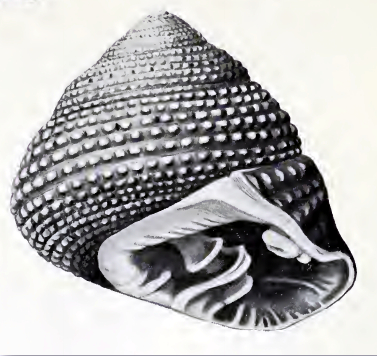
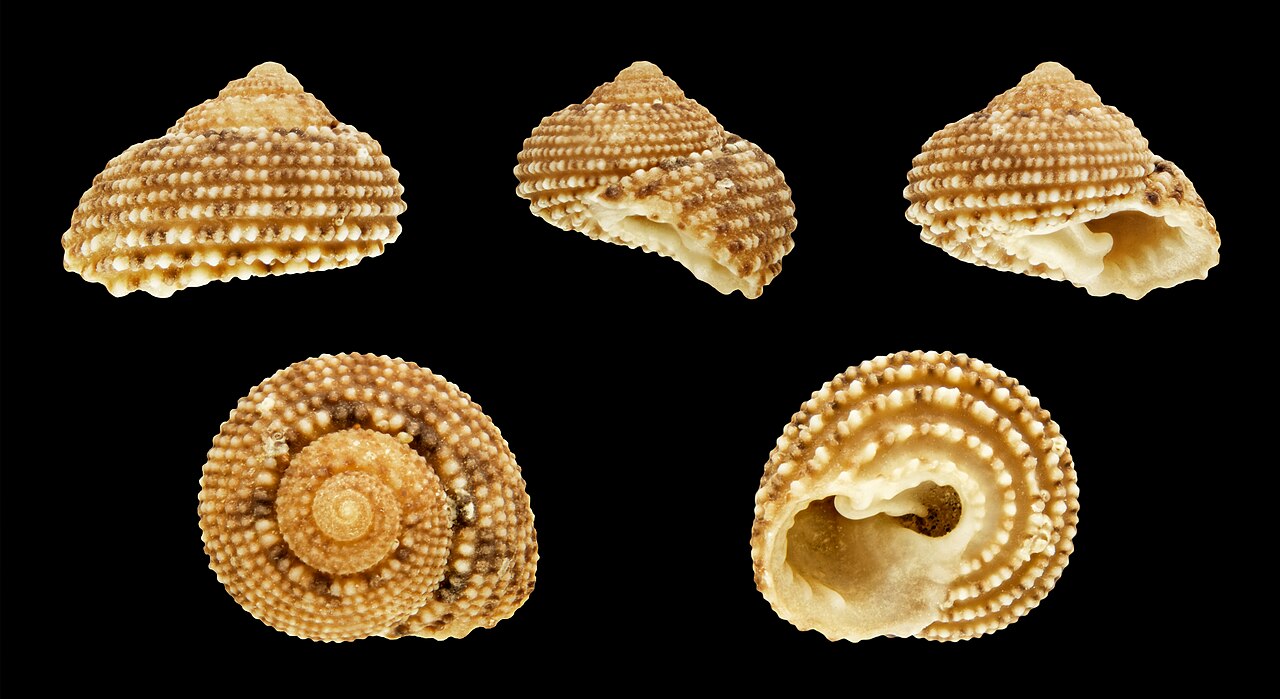
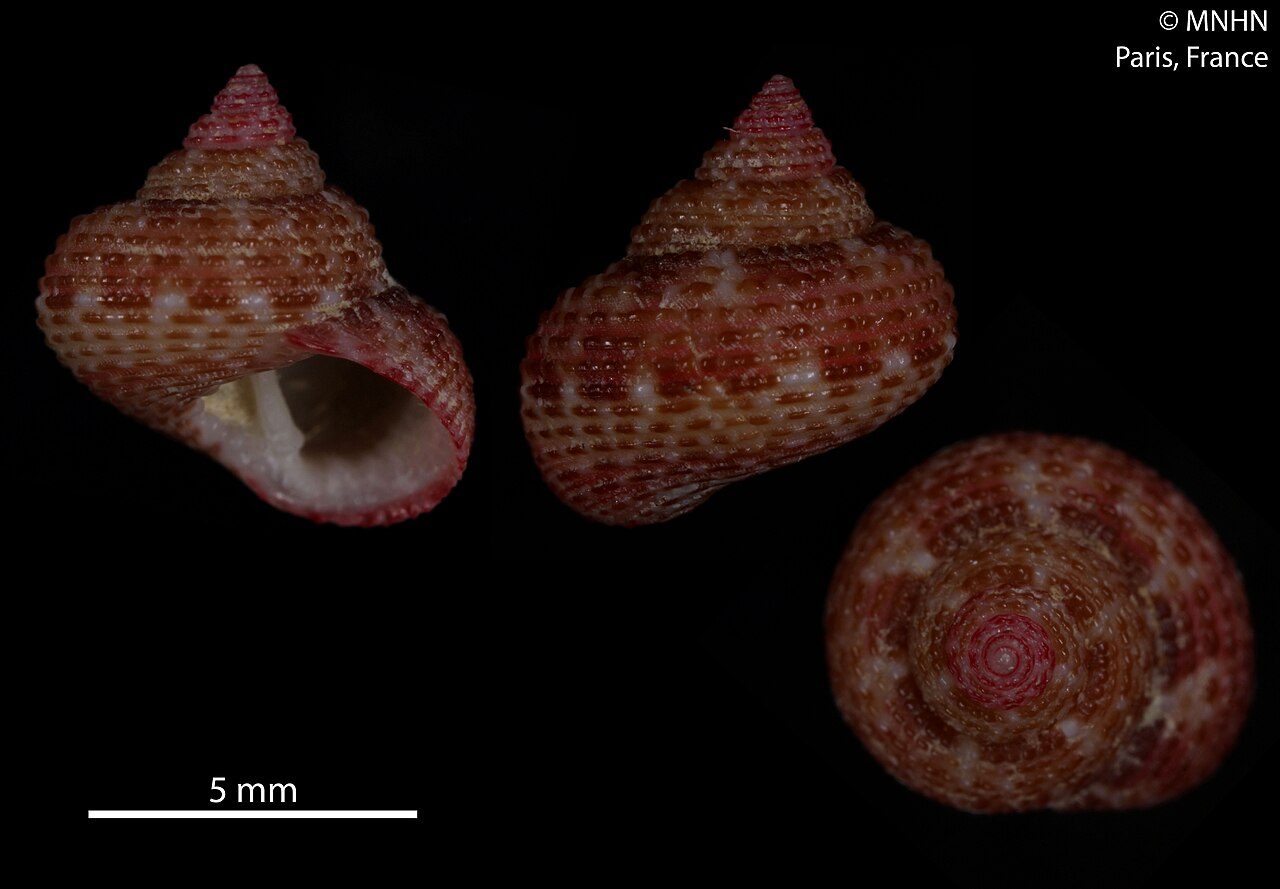
The shells of these top snails are broadly conical with a low spire. Their surfaces are sculpted with prominent, even rows of sturdy, rounded beads. The whorls have a deep suture and the final whorl is swollen. The shell opening is oval with a strongly ridged lip, and the umbilicus is usually deep. Shell colors range from orange and dark red to chocolate brown.
The type species for the genus is *Clanculus pharaonius*, originally described by Carl Linnaeus in 1758 under the name *Trochus pharaonius*. Many species once placed in *Clanculus* have since been reclassified as synonyms of other species.
Quick Facts
- Taxon
- Clanculus
- Type Species
- Trochus pharaonius / Linnaeus, 1758
Facts from the source article.
Lore & Background
The genus Clanculus is an old genus, with fossils found in Italy dating from the Pliocene, including species such as C. corallinus, C. elevatus, C. bonfittoi, and C. jussieui. Its distribution is worldwide, and individuals of some species sometimes occur in great numbers, from the intertidal zone up to depths of 200 m. Many species can be found in Australia, New Zealand, the Indo-Pacific, Philippines, Sri Lanka, Seychelles, Japan, South Africa, Zanzibar, Indian Ocean, the Red Sea, West Africa, Angola, North Africa and Europe.
The shell description notes that these top shells are wide-conical and low spired. Their spirally ribbed sculpture consists of conspicuous regular rows of robust, round beads. The whorls show a profile with a deep suture and the final whorl inflated. The aperture of the shell is oval, with a strongly ridged lip. The umbilicus is generally deep. The color of the shell varies between orange, dark red, and chocolate brown.
The type species, Clanculus pharaonius, was described by Carl Linnaeus in 1758 as Trochus pharaonius. The article lists many species that have been brought into synonymy, indicating taxonomic revisions over time.
Reader's Guide
The significance of Clanculus lies in its status as an old, widely distributed genus of marine gastropods within the family Trochidae. The article documents its fossil record from the Pliocene in Italy, showing its long evolutionary history. Its worldwide distribution, with some species occurring in great numbers from the intertidal zone to depths of 200 m, highlights its ecological adaptability. The shell description—wide-conical, low spired, with regular rows of robust beads, a deep suture, inflated final whorl, oval aperture with strongly ridged lip, and deep umbilicus—provides key diagnostic features for identification. The color variation from orange to dark red to chocolate brown is also notable. The extensive list of species brought into synonymy reflects ongoing taxonomic refinement, with many names now considered invalid. The type species, Clanculus pharaonius, was described by Carl Linnaeus in 1758, linking the genus to the early foundations of modern taxonomy. The article's references, including works by Powell, Pilsbry, and Jansen, indicate that Clanculus has been the subject of regional studies, particularly in Australia, New Zealand, and southern Africa, contributing to the understanding of trochid diversity.
Did You Know?
- Fossils of Clanculus found in Italy date from the Pliocene.
- The shell color of Clanculus varies between orange, dark red, and chocolate brown.
- Many species of Clanculus can be found in Australia, New Zealand, and the Indo-Pacific.
Taxonomic Placement & Identity
Clanculus largillierti is a sea snail, a marine gastropod mollusk that occupies a defined position within the family Trochidae, the group commonly referred to as top snails. The specific epithet largillierti honors the naturalist Largilliert, while the genus Clanculus situates it among a wider assemblage of similar shell-bearing species. Because it is a perforate form, the shell bears an umbilicus—a small central depression at the base—setting it apart from solid-shelled relatives within the same family. In some taxonomic treatments the species is written with a subgenus designation, Clanculus (Clanculus) largillierti, signalling its placement in the type subgenus of the broader Clanculus complex. This layered nomenclature reflects both the morphological affinities shared with close relatives and the evolutionary relationships that link it to other top snails inhabiting tropical and subtropical marine settings. As a member of the gastropod class, it shares the fundamental body plan of a single coiled shell housing a soft, muscular body, a design that has persisted with remarkable consistency across hundreds of millions of years of molluscan evolution.
Shell Architecture & Surface Ornamentation
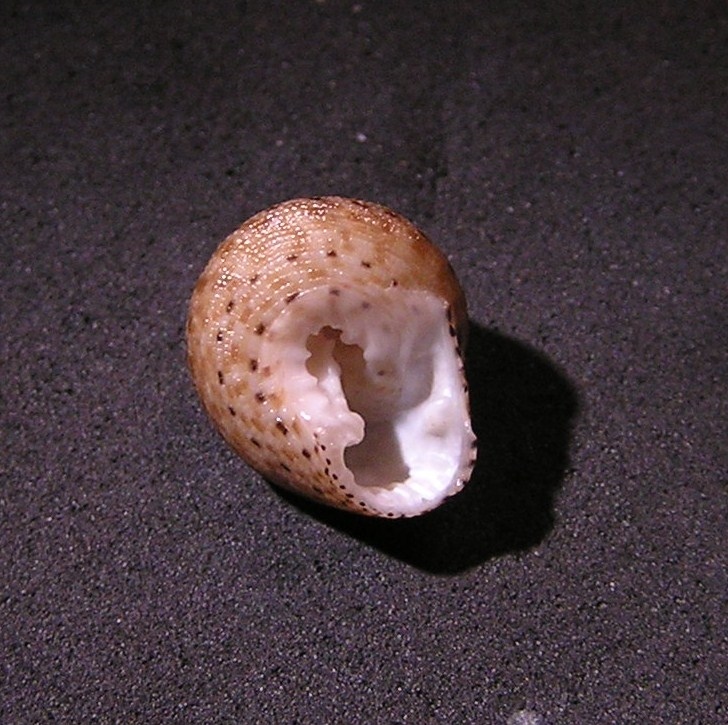
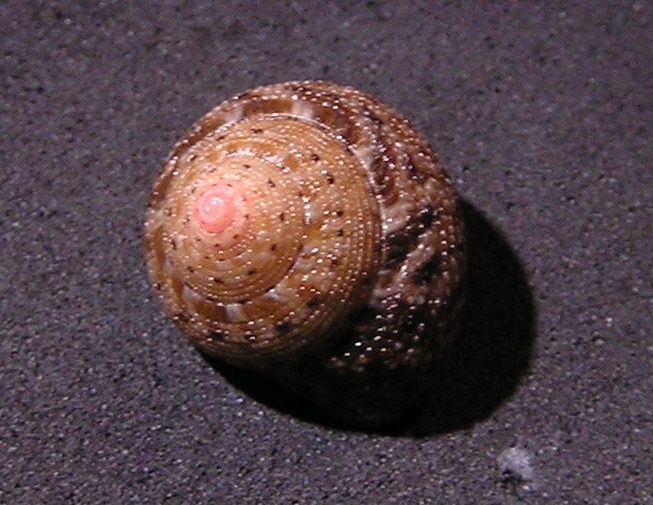
The shell of Clanculus largillierti measures 14 millimeters in height and 16 millimeters in diameter, producing a profile that is slightly broader than it is tall. Its overall silhouette is conoid, narrowing to a sharply pointed apex, with six and a half whorls coiling outward. The initial whorl carries a distinctive rosy tint, whereas the remaining whorls are convex and predominantly grayish, flecked with white and black spots clustered along the narrow sutural grooves. Fine spiral lirae—raised ridges—adorn the surface, numbering between 8 and 10 on the penultimate whorl, and these ridges are studded with numerous tiny granular bumps. The body whorl is broadly rounded and displays concentric lirae on its underside, also in the 8-to-10 range, with an interplay of gray and brown tones. The aperture is oblique and rhomboidal, its upper lip toothed, the basal margin plicate, and the oblique columella bearing teeth at its base. The parietal callus shows a wrinkled texture, while the umbilicus is ringed by prominent white plicae.
Geographic Range & Biogeographic Significance
Clanculus largillierti is documented exclusively from the Indian Ocean waters surrounding the island of Réunion, a volcanic landmass situated in the western Indian Ocean. This single locality constitutes the entire known range of the species; no other populations have been recorded in adjacent seas or elsewhere in the oceanic basin. The extreme narrowness of its distribution suggests that C. largillierti is a highly localized, possibly endemic form, shaped by the particular substrate, salinity, and current conditions characteristic of the waters encircling Réunion. For biogeographers examining how marine gastropods disperse and diversify across the western Indian Ocean, a species confined to one island's surrounding waters offers a focused case study in isolation and adaptation. It also carries conservation implications: a mollusk whose entire known population depends on a single geographic area is inherently more vulnerable to localized environmental change, habitat degradation, or stochastic events than a species spread across multiple regions. The restricted range thus elevates the species' importance in both evolutionary and conservation contexts.
Scientific Record & Reference Sources
The scholarly and cataloguing footprint of Clanculus largillierti is preserved across a handful of key biodiversity resources. The Biodiversity Heritage Library indexes exactly one publication pertaining to this species, representing the historical literature in which it was originally described or subsequently discussed. The World Register of Marine Species, a globally recognized authority on marine nomenclature, maintains an entry for C. largillierti, ensuring that its valid name and taxonomic placement are consistently referenced by researchers worldwide. The online gastropod reference portal Gastropods.com also hosts a dedicated page for Clanculus (Clanculus) largillierti, a resource that was consulted on 15 January 2019, confirming that the species remains an active entry in digital taxonomic databases. The modest volume of indexed literature—just a single publication in the Biodiversity Heritage Library—highlights a notable gap between the species' existence in the natural world and the depth of dedicated scientific attention it has attracted. For a species known from only one island's waters, this thin documentary record underscores both the challenges of studying remote marine biodiversity and the value of the existing references in anchoring the species' identity for future researchers.
Gallery
Frequently Asked Questions
What is Clanculus?
Clanculus is a genus of marine gastropod mollusks placed in the top shell family, Trochidae. It represents a globally distributed group of sea snails whose shells are instantly recognizable by their rows of rounded, bead-like sculptures.
What does a Clanculus shell look like?
The shell is broadly conical with a low spire, a deep suture separating the whorls, and a conspicuously swollen final whorl. Its surface is sculpted with prominent, evenly spaced rows of sturdy rounded beads that give it a distinctive beaded texture.
Where can I find Clanculus snails?
These top shells occur worldwide, with records from Australia, New Zealand, the Indo-Pacific, the Indian Ocean, the Red Sea, and coastlines across Africa and Europe. They range from the intertidal zone down to depths of about 200 meters.
How old is the genus Clanculus?
Clanculus is an ancient lineage; fossils of several of its species have been recovered from Pliocene deposits in Italy. The type species, Clanculus pharaonius, was first formally described by Carl Linnaeus in 1758 under the older name Trochus pharaonius.
Why is Clanculus notable among top shells?
Some Clanculus species live in enormous population densities, making them a visually dominant component of rocky-shore and reef communities. Their beaded sculpture and broad conical profile set them apart at a glance from many other trochid genera.
More in Marine Snails 1-24
Spotted an error? Know more?
Reader corrections go straight into our review queue. Suggest an edit · How this site is sourced