Trochidae
Marine snails with corneous opercula and often brightly colored shells.

Kiener, 1839 · CC0
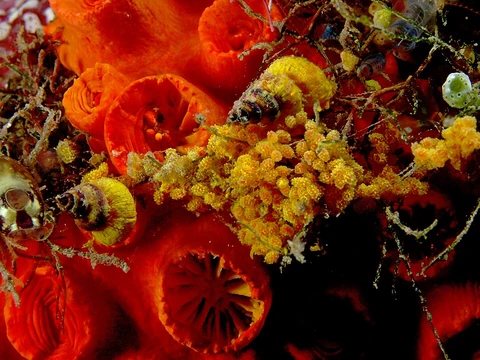
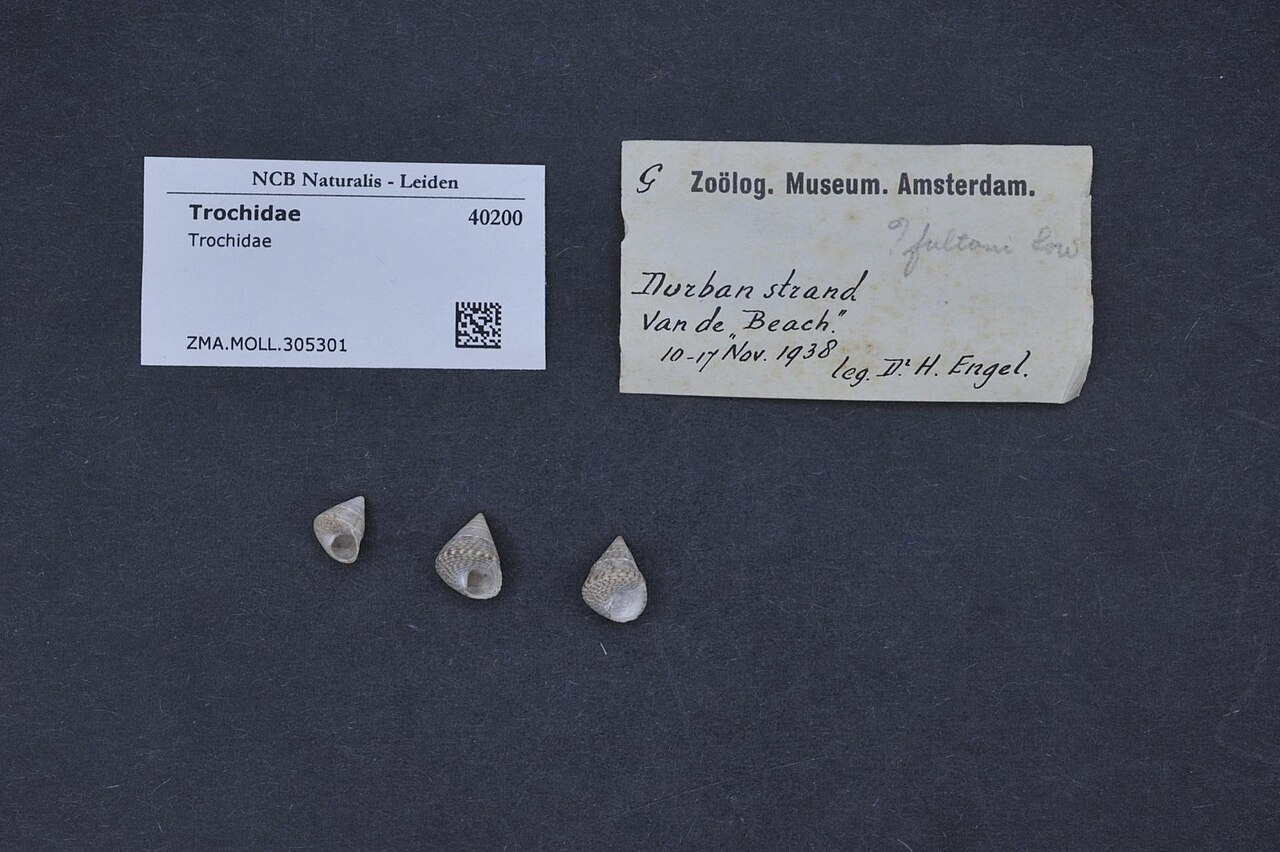
Trochidae, also called top-snails or top-shells, are a family of sea snails—marine gastropod molluscs in the subclass Vetigastropoda. Their common name comes from the shell shape in many species, which looks like a spinning top.
The family includes these subfamilies: Alcyninae, Cantharidinae, Carinotrochinae, Chrysostomatinae, Fossarininae, Halistylinae, Kaiparathininae, Monodontinae, Stomatellinae, Trochinae, and Umboniinae. Several genera have not yet been assigned to any subfamily: Callumbonella, †Chuelskia, †Coeloconulus, Enida, †Eocalliostoma, †Fagnastesia, †Falsotectus, †Guidonia, †Lithotrochus, †Molvaldesia, and †Protorotella.
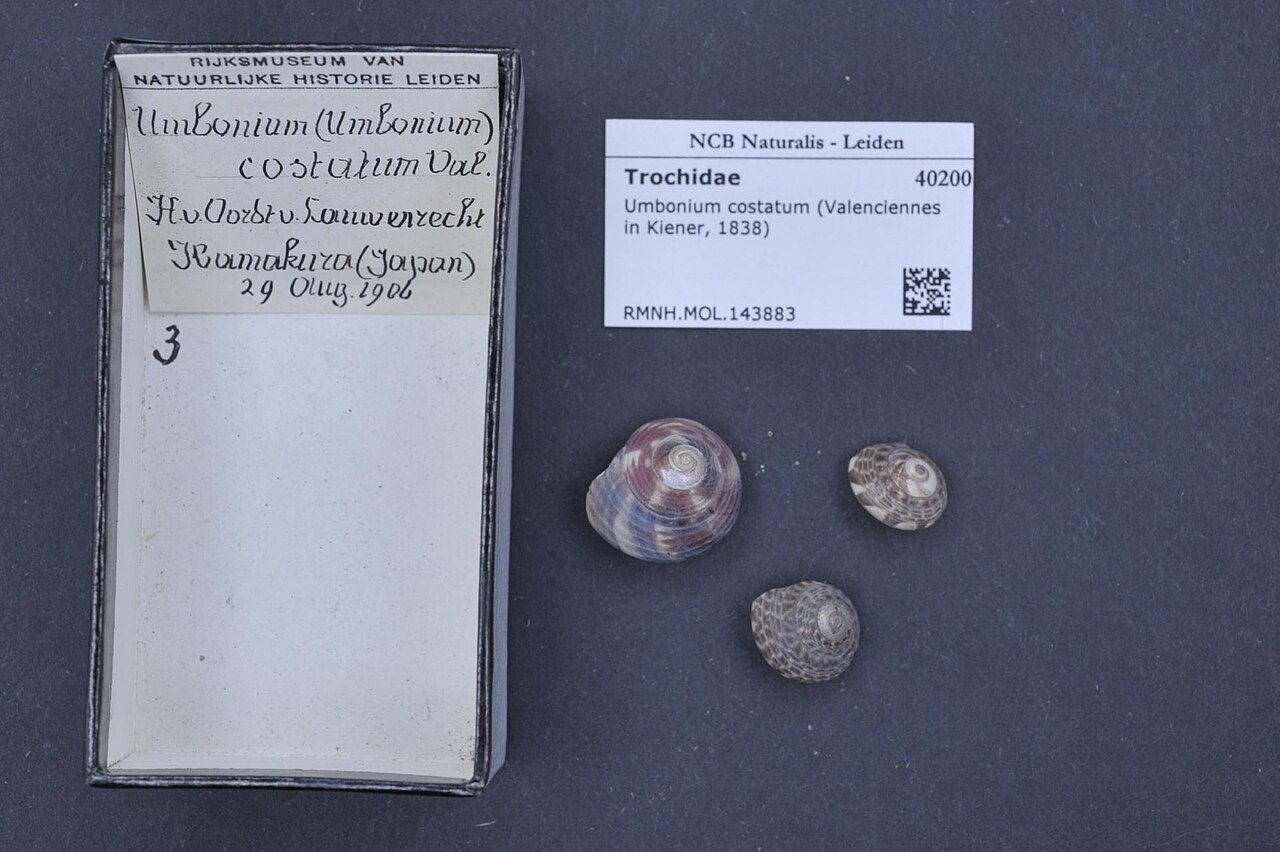
Adult shells range from 5 mm to 130 mm in length, and from 3 mm to 152 mm in height. Shell shape varies widely—from low, ear-shaped forms with a wide opening to long, slender, conical shapes typical of top shells, as well as subglobose, turbinate, or helicoid forms. The shell has only a few whorls, and its exterior can be smooth, glossy, or sculptured. The interior is nacreous. The operculum is brown, entirely horny, circular, and multispiral, fitting snugly into the aperture; it consists of many gradually enlarging whorls with a central nucleus. The aperture may be entire, tetragonal, or rounded, with no reflected lip, and the peristome is usually not continuous. Shells are often brightly colored and marked with darker bands. Trochidae differ from Turbinidae in having a horny, never calcareous, operculum that is always multispiral.
Internally, the animal resembles Turbinidae. Top snails have some primitive features: a heart with two atria, only one kidney, and the second osphradium lost during evolution. The mantle cavity holds a single gill. Along the foot are three or more pairs of sensory epipodial tentacles. The head has a short, broad rostrum. The intertentacular lobes are simple or finger-like, separate or joined across the front, sometimes absent. Jaws may be present or absent. The radula is rhipidoglossate, with always present and well-developed rhachidian teeth, usually five lateral teeth on each side (sometimes more), and many narrow marginal teeth.
This family occurs worldwide in tropical, temperate, and arctic waters. Members are among the most common marine snails along Europe’s rocky shores. Most live in the intertidal or shallow subtidal zones, but some inhabit deeper water.
Quick Facts
- Taxon
- Trochidae
Facts from the source article.
Lore & Background
The family Trochidae is characterized by a wide variation in shell shape, ranging from low auriform (ear-shaped) with a wide aperture to long, slender conical forms typical of top shells, as well as subglobose, turbinate, or helicoid shapes. The shell contains only a few whorls, with a highly variable exterior that may be smooth, glossy, or sculptured, and the internal shell is nacreous. The operculum is brown, entirely corneous, circular, and multispiral, fitting the aperture snugly, and differs from the family Turbinidae in having a corneous, never calcareous, operculum.
Internally, the animal is similar in general form to Turbinidae, with primitive traits including a heart with two atria, a single kidney, and a single gill in the mantle cavity. The foot has three or more pairs of sensory epipodial tentacles, and the head has a short, broad rostrum. The radula is rhipidoglossate, with well-developed rhachidian teeth, generally five lateral teeth on each side, and numerous narrow marginal teeth.
Members of this family are among the most common marine snails along the rocky shores of Europe, living mostly in the intertidal or shallow subtidal zones, though some inhabit deeper water. They are usually abundant on solid substrates such as rocky shores and reefs.
Reader's Guide
The family Trochidae holds significance as one of the most common marine snail groups along European rocky shores, with a worldwide distribution across tropical, temperate, and arctic waters. Their shells are often brightly colored and adorned with darker bands, making them notable in marine collections. The family is distinguished from the related Turbinidae by its corneous, multispiral operculum, a key taxonomic feature. Ecologically, Trochidae species are primarily herbivores, grazing on algae and vegetable detritus using their rhipidoglossate radulae, though some, like the genus Umbonium, engage in filter-feeding. Their life cycle involves dioecious reproduction with external fertilization, and larvae may hatch as free-swimming planktonic forms or as juvenile crawlers. The family's taxonomy includes 11 subfamilies and several unplaced genera, reflecting ongoing research into their evolutionary relationships, as seen in molecular studies published in 2010. Their presence in both shallow and deeper waters, along with their varied shell morphology, contributes to their legacy as a diverse and widespread group of marine snails.
Did You Know?
- The family Trochidae is named for the resemblance of many species' shells to a toy spinning top.
- Trochidae species have a corneous, multispiral operculum, unlike the calcareous operculum of Turbinidae.
- The radula of Trochidae is rhipidoglossate, with well-developed rhachidian teeth and numerous marginal teeth.
- Some Trochidae species, such as those in the genus Umbonium, can filter-feed in addition to grazing.
Taxonomic Breadth and Unresolved Lineages
The family Trochidae encompasses a remarkably broad taxonomic framework, organized into eleven recognized subfamilies whose descriptions span more than two centuries of malacological research. The oldest of these, Trochinae, was named by Rafinesque in 1815, while the most recent, Carinotrochinae, was only formally described in 2020 by Zhang, Zhang, and Zhang. Other subfamilies include Alcyninae and Chrysostomatinae (both 2010), Fossarininae (2009), Halistylinae (1958), Kaiparathininae (1993), Monodontinae and Cantharidinae (both 1857), Stomatellinae (1840), and Umboniinae (1854, originally 1840). Beyond this structured hierarchy, a number of genera remain unassigned to any subfamily, including the living Callumbonella and Enida, alongside a substantial roster of fossil forms such as Chuelskia, Coeloconulus, Eocalliostoma, Fagnastesia, Falsotectus, Guidonia, Lithotrochus, Molvaldesia, and Protorotella. This mix of extant and extinct lineages underscores how much of the family's evolutionary history is still being pieced together from the fossil record.
Shell Morphology and the Defining Operculum
No two top-snail shells look alike, yet all belong to the same family. Adult specimens range from a mere 5 millimeters to 130 millimeters in length, with heights spanning 3 to 152 millimeters. In terms of overall shape, the family covers an extraordinary spectrum: some shells are low and ear-shaped with a broad aperture, while others stretch into the long, slender cones that give the group its common name. Subglobose, turbinate, and helicoid forms also appear. Despite this diversity, the shells share a common feature of containing only a small number of whorls. The exterior surface can be perfectly smooth and glossy or heavily sculptured, and many species display vivid coloration punctuated by darker bands. Inside, the shell is lined with nacre. A distinctive circular operculum, made entirely of corneous material rather than calcium carbonate, seals the aperture snugly; it is multispiral, built from numerous gradually enlarging whorls around a central nucleus. The aperture itself may be entire, tetragonal, or rounded, and it lacks a reflected lip. This corneous, never calcareous, multispiral operculum is the key trait separating Trochidae from the closely related Turbinidae.
Primitive Internal Anatomy and Sensory Structures
Beneath the colorful exterior, top-snails retain several anatomical features that mark them as relatively primitive among marine gastropods. Their heart possesses two atria, a trait that has been lost in more derived lineages. Only one kidney is retained, and the second osphradium has disappeared entirely over the course of evolution. The mantle cavity houses a single gill. Along the lateral edges of the foot, three or more pairs of sensory epipodial tentacles provide environmental awareness, while the head bears a short, broad rostrum. The intertentacular lobes show considerable variation: they may be simple or digitated, separate or fused across the front, and in some species are nearly obsolete. Jaws are present in some forms but absent in others. The feeding apparatus is a rhipidoglossate radula in which the central rhachidian teeth are always well developed. Lateral teeth typically number five on each side, though some species carry more, and the marginal teeth are narrow and extremely numerous. In general body form, these snails closely resemble their Turbinidae relatives.
Global Distribution, Reproduction, and Feeding Ecology
Trochidae are truly cosmopolitan, occurring in tropical, temperate, and even arctic waters around the globe. Along the rocky coasts of Europe, they rank among the most frequently encountered marine snails. The vast majority of species inhabit the intertidal zone or the shallow subtidal region, though a minority venture into deeper water. Wherever suitable solid substrate exists—rocky shores, reefs, and similar hard surfaces—top-snails tend to be abundant. Reproduction in this family follows a dioecious pattern: males and females are separate individuals, and fertilization takes place externally after eggs and sperm are released into the water. Eggs may be deposited one at a time or clustered in gelatinous masses. Depending on the species, young emerge either as free-swimming planktonic larvae or as juvenile crawlers that undergo only a brief swimming phase. Nutritionally, trochids are herbivores that use their radulae to graze algae and vegetable detritus from rocky surfaces. A rare exception is the genus Umbonium, whose members have been observed engaging in filter-feeding rather than direct grazing.
Gallery
Frequently Asked Questions
What is Trochidae?
Trochidae is a family of marine gastropod molluscs within the subclass Vetigastropoda, popularly known as top-snails or top-shells. The common name comes from the characteristic shell silhouette of many species, which closely resembles a spinning top.
How big do Trochidae snails get?
Adult shells in this family span a remarkable range, from just 5 mm up to 130 mm in length and 3 mm to 152 mm in height. That means some members are barely visible to the naked eye while others are quite substantial.
What subfamilies are included in Trochidae?
The family is organized into eleven recognized subfamilies, such as Trochinae, Stomatellinae, Chrysostomatinae, Monodontinae, and Fossarininae. On top of that, twelve genera—both living and fossil—have not yet been formally placed into any subfamily.
What does a Trochidae operculum look like?
Trochidae carry a corneous, multispiral operculum that plugs the shell aperture when the snail retracts. Their feeding structure is a rhipidoglossate radula, a specialized rasping tongue used to scrape food from surfaces.
Why are Trochidae popular with shell collectors?
Many species in this family sport brightly colored shells, and the iconic spinning-top shape gives them a visually distinctive profile compared to other marine snails. That combination of vivid coloration and a recognizable silhouette makes them a favorite in hobbyist collections.
More in Marine Snails 1-24
Spotted an error? Know more?
Reader corrections go straight into our review queue. Suggest an edit · How this site is sourced