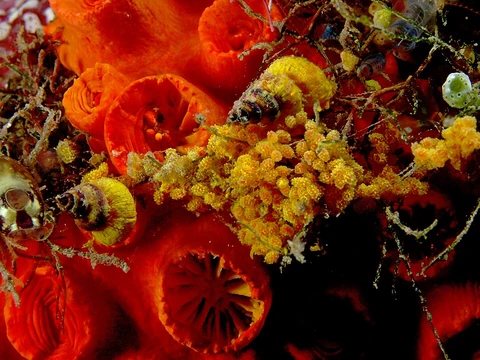
Calliotrochus
A genus of small, shining turbinate sea snails.

Manuel CABALLER · CC BY 4.0
Calliotrochus is a genus of marine gastropod mollusks, specifically sea snails, belonging to the subfamily Stomatellinae within the family Trochidae—commonly known as top snails. Members of this genus are small, thin-shelled, and glossy, with a globose and turbinate shape. Their whorls are convex and either smooth or marked with spiral grooves. The aperture is rounded, and both the outer lip and columella are simple, thin, and curved. The umbilicus is narrow.
The only recognized species in the genus is *Calliotrochus marmoreus* (Pease, 1861). Several other names have been placed into synonymy: *Calliotrochus excellens*, *Calliotrochus normalis*, and *Calliotrochus symbolicus* are all considered synonyms of *C. marmoreus*. *Calliotrochus legrandi* is now accepted as *Minopa legrandi*, and *Calliotrochus tasmanicus* is treated as *Nanula tasmanica*.
Quick Facts
- Taxon
- Calliotrochus
- Type Species
- Turbo phasianellus
- Type Species Authority
- Deshayes, G.P., 1863
Facts from the source article.
Lore & Background
The genus Calliotrochus is characterized by thin, small, shining globose shells with a turbinate shape. Its whorls are rounded, smooth or spirally striate, and convex. The aperture is rounded, and both the outer lip and columella are simple, thin, and arcuate. The umbilicus is narrow.
Species within the genus include Calliotrochus marmoreus, originally described by Pease in 1861. Several other species have been brought into synonymy with Calliotrochus marmoreus, including Calliotrochus excellens, Calliotrochus normalis, and Calliotrochus symbolicus, all described by Iredale in 1937. Other species, such as Calliotrochus legrandi and Calliotrochus tasmanicus, have been reassigned to different genera.
Reader's Guide
The significance of Calliotrochus lies in its placement within the subfamily Stomatellinae of the family Trochidae, contributing to the understanding of marine gastropod diversity. The genus is notable for its morphological features—thin, shining, globose turbinate shells with a narrow umbilicus—which aid in identification and classification. The synonymy of several species under Calliotrochus marmoreus reflects taxonomic revisions that clarify species boundaries within the genus. The genus has been the subject of a revision by Herbert in 1998, which further refined its taxonomy. Its legacy is tied to the study of top snails and the ongoing refinement of molluscan systematics.
Did You Know?
- Calliotrochus is a genus of sea snails in the subfamily Stomatellinae of the family Trochidae.
- The genus consists of thin, small, shining globose species with a turbinate shape.
- Calliotrochus marmoreus was described by Pease in 1861.
- Several species, including Calliotrochus excellens and Calliotrochus normalis, are synonyms of Calliotrochus marmoreus.
Shell Morphology & Visual Character
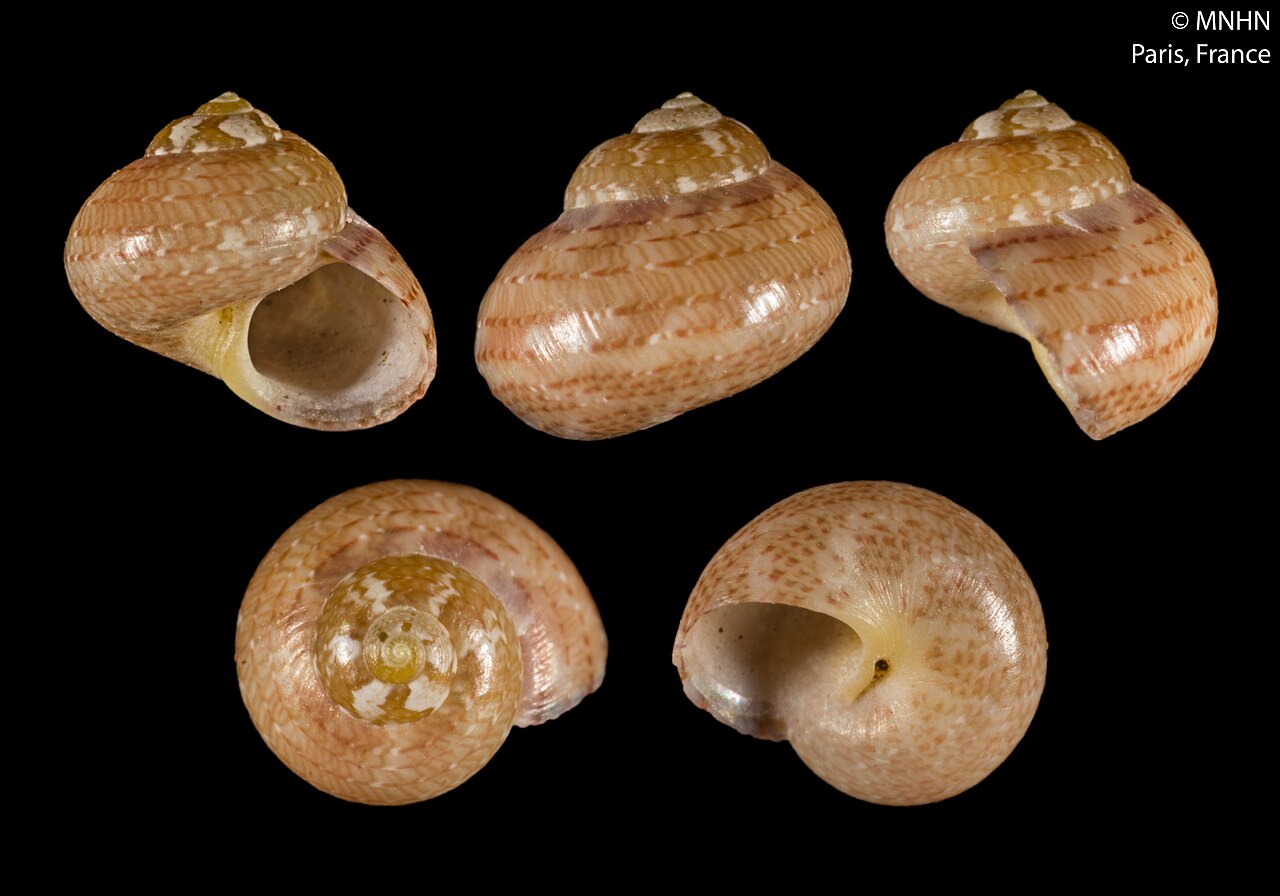
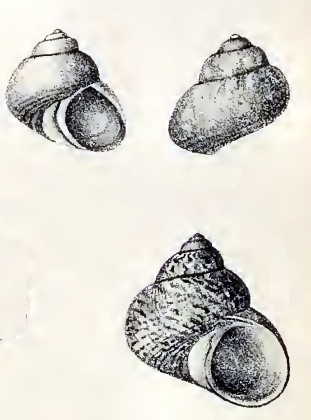
The shell of Calliotrochus marmoreus is a remarkably compact structure, measuring just six millimetres in both height and diameter. Its overall form is described as globose-turbinate, meaning it sits low and rounded rather than tall and conical, with a narrow perforation at the base. The surface is thin, smooth, and possesses a natural shine, decorated with a marbled and mottled pattern that blends olive, brown, and pinkish tones. White accents appear either as scattered dots or as articulated spiral lines of white, pink, or brown. The spire is short and conical, terminating in a tiny, sharply pointed apex, while the sutures between whorls are visibly impressed. Approximately five rounded whorls compose the shell, with the body whorl being notably large and convex on its underside. A narrow white umbilicus sits at the base, and the oblique, rounded-oval aperture reveals a delicate layer of bluish iridescent nacre along its inner surface. The outer, basal, and columella margins are thin, well curved, and simple, converging and joining across the parietal wall through a thin layer of callus.
Taxonomic History & Scientific Documentation
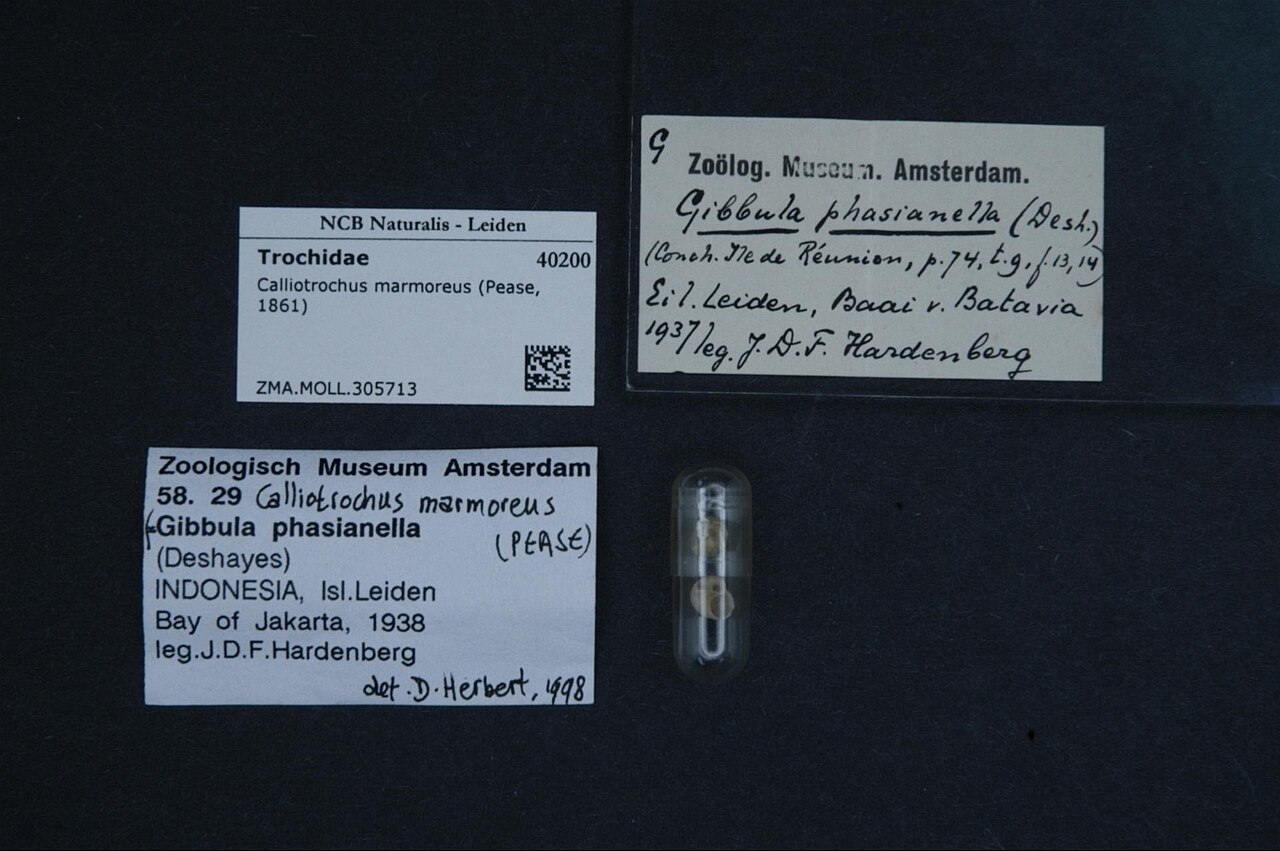
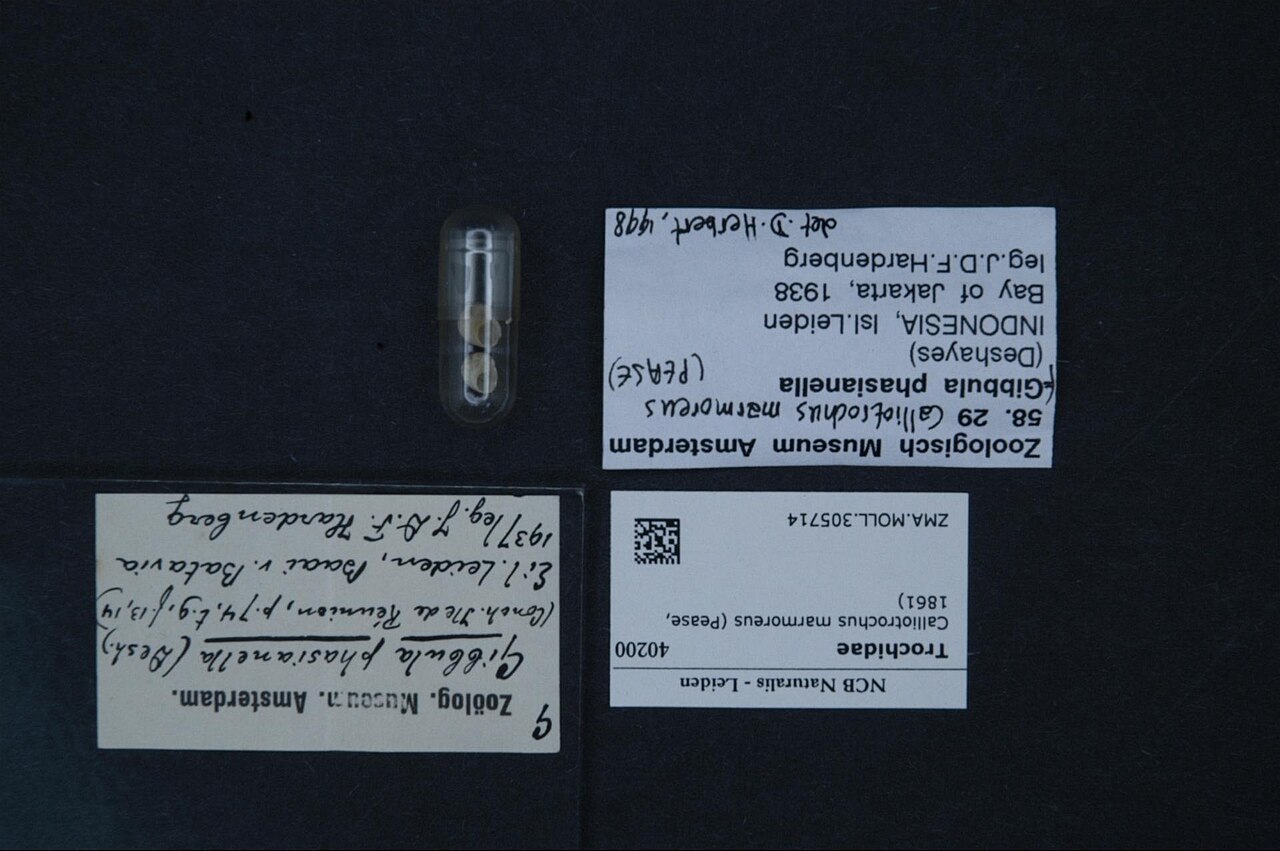
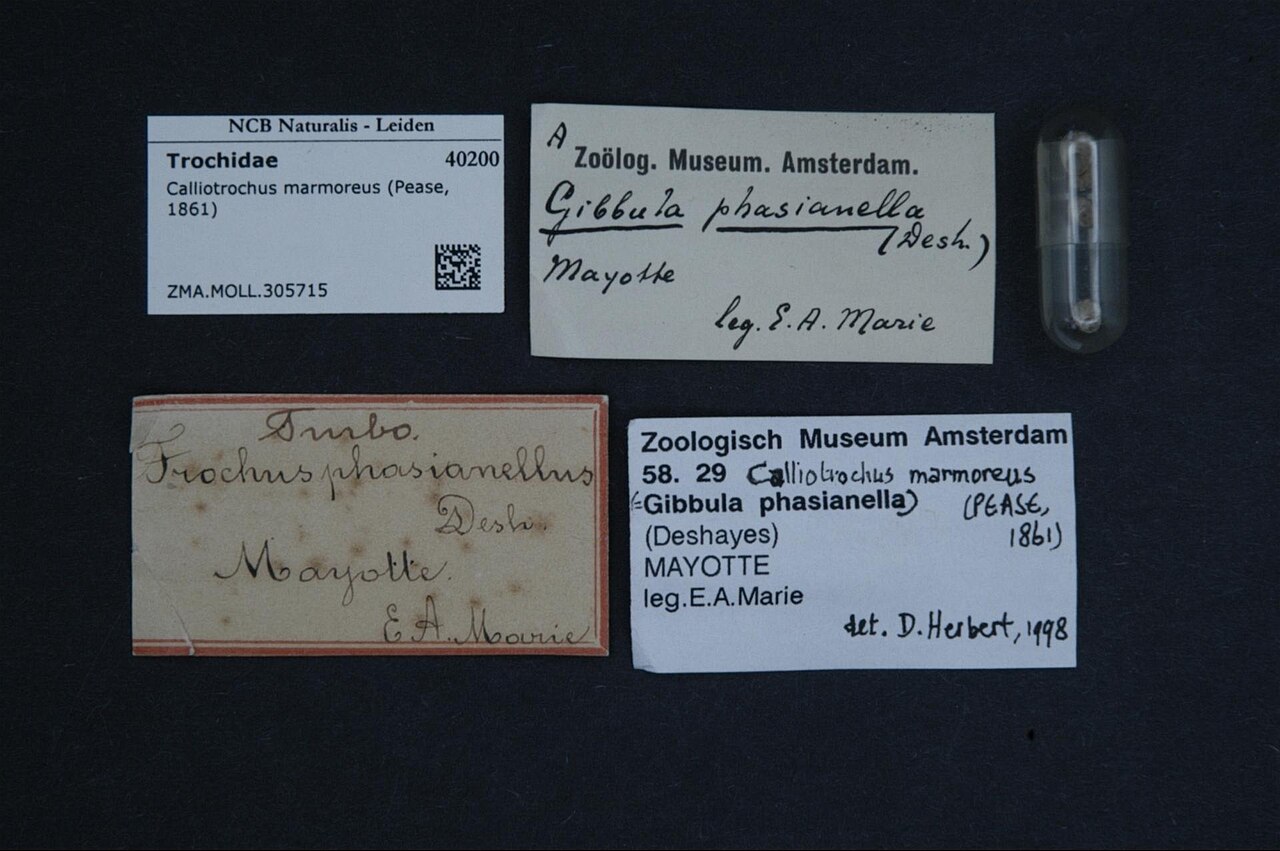
The scientific record of Calliotrochus marmoreus stretches back to the mid-nineteenth century, reflecting a long tradition of malacological inquiry across the Pacific and Indian Oceans. Garrett's 1857 paper on new marine shell species from the Sandwich Islands represents one of the earliest documented engagements with Hawaiian gastropod diversity. Shortly after, Pease in 1861 described forty-seven new shell species from the same island group, further enriching the taxonomic baseline. Throughout the late 1800s and early 1900s, researchers including Deshayes, Hedley, and Preston contributed descriptions from Réunion, Funafuti, and the Andaman Islands respectively, gradually assembling a broader picture of the genus. A pivotal moment came in 1998 when Herbert undertook a full revision of the genus Calliotrochus Fischer, 1879, consolidating earlier scattered descriptions into a coherent framework. More recently, Dekker and Orlin Z's 2000 checklist of Red Sea molluscs confirmed the species' presence in that region, extending the known range and reaffirming its taxonomic placement.
Geographic Range & Biogeographic Significance
Calliotrochus marmoreus occupies a broad swath of tropical and subtropical marine waters, spanning from the Red Sea eastward through the tropical Indo-Pacific region. Its range extends to the Hawaiian Islands in the central Pacific and reaches as far south as Queensland, Australia. This distribution pattern places the species firmly within the warm-water realms of the world's oceans, suggesting an affinity for the shallow, sunlit habitats typical of reef and shore environments in these latitudes. The presence of the snail in both the Red Sea and the Indo-Pacific highlights its capacity to persist across a considerable longitudinal expanse, while its occurrence in Hawaii and Queensland underscores the species' ability to colonize island and continental shelf settings alike. The historical literature documenting these localities, spanning papers from the 1850s through the 2000s, confirms that this range has been recognized and verified by multiple independent researchers over more than a century of fieldwork and collection.
Classification & Ecological Identity
Calliotrochus marmoreus belongs to the family Trochidae, commonly known as the top snails, a group of marine gastropod molluscs characterized by their distinctive shell architecture. The genus Calliotrochus was established by Fischer in 1879, and the species marmoreus was later assigned within it, a placement that was formally examined and confirmed during Herbert's 1998 taxonomic revision. As a marine gastropod, this snail occupies the ecological niche of a small, benthic invertebrate in tropical waters, its diminutive six-millimetre shell suggesting a lifestyle closely tied to the substrate of coral reefs, rocky shores, or similar hard-bottom habitats. The thin, smooth, and shining nature of its shell, combined with the narrow perforation and the delicate nacreous lining of the aperture, points to a creature adapted to calm, shallow marine environments rather than exposed, high-energy coastlines. Its classification within Trochidae links it to a diverse and widespread family of top snails found across the world's oceans.
Gallery
Frequently Asked Questions
What is Calliotrochus?
Calliotrochus is a genus of small, glossy sea snails placed in the subfamily Stomatellinae within the family Trochidae, the top snails. It is a monotypic genus, so only a single valid species is currently recognized under this name.
What does a Calliotrochus shell look like?
The shell is thin, highly polished, and takes on a rounded, top-like (turbinate-globose) form with convex whorls that are either smooth or carry fine spiral grooves. The aperture is round, the outer lip and columella are thin and gently curved, and the umbilicus is notably narrow.
How many species belong to the genus Calliotrochus?
Only one species is accepted: Calliotrochus marmoreus, first described by Pease in 1861. A number of other names that were once applied to this genus have since been reduced to synonymy under that single valid name.
What family and subfamily does Calliotrochus sit in?
It belongs to the family Trochidae (top snails) and, more specifically, to the subfamily Stomatellinae. This positions it among the smaller, thin-shelled marine gastropods rather than the heavier-bodied trochids.
What sets Calliotrochus apart from other top snails?
Its very thin, highly lustrous shell combined with a narrow umbilicus and a simple, unadorned aperture with thin, curved lips distinguishes it from many other trochid genera. The overall small, delicate build is the quickest visual cue for spotting it among similar species.
More in Marine Snails 1-24
Spotted an error? Know more?
Reader corrections go straight into our review queue. Suggest an edit · How this site is sourced