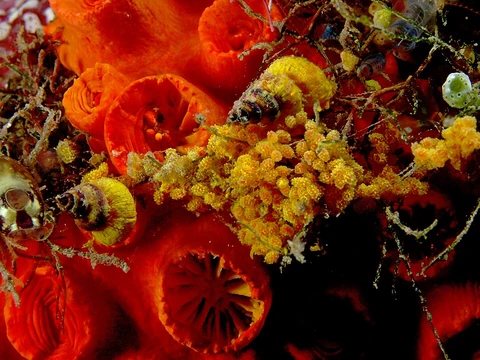
Botelloides
Genus of marine snails endemic to Australia, family Trochidae.

Botelloides is a genus of sea snails, specifically marine gastropod mollusks belonging to the family Trochidae, commonly known as top snails. These snails are found only in Australia, along the coasts of New South Wales, the Northern Territory, Queensland, South Australia, Tasmania, Victoria, and Western Australia.
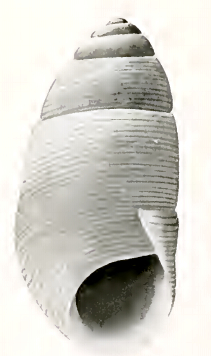
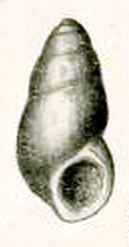
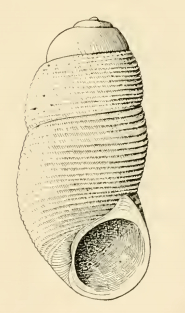
The shells of Botelloides species are subcylindrical and pupoid in shape. The whorls wind obliquely over the last two-thirds of the shell. Early whorls are smooth, while later whorls have fine incised spiral grooves. The aperture is pyriform to circular, the columella is excavate, and the outer lip is grooved inside and bevelled to a sharp edge. Species differ in whether the shell gradually widens toward the body whorl or remains cylindrical.
Species in this genus include Botelloides bassianus, Botelloides chrysalidus, Botelloides glomerosus, Botelloides ludbrookae, and Botelloides sulcatus.
Quick Facts
- Taxon
- Botelloides
- Type Species
- Onoba bassiana
- Type Species Authority
- Hedley, 1911
Facts from the source article.
Lore & Background
The genus Botelloides comprises sea snails with a subcylindrical and pupoid shell shape. The whorls wind obliquely on the last two-thirds of the shell. Sculpture varies: earlier whorls are smooth, while later whorls bear fine incised, spiral grooves. The aperture is pyriform to circular, the columella is excavate, and the outer lip is grooved within and bevelled to a sharp edge.
Differences between species are defined by whether the shell gradually widens towards the body whorl or remains cylindrical without widening. All species in this marine genus are endemic to Australia, occurring off multiple states and territories including New South Wales, the Northern Territory, Queensland, South Australia, Tasmania, Victoria, and Western Australia.
Five species are recognized within the genus: Botelloides bassianus, Botelloides chrysalidus, Botelloides glomerosus, Botelloides ludbrookae, and Botelloides sulcatus. The genus was revised by Ponder in a publication by the Department of Mines and Energy, South Australia.
Reader's Guide
Botelloides is notable as a genus of marine gastropod mollusks within the family Trochidae, the top snails. Its significance lies in its endemic distribution to Australia, with species recorded off New South Wales, the Northern Territory, Queensland, South Australia, Tasmania, Victoria, and Western Australia. The genus was revised by Ponder in a work published by the Department of Mines and Energy, South Australia, and later included in Wilson's comprehensive work on Australian marine shells. The five recognized species—Botelloides bassianus, Botelloides chrysalidus, Botelloides glomerosus, Botelloides ludbrookae, and Botelloides sulcatus—exhibit morphological variation in shell shape, either gradually widening towards the body whorl or remaining cylindrical. The genus contributes to the understanding of trochid diversity in Australian waters, with its distinctive subcylindrical, pupoid shell form and sculptural details such as fine incised spiral grooves on later whorls. Its legacy is documented in taxonomic references and the World Register of Marine Species.
Did You Know?
- Botelloides species have a subcylindrical and pupoid shell shape.
- The later whorls of Botelloides shells bear fine incised, spiral grooves.
- All species in the genus Botelloides are endemic to Australia.
Taxonomic Identity & Classification
Botelloides glomerosus occupies a specific niche within the broader world of marine invertebrates. It is a sea snail, placing it firmly among the gastropod mollusks that inhabit ocean environments. More precisely, it belongs to the family Trochidae, a group commonly referred to as top snails, which distinguishes it from other gastropod lineages. Within that family, it sits in the genus Botelloides, a grouping that has received dedicated taxonomic attention. The species epithet glomerosus completes its binomial name, identifying this particular form among its congeners. As a marine organism, it is entirely dependent on saltwater habitats for its existence, and its classification as a prosobranch gastropod places it within the broader evolutionary framework of shelled sea creatures. The combination of these taxonomic ranks—from family through genus to species—provides researchers with a precise coordinate in the tree of life, anchoring this small mollusk within the well-studied trochid lineage.
Shell Architecture & Morphology
The shell of Botelloides glomerosus is a compact, solid structure measuring between 2.9 and 6 millimeters in length, giving it a notably diminutive profile. Its overall form is columnar with blunt termination at both the apex and the base, and its surface carries a glossy finish. Coloration ranges from milk-white to pale ochre, with the summit tending toward a warmer yellow hue. The shell is composed of five whorls; the first three are turbinate in shape and collectively account for roughly the last two-thirds of the shell's total length. These whorls are slightly inflated, show contraction at the sutures, and are wound obliquely. Ornamentation is concentrated on the final two whorls, which bear fine, flat-topped spiral riblets separated by shallow grooves marginally wider than the riblets themselves. These riblets grow more densely packed toward the center of each whorl, with approximately twenty on the last whorl and ten on the antepenultimate one. Faint growth striae cross both riblets and grooves at an oblique angle. The aperture is round, with a bevelled edge thickened on the interior rather than the exterior.
Australian Endemism & Range
Botelloides glomerosus is a species found exclusively within Australian waters, making it a true endemic of that continent's marine environment. Its known range stretches across three distinct coastal regions: the Northern Territory, Western Australia, and Queensland. This distribution pattern suggests a presence in the warmer, tropical to subtropical waters that characterize the northern and western margins of the Australian coastline. As a marine gastropod, it inhabits the ocean environment rather than freshwater or terrestrial settings, and its restricted geographic footprint underscores the degree of endemism present in the country's marine mollusk fauna. For shell collectors and marine biologists working in these regions, this species represents a small but distinctive component of the local benthic community, identifiable by its modest size and characteristic trochid shell form. Its absence from records outside Australian shores reinforces the uniqueness of the nation's coastal biodiversity.
Taxonomic History & Scientific Record
The formal scientific documentation of Botelloides glomerosus traces back to a dedicated taxonomic revision undertaken by W.F. Ponder in 1985. Published as part of a Special Publication by the Department of Mines and Energy in South Australia, Ponder's work provided a comprehensive re-examination of the entire genus Botelloides within the order Trochacea, and the species in question was described on page 305 with accompanying illustrations. This revision helped clarify the boundaries and characteristics of the genus at a time when trochid systematics was being refined. Subsequently, B. Wilson included the species in his 1993 volume on Australian prosobranch gastropods, published by Odyssey Publishing in Kallaroo, Western Australia, making it accessible to a broader audience of shell enthusiasts and regional biologists. Today, the species is catalogued in the World Register of Marine Species, ensuring its continued recognition within the global framework of marine biodiversity documentation.
Gallery
Frequently Asked Questions
What is Botelloides?
Botelloides is a small genus of marine gastropod mollusks—commonly called top snails—classified within the family Trochidae. It is a purely Australian group, with no known records outside the country's waters.
Where can you find Botelloides species?
Every described species is endemic to Australian coastal waters, ranging from New South Wales, the Northern Territory, Queensland, South Australia, Victoria, and Western Australia up through to Tasmania. No populations have been documented on any other continent or island chain.
What does a Botelloides shell look like?
The shells are subcylindrical with a pupoid profile, and the whorls spiral obliquely across roughly the final two-thirds of the body. Early whorls are smooth, while the later ones carry fine incised spiral grooves; the aperture ranges from pyriform to circular and the columella is noticeably excavate.
How many species are recognized in the genus Botelloides?
Five species currently make up the genus: B. bassianus, B. chrysalidus, B. glomerosus, B. ludbrookae, and B. sulcatus. Each is restricted to Australian shelf and slope habitats.
How does Botelloides relate to other top snails?
It sits squarely within Trochidae, the large family of top snails, so it shares the general trochid body plan with many familiar reef and shore species. What sets it apart taxonomically is its exclusively Australian range and the particular combination of oblique whorl winding with fine late-whorl spiral sculpture.
More in Marine Snails 1-24
Spotted an error? Know more?
Reader corrections go straight into our review queue. Suggest an edit · How this site is sourced