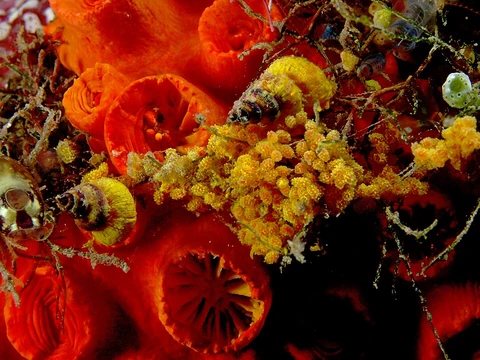
Turbinidae
Marine snails with a distinctive calcareous operculum used for defense.

Turbinidae, commonly called turban snails, is a family of marine gastropod molluscs that range from small to large in size. They belong to the superfamily Trochoidea.
Their most distinctive feature is a strong, thick calcareous operculum, which sets them apart from the similar-looking Trochidae (top snails), whose opercula are made of a horn-like material. This sturdy operculum acts as a passive defense, blocking predators that try to enter through the shell's opening or break it at the outer lip. The opercula are rounded ovals, flat with a swirl pattern on one side and domed on the other. They are known by several folk names—Pacific cat's eye, Shiva eye shells, or mermaid money—and are used for decoration.
The common name "turban snail" comes from the shell's resemblance to a turban. The scientific name Turbinidae, however, is based on the genus *Turbo*, which is Latin for "spinning top," a child's toy; the word "turbine" shares this origin.
This is an ancient group of gastropods, likely originating in the Permian period. They retain primitive traits, such as a nacreous (mother-of-pearl) interior shell layer. Turbinids are found in both shallow and deep waters, with a broad distribution from the tropics to polar regions. Most species, however, live in tropical and subtropical shallow waters. In several regions of Japan, Ama divers have observed a noticeable decline in both the size and number of turban snails over the last 50 years.
Taxonomically, the family has been reorganized. Under the 2005 taxonomy of Bouchet & Rocroi, Turbinidae belonged to the superfamily Turbinoidea and included eight subfamilies: Turbininae, Angariinae, Colloniinae (with tribes Colloniini, †Adeorbisinini, †Crossostomatini, and †Helicocryptini), Moellerinae, †Moreanellinae, Prisogasterinae, Skeneinae, and Tegulinae. By 2008, following Williams et al., Turbinidae was moved back to the redefined superfamily Trochoidea. In this revision, Angariidae was elevated to a family, Colloniinae became the family Colloniidae within Phasianelloidea, and Margaritinae was moved into Turbinidae from Trochidae. The 2008 classification recognizes five subfamilies: Turbininae, Skeneinae, Margaritinae (with tribes Margaritini, Gazini, and Kaiparathinini), Tegulinae, and Prisogasterinae.
Quick Facts
- Taxon
- Turbinidae
Facts from the source article.
Lore & Background
The common name turban snail presumably refers to the shell's similarity in appearance to a turban. However, the scientific name Turbinidae is based on the genus name Turbo, which is Latin for spinning top, a child's toy; the word turbine has a similar derivation. This is a quite ancient group of gastropods, probably originating in the Permian period 298 to 250 million years ago, and they have typical primitive characters like the nacreous interior of the shell.
Turbinids occur in shallow and deep waters, with a large distribution from the tropics to the polar regions, but most species live in tropical and subtropical shallow waters. Over the last 50 years a noticeable decline in both size and quantity of turban snail population has been observed by Ama divers of several regions of Japan.
The taxonomy of Turbinidae has been subject to revision. According to the 2005 taxonomy of Bouchet & Rocroi, the family belonged to superfamily Turbinoidea and consisted of eight subfamilies. In 2008, Williams et al. redefined Turbinidae and moved it to the redefined superfamily Trochoidea, elevating some subfamilies to family level (Angariidae, Colloniidae, Skeneidae, Margaritidae, Tegulidae) and retaining others within Turbinidae.
Reader's Guide
The significance of Turbinidae lies in its distinctive calcareous operculum, which is a key identifying feature and serves as a passive defensive structure against predators that try to enter by way of the aperture or that would break the shell at the outer lip. These opercula are known as Pacific cat's eye or Shiva eye shells or mermaid money, and are used for decorative purposes. The family's scientific name derives from the Latin 'Turbo', meaning spinning top, reflecting the shell's shape. Turbinidae is an ancient group, probably originating in the Permian period, and retains primitive characters such as a nacreous interior. The family has a wide distribution from tropics to polar regions, though most species are in tropical and subtropical shallow waters. Notably, Ama divers in Japan have observed a decline in both size and quantity of turban snail populations over the last 50 years. The taxonomy of the family has been revised multiple times, with the 2008 classification by Williams et al. redefining it and moving it to the superfamily Trochoidea, while elevating several former subfamilies to family status.
More in Marine Snails 1-24
Spotted an error? Know more?
Reader corrections go straight into our review queue. Suggest an edit · How this site is sourced