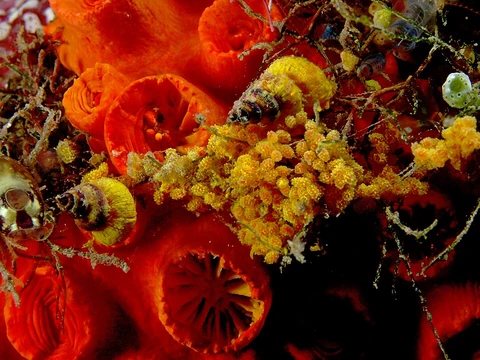
Trochinae
A subfamily of top-snails with corneous, multispiral opercula.

Trochinae is a subfamily of sea snails within the family Trochidae, commonly known as top-snails or top-shells. This subfamily is one of several recognized in the family, which is characterized by shells that often resemble a toy spinning top.
Quick Facts
- Taxon
- Trochidae
Facts from the source article.
Lore & Background
The subfamily Trochinae was established by Rafinesque in 1815. It is one of eleven subfamilies listed within the family Trochidae. Members of this subfamily share the general characteristics of the family: a nacreous internal shell, a brown, entirely corneous, circular, multispiral operculum, and a rhipidoglossate radula with well-developed rhachidian teeth. The shell shape varies widely, from low auriform to long, slender conical forms, and may be subglobose, turbinate, or helicoid. Shells are often brightly colored with darker bands.
The animal has a heart with two atria, a single kidney, and a single gill in the mantle cavity. Along the side of the foot are three or more pairs of sensory epipodial tentacles. The head has a short, broad rostrum. The radula typically has five lateral teeth on each side, with narrow and very numerous marginal teeth. Species are dioecious with external fertilization, and larvae may be free-swimming or juvenile crawlers.
Reader's Guide
The subfamily Trochinae is significant within the family Trochidae as one of its long-recognized taxonomic groups, named by Rafinesque in 1815. Its members are among the most common marine snails along rocky shores of Europe, and the family as a whole has a worldwide distribution. The subfamily shares the diagnostic feature that distinguishes Trochidae from the related family Turbinidae: a corneous, never calcareous, multispiral operculum. This trait is consistent across all Trochidae subfamilies, including Trochinae.
The ecological role of Trochinae snails is primarily as herbivores, grazing on algae and vegetable detritus using their radulae. They are abundant on solid substrates such as rocky shores and reefs, living mostly in intertidal or shallow subtidal zones, though some species inhabit deeper waters. The subfamily's legacy lies in its contribution to the diversity of marine gastropods, with shells that vary greatly in size and shape, and in its representation of primitive anatomical traits such as two atrial hearts and a single gill. The taxonomy of Trochinae, like that of the entire family, continues to be refined through molecular studies.
Did You Know?
- The subfamily Trochinae was named by Rafinesque in 1815.
- Trochinae snails have a corneous, multispiral operculum, never calcareous.
- Members of Trochinae are herbivores that graze on algae and vegetable detritus.
- The family Trochidae is named for the shell's resemblance to a toy spinning top.
More in Marine Snails 1-24
Spotted an error? Know more?
Reader corrections go straight into our review queue. Suggest an edit · How this site is sourced