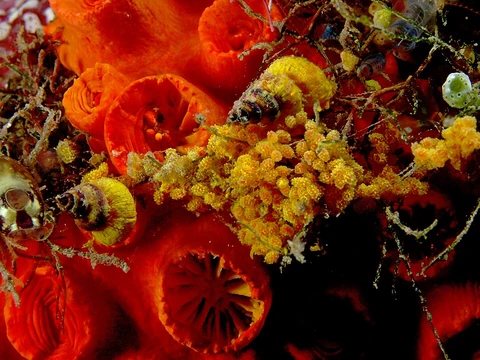
Stomatellinae
Small sea snails with brilliantly nacreous shell interiors.

Stomatellinae are a subfamily of small marine gastropods belonging to the top snail family, Trochidae. Their shells are distinguished by a brilliantly iridescent inner layer of nacre.
In older classifications, such as the *Treatise on Invertebrate Paleontology*, this group was placed in the Archaeogastropoda, but that taxon has largely been replaced by the more modern Vetigastropoda. Following the work of Bouchet & Rocroi (2005), Williams et al. (2008), and Williams et al. (2010), the group was downgraded from the family Stomatellidae to the subfamily Stomatellinae within Trochidae.
The shells are mostly low-spired, subglobose, and have few whorls. They can be shaped like an abalone (*Haliotis*) or be non-spiral and limpet-like. They lack an umbilicus, and most species have no operculum. The aperture is very large, making the entire interior of the last whorl visible from below. The muscle scar inside the shell is crescent-shaped. The animal itself has a broad foot, split lengthwise by a median groove underneath and covered with tubercles above. Its muzzle is broad and ends in an oval disc, with a rounded mouth. The tentacles are long and pointed, and the eyes sit on short, thick stalks behind and outside the tentacles. The epipodium is prominent and fleshy, sometimes with cirri, and there are frontal lobes. The mantle edge is either simple or reflexed and foliated, with no slit in the front. When present, the operculum is small, horny, thin, and multispiral. The single gill is a curved plume on the left or outer side of the mantle cavity, with its distal third free.
Genera within Stomatellinae include *Calliotrochus*, *Microtis*, *Pseudostomatella*, *Stomatella*, *Stomatia*, and *Stomatolina*. Several genera have been synonymized: *Gena* is a synonym of *Stomatella*; *Microtina* is a synonym of *Microtis*; *Plocamotis* is a synonym of *Stomatella*; and *Stomax* is an unnecessary substitute name for *Stomatia*.
Quick Facts
- Taxon
- Stomatellinae
Facts from the source article.
Lore & Background
The subfamily Stomatellinae was previously classified as the family Stomatellidae within the Archaeogastropoda, as used in the Treatise on Invertebrate Paleontology. However, that taxon is now largely abandoned in favor of the more recently defined Vetigastropoda. According to Bouchet & Rocroi (2005), Williams et al. (2008) and Williams et al. (2010), this taxon underwent a rank change from family Stomatellidae to subfamily Stomatellinae within the family Trochidae.
The shells of species in this subfamily are mostly low-spired, subglobose, with few whorls. They are either Haliotis-shaped or non-spiral and limpet-like. They lack an umbilicus. Most species lack an operculum. The aperture is very large, and through it the interior of the last whorl is entirely visible from below. The interior of the shell is iridescent because of a layer of nacre. The muscle impression inside the shell is crescent-shaped.
The animal has a broad foot, longitudinally divided by a median line below, and tuberculate above. The muzzle is broad, ending distally in an oval disc. The mouth is rounded. The long tentacles are pointed. The eyes are situated on short and heavy peduncles outside and behind the tentacles. The epipodium is prominent, fleshy, with or without cirri. Frontal lobes are present. The mantle edge is simple or reflexed and foliated. There is no slit in the front. The operculum is small, horny, thin, multispiral and often wanting. The gill has a single curved plume on the left or on the outer side of the mantle cavity. Its distal third is free.
Reader's Guide
Stomatellinae holds significance as a subfamily within the Trochidae, having undergone a rank change from family status based on molecular systematics work by Williams et al. (2008) and Williams et al. (2010). Its taxonomic history reflects broader shifts in gastropod classification, moving from the older Archaeogastropoda concept to the more recent Vetigastropoda. The subfamily is characterized by distinctive shell morphology: mostly low-spired, subglobose shells with few whorls, either Haliotis-shaped or limpet-like, lacking an umbilicus, and with a very large aperture that reveals the nacreous interior. Most species lack an operculum, and when present it is small, horny, thin, and multispiral. The animal's anatomy includes a broad foot divided by a median line, a broad muzzle with an oval disc, pointed tentacles, eyes on short peduncles, and a prominent epipodium. The gill is a single curved plume on the left side of the mantle cavity with its distal third free. The subfamily includes six accepted genera: Calliotrochus, Microtis, Pseudostomatella, Stomatella, Stomatia, and Stomatolina, with several other genera considered synonyms. This anatomical and taxonomic detail makes Stomatellinae a well-documented group within the top snails.
More in Marine Snails 1-24
Spotted an error? Know more?
Reader corrections go straight into our review queue. Suggest an edit · How this site is sourced