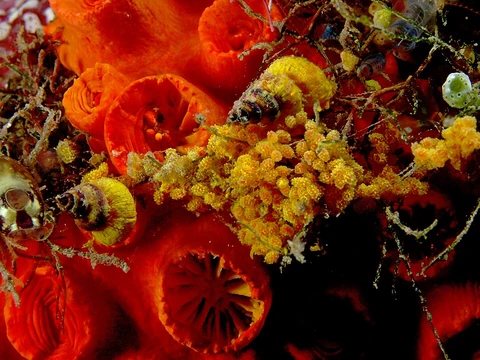
Stomatella
A genus of small to medium marine snails in the family Trochidae.

Stomatella is a genus of small to medium-sized marine gastropod mollusks belonging to the family Trochidae, which includes top snails and their relatives. The name was first mentioned by Lamarck in 1809 as "Stomatelle," but he provided no description or species at that time. The authorship is now attributed to Rafinesque, who Latinized the name to Stomatella.
The shell is spiraled, orbicularly depressed, and imperforate, with a short, elevated conical spire. Its whorls are rounded and lack plications below the sutures, with the last whorl making up most of the shell. The variegated surface is ribbed spirally, and the large aperture is wider than it is long, with a nacreous interior. The operculum is horny, circular, and multispiral. The foot is truncated posteriorly, and there are no epipodial tentacles.
Species within the genus include *Stomatella auricula*, *Stomatella caledonica*, *Stomatella callosa*, *Stomatella capieri*, *Stomatella duplicata*, *Stomatella elegans*, *Stomatella esperanzae*, *Stomatella gattegnoi*, *Stomatella haliotiformis*, *Stomatella illusa*, *Stomatella impertusa*, †*Stomatella incola*, *Stomatella lintricula*, *Stomatella modesta*, *Stomatella monteiroi*, *Stomatella oliveri*, *Stomatella ornata*, *Stomatella pallida*, *Stomatella planulata*, *Stomatella plumbea*, *Stomatella striatula*, *Stomatella terminalis*, and *Stomatella ungula*. Several taxa are considered inquirenda, including *Stomatella candida*, *Stomatella costellata*, *Stomatella crassa*, *Stomatella dilecta*, *Stomatella elata*, *Stomatella laevis*, *Stomatella nigra*, *Stomatella rosacea*, *Stomatella sulcata*, and *Stomatella ziczac*.
Quick Facts
- Taxon
- Stomatella
- Type Species
- Stomatella auricula
- Type Species Authority
- Lamarck, 1816
Facts from the source article.
Lore & Background
The shell of Stomatella is spiral, orbicularly depressed, and imperforate, with a conical spire that is elevated but short. The whorls are rounded and not plicate below the sutures, and the last whorl forms the greater part of the shell. The variegated surface is spirally ribbed, and the large aperture is wider than the long, nacreous interior. The operculum is horny, circular, and multispiral. The foot is truncated posteriorly, and there are no epipodial tentacles.
Lamarck first mentioned the genus in 1809 as 'Stomatelle' but did not describe it or cite any species. He later cited it in 1819 with Stomatella imbricata as the first species, which is now considered a synonym of Granata imbricata. According to the Nomenclator Zoologicus, authorship should be attributed to Rafinesque, who Latinized the name to Stomatella.
The genus includes numerous species, such as Stomatella auricula, Stomatella elegans, and Stomatella haliotiformis, as well as several taxa inquirenda and many species brought into synonymy with other genera like Granata, Synaptocochlea, and Pseudostomatella.
Reader's Guide
Stomatella is notable as a genus within the Trochidae family, encompassing a variety of small to medium sea snails with distinctive shell morphology. The genus has a complex taxonomic history, beginning with Lamarck's initial mention in 1809 without formal description, and later attribution to Rafinesque. The shell characteristics—spiral, depressed, imperforate, with a nacreous interior and multispiral operculum—distinguish it from related groups. The absence of epipodial tentacles and the truncated foot are key anatomical features. The extensive list of species and synonyms reflects ongoing taxonomic revisions, with many species reassigned to other genera such as Granata, Synaptocochlea, and Pseudostomatella. This indicates that Stomatella has served as a taxonomic 'catch-all' for various trochid snails, and its boundaries remain subject to scientific scrutiny. The genus's legacy lies in its role in the historical classification of marine gastropods and the continued refinement of its species composition.
Did You Know?
- Lamarck first mentioned the genus as 'Stomatelle' in 1809 without describing it or citing any species.
- The shell of Stomatella is imperforate and has a nacreous interior.
- Many species originally placed in Stomatella have been moved to other genera such as Granata and Synaptocochlea.
More in Marine Snails 1-24
Spotted an error? Know more?
Reader corrections go straight into our review queue. Suggest an edit · How this site is sourced