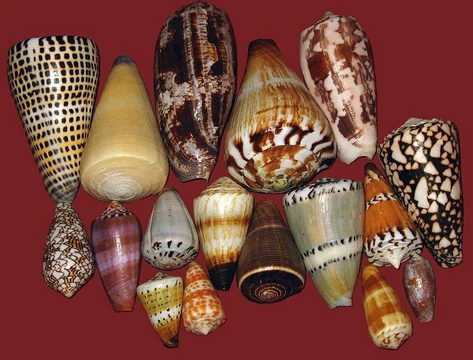
Clanculus thomasi
A marine gastropod mollusk in the family Trochidae.

Clanculus thomasi is a marine gastropod mollusk belonging to the Trochidae family, commonly known as top snails. Its shell ranges from 5 to 15 mm in size, is umbilicate, and has a conic-globose shape. The shell is marked with white blotches on a reddish carmine background. It has five convex whorls, each crossed by five finely granulose spiral ridges: the first two are small, the third is larger, the fourth is small, and the fifth is the largest. The suture is deeply impressed and channel-like. On the body whorl, eight ridges encircle the base around the umbilicus. The columella has two unequal teeth, with the basal tooth larger and flattened. The lip at the base is faintly toothed, but otherwise lacks teeth. The aperture is oblique and less gaping than in most Clanculus species; its interior is grooved and pearly. The umbilicus is white—smooth in young shells and faintly crinkled in adults. One variety is olive-green with white spots and a rosy apex; it is a small species with a prominent, compressed basal tooth, slight crinkling at the umbilicus margin, and an undented right lip. This species occurs off New Caledonia and Lord Howe Island.
Quick Facts
- Taxon
- Clanculus thomasi
Facts from the source article.
Lore & Background
The shell of Clanculus thomasi varies between 5 mm and 15 mm. It is umbilicate and conic-globose, with a white maculation on a reddish carmine ground. The five convex whorls are spirally traversed by five very finely granulose lirae: the first two small, the third larger, the fourth small, and the fifth larger than the others. The suture is profoundly impressed and canaliculate. The body whorl has eight lirae on the base encircling the umbilicus. The columella is unequally bidentate, with the basal tooth larger and compressed. The lip at the base is obsoletely denticulate, elsewhere edentulous. The oblique aperture is less ringent than most species of Clanculus, and the fauces are sulcate and nacreous. The umbilicus is white, smooth in young shells, and obsoletely crenulated in adults. A variety is olivaceous green, maculate with white, with a rosy apex; it is a small species with a very prominent, compressed basal tooth and slight crenulations at the margin of the umbilicus, the right lip not dentate.
Reader's Guide
Clanculus thomasi is known from the marine waters off New Caledonia and Lord Howe Island. The species was described in the 19th century, with references including works by Crosse (1862) and later by Salisbury (1936) and Iredale (1938). Its shell characteristics, such as the finely granulose lirae, bidentate columella, and nacreous fauces, place it within the genus Clanculus. The variety with olivaceous green coloration and rosy apex indicates intraspecific variation. The species is documented in the Journal de Conchyliologie and other malacological publications, and its type material is preserved in the collection associated with that journal. The entry in the World Register of Marine Species and other external links confirm its taxonomic standing.
Did You Know?
- The shell size varies between 5 mm and 15 mm.
- The columella is unequally bidentate, with a larger, compressed basal tooth.
More in Marine Snails, Part 3 1-24
Spotted an error? Know more?
Reader corrections go straight into our review queue. Suggest an edit · How this site is sourced