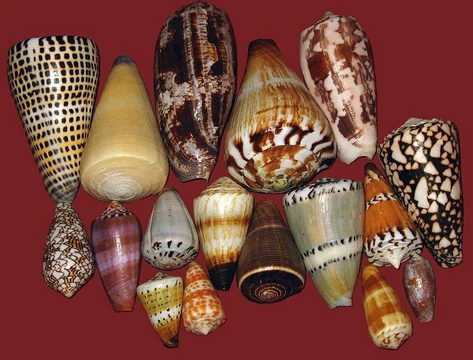
Clanculus atypicus
A small, solid, umbilicate top snail from the Kermadec Islands.

Clanculus atypicus is a marine gastropod mollusk belonging to the Trochidae family, commonly known as top snails. This sea snail is endemic to New Zealand, specifically found off the Kermadec Islands.
The shell is small, solid, and depressedly globose, with six whorls. It has a rounded periphery and a flattened base. Its color is dark greyish-brown, with oblique yellow or fawn markings. The sculpture features fine spiral threads of varying strength, with about eighteen major threads on the body whorl and only six on the preceding whorl. Very fine, closely spaced axial lines are also present. The suture is deep and channeled, bordered by a row of nodules. The aperture is oblique and subquadrate, with a slightly crenulate and recurved outer lip. The deep umbilicus is surrounded by a noduled, callused rim that extends to meet the outer lip. The columella is inserted obliquely into the umbilicus, with a small nodule at each end. The operculum is circular, horny, thin, and multispiral, with a central nucleus.
Quick Facts
- Taxon
- Clanculus atypicus
Facts from the source article.
Lore & Background
The original description of Clanculus atypicus was provided by Tom Iredale. The shell is small, solid, and umbilicate, with a depressedly globose shape and six whorls. Its periphery is rounded, and its base flattened. The colour is dark greyish-brown, painted obliquely with yellow or fawn. The sculpture consists of fine spiral threads of varying strengths, with about eighteen major ones on the body whorl and six major threads on the preceding whorl. The axial sculpture is represented by very fine close lines. The suture is deep, channelled, and bounded by a row of nodules. The aperture is oblique and subquadrate, with a slightly crenulate and recurved outer lip. The deep umbilicus is surrounded by a noduled callused rim, with the callus extending to meet the outer lip. The columella is obliquely inserted in the umbilicus, with a small nodule at each end. The operculum is circular, horny, thin, multispiral, with a central nucleus.
Reader's Guide
Clanculus atypicus is notable as a marine gastropod mollusk in the family Trochidae, described by Tom Iredale. Its significance lies in its detailed shell morphology, including the fine spiral threads, deep channelled suture, and noduled umbilicus. The species is endemic to New Zealand, specifically off the Kermadec Islands, contributing to the region's unique marine biodiversity. The original description provides a thorough account of its shell features, such as the depressedly globose shape, oblique aperture, and multispiral operculum. These characteristics help distinguish it within the genus Clanculus. The species' limited distribution and detailed anatomical description make it a point of reference for studies of Trochidae in the South Pacific. Its legacy is preserved through the original publication in the Proceedings of the Zoological Society of London and subsequent listings in the World Register of Marine Species.
Did You Know?
- The shell of Clanculus atypicus has about eighteen major spiral threads on the body whorl.
- The species was originally described by Tom Iredale.
- It is endemic to New Zealand, occurring off the Kermadec Islands.
Taxonomic Identity & Family Placement
Clanculus is a genus of marine gastropod molluscs, specifically sea snails, that falls within the family Trochidae, the group universally recognized as top shells. Every member of this genus is exclusively ocean-dwelling, with no freshwater or terrestrial representatives known. The genus is regarded as evolutionarily old, a lineage that has persisted in marine environments for a very long time. Its type species, Clanculus pharaonius, was first formally described by Carl Linnaeus in 1758, though at that time it was placed under the broader name Trochus pharaonius. That earlier taxonomic home reflects a historical convention in which many top shells were lumped together under Trochus before more careful morphological study warranted separation into distinct genera. The placement of Clanculus within Trochidae gives it a well-defined ecological and evolutionary niche, one characterized by a particular shell architecture and a remarkably broad geographic footprint that sets it apart from many of its close relatives.
Global Range & Fossil Heritage
The geographic footprint of Clanculus is strikingly extensive, with living individuals documented across Australia, New Zealand, the wider Indo-Pacific, the Philippines, Sri Lanka, the Seychelles, Japan, South Africa, Zanzibar, the Indian Ocean, the Red Sea, West Africa, Angola, North Africa, and European coastal waters. This near-cosmopolitan spread points to a high degree of ecological flexibility. Vertically, these top shells occupy a broad depth window, ranging from the intertidal zone, where they are periodically exposed to air at low tide, down to roughly 200 meters. In favorable habitats, some species form particularly dense aggregations, occurring in great numbers. The genus also carries a meaningful fossil record: specimens recovered from Italian geological strata date to the Pliocene epoch, including C. corallinus, C. elevatus, C. bonfittoi, and C. jussieui. These finds confirm that Clanculus has been a persistent and recognizable component of marine benthic communities for millions of years, long before modern taxonomy gave it a formal name.
Shell Architecture & Coloration
The shells of Clanculus species carry a distinctive and immediately recognizable architecture that sets them apart from many other top shells. They are wide-conical in overall form with a relatively low spire, producing a squat, robust silhouette rather than a tall, pointed one. The surface sculpture is perhaps the most diagnostic feature: spirally arranged ribs bear conspicuous, regular rows of robust, round beads, lending the shell a textured, almost beaded appearance to the touch. The whorls display a deep suture line, and the final whorl is notably inflated, adding fullness to the shell's profile. The aperture is oval in shape and bordered by a strongly ridged lip, while a generally deep umbilicus sits at the shell's center. In coloration, Clanculus shells range across warm, earthy tones, shifting between vivid orange, deep dark red, and rich chocolate brown. This palette, combined with the pronounced beaded sculpture, makes these top shells visually striking among marine invertebrates and relatively easy to identify in the field.
Taxonomic Turmoil & Synonymy
One of the most revealing aspects of Clanculus taxonomy is the sheer volume of synonymy that has accumulated over nearly two centuries of malacological research. Dozens of names originally assigned to what were believed to be separate species have since been collapsed into a smaller set of valid taxa. Clanculus miniatus (Anton, 1838), for instance, has absorbed multiple synonyms including C. alfredensis, C. becki, C. carinatus, C. elevatus, C. eucosmia, C. kowiensis, C. laceyi, and C. trochiformis, all later recognized as the same organism. Likewise, C. plebejus (Philippi, 1852) has claimed C. angeli, C. dominicanus, C. nodiliratus, and C. plabeius. Other names have been redirected to entirely different genera, such as C. capensis becoming Gibbula capensis or C. patagonicus becoming Tegula patagonica. This extensive reclassification underscores how difficult it is to distinguish closely related top shell species on shell morphology alone, and how the genus Clanculus has long served as a taxonomic catch-all for names that ultimately belonged elsewhere.
Gallery
Frequently Asked Questions
What is Clanculus atypicus?
Clanculus atypicus is a small, solid marine gastropod in the top snail family Trochidae. It is a deep-umbilicate species whose entire known range is limited to New Zealand waters.
Where can I find Clanculus atypicus in the wild?
This snail is endemic to New Zealand and occurs specifically off the Kermadec Islands. No populations have been recorded outside that region.
What does the shell of Clanculus atypicus look like?
The shell is small, solid, and depressedly globose with six whorls, a rounded periphery, and a flattened base. It is dark greyish-brown with oblique yellow or fawn markings, and its surface carries fine spiral threads together with very fine, closely spaced axial lines.
Who originally described Clanculus atypicus?
The species was named and described by the malacologist Tom Iredale. It is classified within the Trochidae family of top snails.
What makes Clanculus atypicus distinctive among other trochids?
Its geographically restricted range to the Kermadec Islands sets it apart from more widespread relatives. The shell sculpture is also unusual: the body whorl bears roughly eighteen major spiral threads while the preceding whorl has only six, a notable contrast within a single shell.
More in Marine Snails, Part 3 1-24
Spotted an error? Know more?
Reader corrections go straight into our review queue. Suggest an edit · How this site is sourced