Clanculus clanguloides
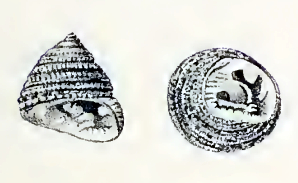
A globose-conic top snail with granose lirae and articulated dots.

Wood, 1828 · CC0
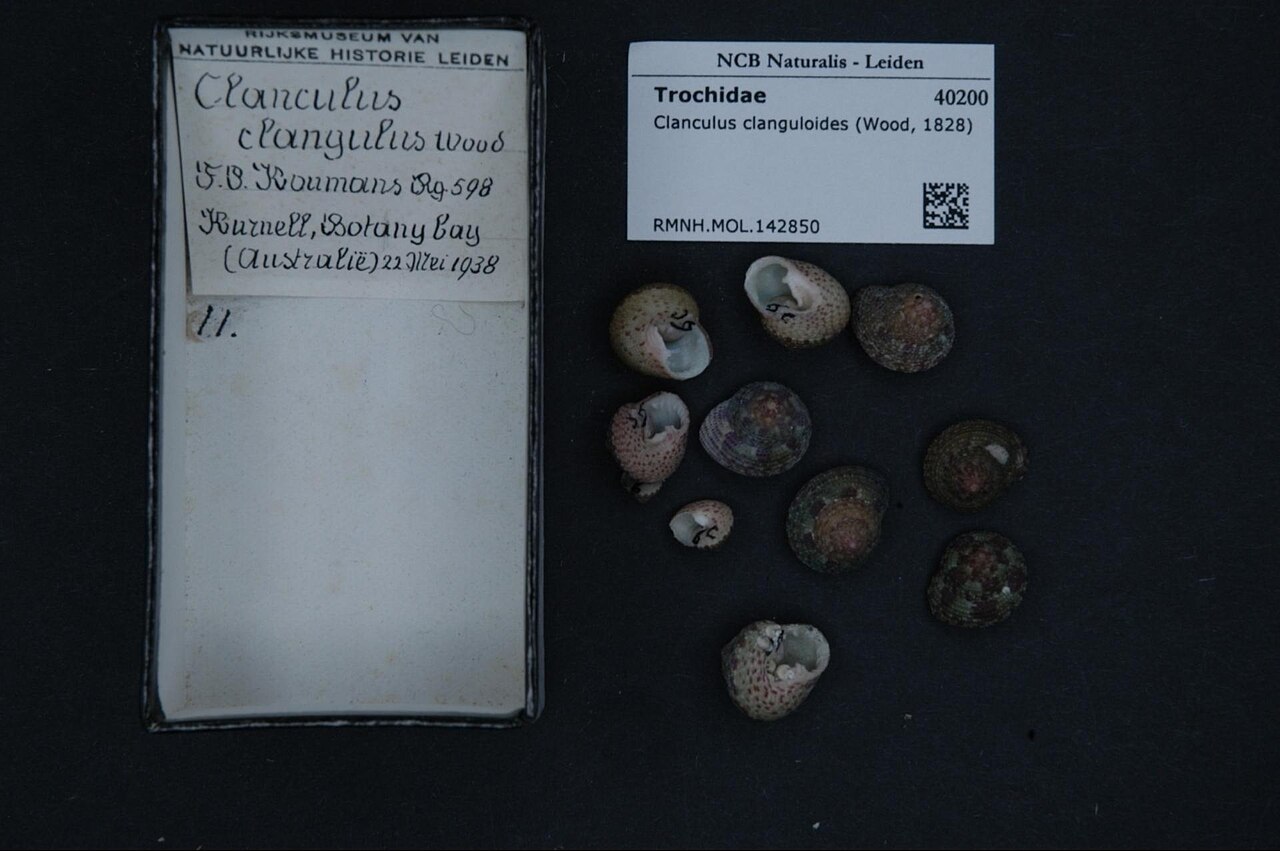
Clanculus clanguloides, known as the secret clanculus, is a marine gastropod mollusk in the family Trochidae, the top snails. Its shell, which ranges from 10 to 12 mm in height and 12 to 15 mm in diameter, is very solid, globose-conic, and has a narrow, deep false umbilicus. The shell is fawn-colored, lighter underneath, with a roseate apex, and is sharply marked with granulose spiral ribs. Typically, every second rib is dotted with white, black, or both. There are about six whorls; the upper ones are nearly flat, while the penultimate and last whorls are convex. The penultimate whorl has seven or eight distinctly granulose spiral ridges, and the last whorl has about eighteen, with the seventh usually at the periphery. Fine oblique striae fill the spaces between ribs. The body whorl is deflected forward and rounded at the periphery, and the base is somewhat convex. The oblique aperture is small and contracted. Inside, the outer lip has a strong tooth above and an inconspicuous, rather acute thread at the periphery. The basal lip is expanded, curved, and slightly toothed. The columella is very oblique, slightly twisted above, and enters deeply, ending below in a strong plicate tooth; its margin is smooth except for a small denticle just above the basal tooth. The parietal area is wrinkled, and the umbilicus has a plicate-toothed border. In the typical form, the first, third, fifth, seventh, and ninth ridges, plus one or two on the base, are dotted with black.
This marine species is found in the Central and East Indian Ocean, off East Africa, East India, Indo-China, Indo-Malaysia, and Oceania, across the tropical Indo-West Pacific, and off Queensland, Australia.
Quick Facts
- Taxon
- Clanculus clanguloides
Facts from the source article.
Lore & Background
The shell of Clanculus clanguloides is very solid, deeply and narrowly false-umbilicate, and globose-conic in shape. It is fawn colored, lighter beneath and roseate at the apex. The shell is sharply granose-lirate, usually with every second rib articulated with dots of white or black or both. It contains about 6 whorls; the upper ones are nearly flat, while the penultimate and last are convex. The penultimate whorl bears 7 or 8 spiral distinctly granose lirae, and the last whorl has about 18, of which the 7th is usually upon the periphery. The interstices are finely obliquely striate. The body whorl is deflected anteriorly and rounded at the periphery. The base is somewhat convex. The oblique aperture is small and contracted. The outer lip bears a strong tooth above and an inconspicuous acute thread at the periphery. The basal lip is expanded, curved, and slightly denticulate. The columella is very oblique, slightly tortuous above, entering deeply and terminating below in a strong plicate tooth, with a smooth margin save for a small denticle immediately above the basal tooth. The parietal tract is wrinkled. The umbilicus has a plicate-denticulate border. In the typical form, the 1st, 3rd, 5th, 7th, and 9th lirae, and one or two upon the base, are articulated with black.
Reader's Guide
Clanculus clanguloides is a well-documented species within the Trochidae family, first described by Wood in 1828. Its shell morphology—particularly the granose lirae, articulated color dots, and the distinctive columellar tooth—has been consistently noted in subsequent works by Philippi (1845), Angas (1867), Fischer (1878, 1879), Hedley (1918), Satyamurti (1952), Hinton (1978), Rajagopal & Mookherjee (1978), Kay (1979), Wilson (1993), and Jansen (1995). The species is recorded from a broad geographic range spanning the Central and East Indian Ocean, East Africa, East India, Indo-China, Indo-Malaysia, Oceania, the tropical Indo-West Pacific, and Queensland, Australia. Its presence in multiple regional faunal checklists and shell guides underscores its significance as a representative trochid of the Indo-Pacific. The detailed description of its shell sculpture and color pattern, including the typical black-articulated lirae, provides a reliable basis for identification. The species has been cataloged in major malacological references and remains a subject of study in regional marine biodiversity surveys.
Did You Know?
- The shell height varies between 10 mm and 12 mm, and its diameter between 12 mm and 15 mm.
- This species occurs off Queensland, Australia, and across the tropical Indo-West Pacific.
Shell Architecture & Morphological Detail
The secret clanculus produces a remarkably compact and robust shell, measuring between 10 and 12 millimeters in height and 12 to 15 millimeters in diameter. Its overall form is globose-conic, with a deep, narrow false umbilicus that gives the base a slightly convex profile. The coloration is predominantly fawn, fading to a paler tone on the underside while the apex takes on a rosy hue. The surface texture is sharply granose-lirate, and in the typical form, the first, third, fifth, seventh, and ninth spiral ribs—along with one or two on the base—are articulated with black dots, sometimes accompanied by white. The shell carries roughly six whorls: the upper ones sit nearly flat, while the penultimate and final whorls are distinctly convex. The body whorl deflects forward and rounds out at the periphery. The aperture is small, oblique, and contracted, with a strong tooth on the outer lip, an expanded and slightly denticulate basal lip, and a deeply entering, very oblique columella that terminates in a powerful plicate tooth. The parietal tract is wrinkled, and the umbilicus is bordered by a plicate-denticulate edge.
Geographic Range Across the Indo-Pacific
The secret clanculus is a marine species whose documented range spans the Central and East Indian Ocean, the tropical Indo-West Pacific, and surrounding coastal waters. Its distribution extends off East Africa, along East India, through Indo-China and Indo-Malaysia, and into Oceania, including the waters off Queensland, Australia. The species has been specifically recorded in the Palk Strait and Gulf of Mannar off the Coromandel Coast, in the waters around Krusadai Island, in Port Jackson harbour and adjacent New South Wales coasts, and in Hawaiian reef and shore habitats. This consistently tropical, Indo-Pacific distribution—stretching from the eastern coast of Africa to Pacific island waters—reflects the species' presence across warm marine environments throughout this vast region. The breadth of its range, encompassing multiple national coastlines and island groups, indicates that the secret clanculus is a broadly distributed component of tropical Indo-Pacific molluscan fauna, encountered along both continental coasts and island shores throughout the region.
Taxonomic Placement & Nomenclature
The secret clanculus is a species of sea snail belonging to the class of marine gastropod mollusks. It is classified within the family Trochidae, commonly known as the top snails, and placed in the genus Clanculus, which was originally described by Montfort in 1810. The specific epithet clanguloides and the common name secret clanculus distinguish it among its relatives. As a member of Trochidae, it shares the characteristic solid shell architecture typical of the family, though its particular combination of granose-lirate sculpture, false umbilicus, and the specific arrangement of denticulate and plicate features on the aperture set it apart from congeners. The genus Clanculus itself has been the subject of taxonomic review, with Jansen in 1995 conducting a comprehensive reassessment of the genus in Australian waters, describing a new subspecies and introducing a nomen novum, which reflects the ongoing refinement of classification within this group. The species' placement in the broader Linnean system was catalogued as early as Wood's 1828 Index Testaceologicus, establishing its formal recognition in conchological literature over two centuries ago.
A Long History of Conchological Study
The scientific documentation of Clanculus clanguloides stretches back nearly two centuries, reflecting sustained interest from conchologists across multiple nations and decades. Wood's 1828 Index Testaceologicus provided one of the earliest formal catalog entries, arranging the shell within the Linnean system. Philippi followed in 1845 with illustrations and descriptions of new or little-known conch species. In the latter half of the nineteenth century, Angas in 1867 recorded the species in Port Jackson harbour and adjacent New South Wales coasts, while Fischer contributed two significant works in 1878 and 1879, the latter appearing in the monumental Spécies général et iconographie des coquilles vivantes. The twentieth century brought further regional studies: Hedley's 1918 checklist of New South Wales marine fauna, Satyamurti's 1952 monograph on the molluscs of Krusadai Island, and the 1978 contributions by Hinton on Australian shells and by Rajagopal and Mookherjee on the Coromandel Coast and Palk Strait. Kay's 1979 Hawaiian volume and Wilson's 1993 Australian prosobranch gastropod guide extended the record further, culminating in Jansen's 1995 taxonomic review of the genus in Australia.
Gallery
Frequently Asked Questions
What is Clanculus clanguloides?
Clanculus clanguloides, nicknamed the 'secret clanculus,' is a small marine top snail belonging to the family Trochidae. It is a solid, globose-conic gastropod found across tropical Indo-West Pacific waters.
What does a Clanculus clanguloides shell look like?
The shell is fawn-colored with a roseate apex and a lighter underside, measuring roughly 10–12 mm tall and 12–15 mm across. It features about six whorls, granulose spiral ribs, and a narrow, deep false umbilicus, with every second rib dotted in white, black, or both.
Where can you find Clanculus clanguloides in the wild?
This species ranges across the Central and East Indian Ocean, occurring off East Africa, East India, Indo-China, Indo-Malaysia, and Oceania. It is also recorded off Queensland, Australia, within the broader tropical Indo-West Pacific region.
What makes Clanculus clanguloides stand out among other top snails?
Its most eye-catching trait is the pattern of articulated dots—white, black, or a mix—punctuating every second spiral rib. Combined with the roseate apex and the deep false umbilicus, these features give it a distinctive, jewel-like appearance that collectors and malacologists readily recognize.
How many whorls does Clanculus clanguloides have, and how are they shaped?
The shell typically bears about six whorls, with the upper ones sitting nearly flat. The penultimate whorl carries seven or eight spiral lirae and is convex, while the last whorl swells further and displays roughly eighteen spiral lirae.
More in Marine Snails, Part 3 1-24
Spotted an error? Know more?
Reader corrections go straight into our review queue. Suggest an edit · How this site is sourced