Clanculus brunneus
A dark brown top snail endemic to New South Wales.

Jan Delsing · Public domain
Clanculus brunneus is a marine gastropod mollusk belonging to the Trochidae family, commonly known as top snails. This sea snail is endemic to Australia, specifically found off the coast of New South Wales.
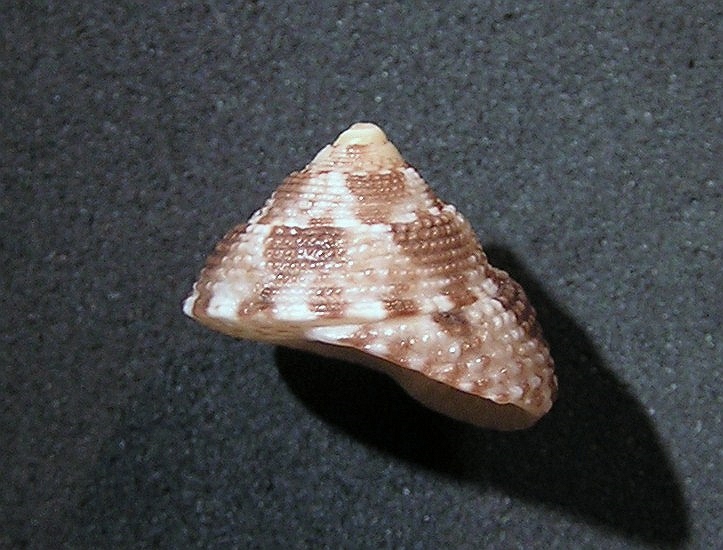
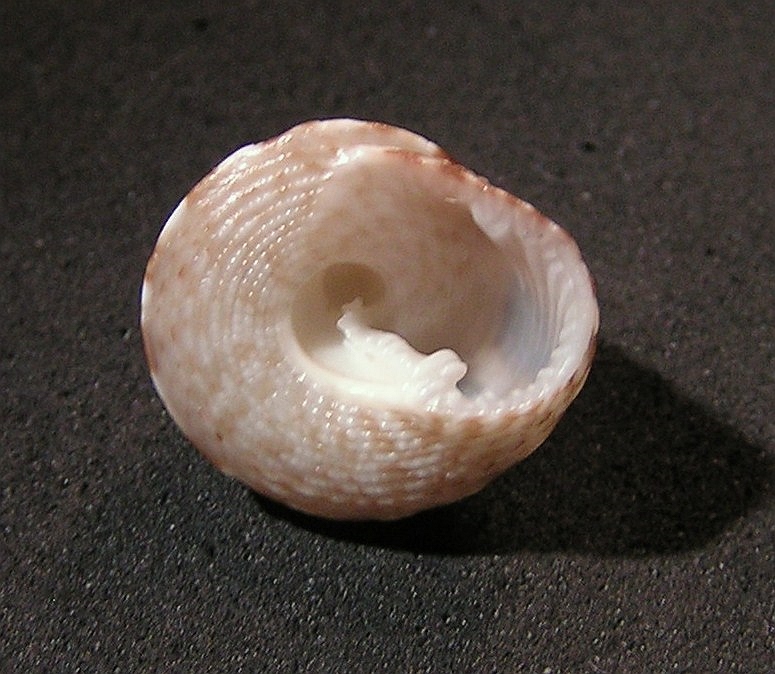
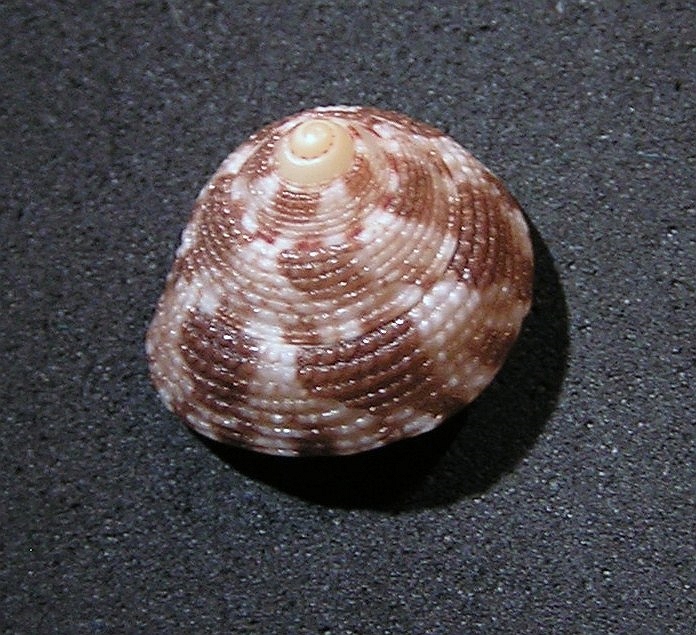
The shell, which ranges from 13 to 15 mm in size, has a depressed-conic shape. It is dark brown and decorated with colored bands featuring granules. The spaces between these bands are raised lengthwise. The whorls are flat, with the final whorl sharply angled. The umbilicus has a flat edge, while the columella is slanted crosswise and ends in a tooth with two folds, its margin appearing tasseled. The inner lip displays fine, raised lines, the last of which is the largest.
Quick Facts
- Taxon
- Clanculus brunneus
Facts from the source article.
Lore & Background
The shell of Clanculus brunneus varies between 13 mm and 15 mm and has a depressed-conic shape. It is dark brown, adorned with colored bands with granules, and the interstices are longitudinally elevated. The whorls are flat, with the last one sharply angulate. The umbilicus has a flat margin, and the columella is transversely oblique with a tasseled margin, terminating in a biplicate tooth. The inner lip shows fine linear elevations, with the last lira the largest.
This marine species is endemic to Australia and occurs off New South Wales. The species was described in the mid-19th century, with references including works by Adams (1853) and Angas (1867), among others. It is part of the genus Clanculus within the family Trochidae.
Reader's Guide
Clanculus brunneus is a species of sea snail in the family Trochidae, known as top snails. Its significance lies in its restricted distribution, being endemic to Australia and occurring only off New South Wales. The species has been documented in multiple scientific works from the 19th and 20th centuries, including contributions by Adams, Angas, Iredale, and Wilson, indicating sustained interest in its taxonomy and occurrence. The shell's distinctive features—depressed-conic shape, dark brown color with colored bands and granules, sharply angulate last whorl, and biplicate tooth on the columella—aid in identification. The species is listed in reference works such as Wilson's 'Australian Marine Shells' (1993) and Jansen's review of the genus Clanculus (1995). Its legacy is as a well-characterized member of the Australian trochid fauna, with a clear morphological description and a known geographic range.
Taxonomic Identity and Classification
Clanculus brunneus belongs to the class of marine gastropod mollusks, specifically within the family Trochidae, commonly known as top snails. This places it among a well-studied group of sea snails that have attracted extensive malacological research since the early nineteenth century. The genus Clanculus itself was established by Montfort in 1810, and the species epithet brunneus reflects its characteristic dark brown coloration. As a member of Trochidae, this snail shares the broader morphological and ecological traits of its family, which are defined by their distinctive shell architecture. The species was formally described in the mid-nineteenth century, with early taxonomic work by Adams in 1853 contributing to the monographic understanding of the Trochidae. Its classification within the prosobranch gastropods situates it among the more ancient lineages of marine snails, and its placement in the genus Clanculus was later reviewed by Jansen in 1995, who examined the Australian representatives of this group and introduced a nomen novum alongside describing a new subspecies.
Shell Morphology and Physical Characteristics
The shell of Clanculus brunneus measures between 13 and 15 millimeters in size, giving it a modest but distinctive profile among its trochid relatives. Its overall form is depressed-conic, lending a low, spreading silhouette to the whorls. The surface presents a dark brown ground color, broken up by colored bands that carry small granules along their length. Between these bands, the interstices are raised in a longitudinal direction, adding texture to the shell's appearance. The individual whorls sit relatively flat, while the final whorl stands out with a sharply angulate profile. At the base, the umbilicus is bordered by a flat margin, and the columella presents a transversely oblique orientation with a tasseled edge. The columella terminates in a biplicate tooth, a small but diagnostically important feature. The inner lip reveals fine linear elevations running along its surface, with the last lira being the most prominent of the series.
Geographic Range and Endemism
Clanculus brunneus is a marine species found exclusively in Australian waters, making it a true endemic of that region. Its known range is restricted to the coastal waters off New South Wales, a state on the southeastern coast of the continent. This limited distribution means the species cannot be found in any other part of the world's oceans, distinguishing it from more cosmopolitan trochid species. The New South Wales coastline, with its varied estuaries, harbors, and open bays, provides the marine habitat in which this snail has been recorded. Early collectors working in Port Jackson harbor and along adjacent coasts documented the species as part of broader surveys of local marine molluscan fauna. The restricted geographic scope of Clanculus brunneus underscores the importance of Australian coastal ecosystems as nurseries for unique marine biodiversity, and it highlights how even small, inconspicuous sea snails can serve as indicators of regional evolutionary isolation.
A Long History of Scientific Documentation
The scientific record for Clanculus brunneus stretches back to the mid-nineteenth century, reflecting sustained interest in Australian marine mollusks over more than a century. Adams's 1853 monographic contribution to the Trochidae laid early groundwork, followed by the comprehensive genus-level work by Adams and Adams in 1854. By the 1860s and 1870s, naturalists such as Angas, Tapparone-Canefri, and Fischer had incorporated the species into regional faunal lists and broader taxonomic treatments. The 1880s brought further attention through Watson's Challenger expedition report and contributions by Brazier and Whitelegge, who catalogued mollusks from Sydney's harbors. The early twentieth century saw Iredale and Hedley produce authoritative checklists of New South Wales marine fauna, while Iredale's 1924 work on Roy Bell's collections added new observations. The most recent major taxonomic treatment came from Jansen in 1995, who reviewed the entire genus Clanculus in Australia, described a new subspecies, and introduced a nomen novum, ensuring the species' classification remained current.
Gallery
Frequently Asked Questions
What is Clanculus brunneus?
Clanculus brunneus is a small marine gastropod mollusk, essentially a sea snail, that belongs to the Trochidae family of top snails. It is a species restricted entirely to Australian waters.
Where can Clanculus brunneus be found?
This snail is endemic to Australia, occurring specifically along the coast of New South Wales. It has no known populations anywhere else in the world.
What does the shell of Clanculus brunneus look like?
The shell is dark brown with a depressed-conic profile, decorated with colored bands that carry small granules. The whorls sit flat, the final whorl comes to a sharp angle, and the umbilicus has a distinctly flat edge.
How large does Clanculus brunneus grow?
The shell measures between 13 and 15 millimeters in length, making it a fairly small top snail.
What makes Clanculus brunneus's columella distinctive?
The columella is slanted crosswise and terminates in a small tooth bearing two folds. This structure, along with the shell's overall dark brown banded pattern, helps separate it from other Trochidae members in the region.
More in Marine Snails, Part 3 1-24
Spotted an error? Know more?
Reader corrections go straight into our review queue. Suggest an edit · How this site is sourced