Clanculus albanyensis
A marine snail endemic to southern Australia.

Clanculus albanyensis, called the yellow top shell, is a marine gastropod mollusk in the family Trochidae. Endemic to Australia, it is found off South Australia, Tasmania, Victoria, and Western Australia.
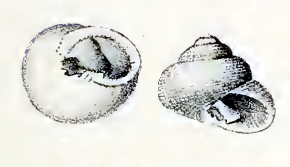
The shell reaches 12 mm in height and is conoidal with an umbilicus. Its isabella color is marked by very fine spiral lirae—about 11 on the penultimate whorl and 40 on the last. On the upper whorls these lirae are distinctly granulose, but on the last whorl they are almost entirely smooth. The shell has six to seven rather rounded whorls with a convex base; the last whorl is scarcely angled. The narrow umbilicus has a dentate margin. The columella is very oblique, not solute above, and ends below in a simple, small denticle. Inside, the outer lip is thickened with five folds, and near the edge it bears numerous wrinkles.
Quick Facts
- Taxon
- Clanculus albanyensis
Facts from the source article.
Lore & Background
The shell of Clanculus albanyensis is umbilicate and conoidal in shape, reaching a height of 12 mm. Its isabella-colored surface is sculptured with very fine spiral lirae—about 11 on the penultimate whorl and 40 on the last whorl. On the upper whorls these lirae are distinctly granulose, but on the last whorl they become almost entirely smooth. The shell has 6 to 7 rather rounded whorls with a convex base, the last whorl scarcely angled. The narrow umbilicus has a dentate margin. The columella is very oblique, not solute above, and terminates below in a simple, small denticle. The outer lip is thickened within with five folds and near the edge with numerous wrinkles.
Reader's Guide
Clanculus albanyensis is documented in several regional works on Australian marine shells, including catalogs of Victorian and Tasmanian mollusks and a handbook of South Australian Archaeogastropoda. The species was originally described by Philippi in the mid-19th century as part of the Trochidae family. Its distribution is limited to Australian waters, specifically off South Australia, Tasmania, Victoria, and Western Australia. The species is referenced in later checklists and reviews, such as Jansen's 1995 review of the genus Clanculus in Australia. The shell's fine spiral sculpture and dentate umbilicus are characteristic features noted in the literature. No further details on its ecology or conservation status are provided in the source article.
Did You Know?
- The shell height of Clanculus albanyensis attains 12 mm.
- The shell has about 11 spiral lirae on the penultimate whorl and 40 on the last whorl.
- This species is endemic to Australia, occurring off South Australia, Tasmania, Victoria, and Western Australia.
Taxonomic Identity and Naming History
Clanculus albanyensis is a species of marine gastropod mollusc belonging to the family Trochidae, commonly known as top shells. It was formally described by Jansen in 1995, though the organism had been recognized earlier under a different name. In fact, the name Clanculus ochroleucus, originally proposed by Philippi in 1853, is now treated as a synonym of albanyensis, meaning that for over a century the species circulated in the literature under that older designation before Jansen's work consolidated its identity. This taxonomic journey is characteristic of the genus Clanculus as a whole, which carries an extensive synonymy record stretching back to the late eighteenth century. The type species of the genus, Clanculus pharaonius, was named by Carl Linnaeus in 1758 under the older genus name Trochus, illustrating how much nomenclatural reshaping has occurred since the foundational era of modern taxonomy. For collectors and researchers, albanyensis represents one thread in a long and tangled web of names that have been applied to closely related top shells across the world's oceans.
Shell Morphology and Appearance
The shell of Clanculus albanyensis follows the characteristic architecture shared across the genus. It is wide-conical in overall shape with a low spire, giving the whorls a broad, squat profile rather than a tall, pointed one. The surface sculpture is immediately striking: spirally arranged rows of robust, rounded beads create a textured, almost beaded appearance that distinguishes these top shells from smoother relatives. Each whorl is separated by a deep suture, and the final whorl is noticeably inflated, adding volume to the shell's lower portion. The aperture, or opening, is oval in shape and framed by a strongly ridged lip, while the umbilicus at the base is generally deep. In terms of coloration, shells across the genus range from warm orange through dark red to a rich chocolate brown, suggesting that albanyensis likely displays one or more of these warm, earthy tones. Together these features—beaded sculpture, inflated whorl, ridged aperture, and deep umbilicus—produce a shell that is both structurally distinctive and visually warm.
Distribution and Habitat Range
Members of the genus Clanculus enjoy a genuinely worldwide distribution, and albanyensis is part of this broadly scattered group. Individuals of various species are found from the intertidal zone, where waves break on rocky shores, down to depths of approximately two hundred metres in deeper marine environments. The geographic footprint is extensive: species within the genus have been recorded along the coasts of Australia, New Zealand, the broader Indo-Pacific region, the Philippines, Sri Lanka, the Seychelles, Japan, South Africa, Zanzibar, the Indian Ocean, the Red Sea, West Africa, Angola, North Africa, and even European waters. In certain localities, populations of particular species can be remarkably abundant, with individuals occurring in great numbers. This wide-ranging presence, spanning tropical, subtropical, and temperate zones across multiple ocean basins, underscores the ecological versatility of the genus. For albanyensis specifically, its placement within this globally distributed clade suggests it occupies a marine habitat within one of these broad regions, contributing to the rich diversity of top shells that characterize the world's coastal and subtidal communities.
Evolutionary Depth and Genus Heritage
The genus Clanculus is an ancient lineage, with a fossil record that reaches back to the Pliocene epoch. Remains of several species—C. corallinus, C. elevatus, C. bonfittoi, and C. jussieui—have been recovered from Italian deposits of that age, demonstrating that the basic body plan of these beaded top shells was already well established millions of years ago. The genus name itself has a long taxonomic pedigree: its type species, Clanculus pharaonius, was originally described by Carl Linnaeus in 1758 under the genus Trochus, a classification that has since been revised. Over the following two and a half centuries, numerous species were described, reclassified, and synonymized, producing one of the more complex naming histories in malacology. The synonymy list for the genus runs to dozens of entries, with names proposed by authors such as Philippi, A. Adams, Gould, Pilsbry, Turton, and many others between the 1840s and the 1990s. Clanculus albanyensis, described by Jansen in 1995 and absorbing the earlier name ochroleucus from 1853, sits at the modern end of this long evolutionary and taxonomic narrative, a living representative of a lineage whose skeleton has been preserved in stone for tens of millions of years.
Gallery
Frequently Asked Questions
What is Clanculus albanyensis?
Clanculus albanyensis, commonly called the yellow top shell, is a small marine gastropod in the family Trochidae. It is a species found only in Australian waters.
Where can you find Clanculus albanyensis in the wild?
The species is endemic to southern Australia, with occurrences documented along the coasts of South Australia, Tasmania, Victoria, and Western Australia.
How large is a Clanculus albanyensis shell?
The shell reaches a maximum height of about 12 mm and is built from six to seven fairly rounded whorls that sit on a convex base.
What does the Clanculus albanyensis shell look like?
It has an isabella-colored, conoidal form with a visible umbilicus, and its surface carries very fine spiral lirae—roughly 11 on the penultimate whorl and around 40 on the final one. The lirae on upper whorls are distinctly granulose, whereas those on the last whorl are almost entirely smooth.
What makes Clanculus albanyensis distinctive among top shells?
Its open umbilicus, the clear textural shift from granulose to smooth spiral lirae between whorls, and its restriction to southern Australian coastlines together set it apart within the Trochidae.
More in Marine Snails, Part 3 1-24
Spotted an error? Know more?
Reader corrections go straight into our review queue. Suggest an edit · How this site is sourced