Clanculus albugo
A marine snail endemic to New South Wales, Australia.

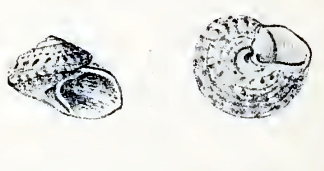
Clanculus albugo is a marine gastropod mollusk belonging to the Trochidae family, commonly known as top snails. Its small shell is conical with a swollen base, featuring a blunt double keel and a visible umbilicus, and has a resinous sheen. The surface is covered in many irregular, faint oblique growth lines and a few widely spaced rounded spirals; these spirals are very weak on the upper part, stronger on the base, and two at the periphery form a faint double ridge. The shell’s color is a pale, translucent resinous brown, marked below the sutures and at the periphery with alternating white and crimson spots. The crimson color also appears as tiny zigzag streaks running down the shell, and both the upper surface and the base have delicate spiral lines of alternating crimson and white specks. The spire is relatively low, with curved outlines and a blunt, rounded tip. The five whorls are rounded and slope above, become flat at the periphery, and are swollen on the base. The suture is linear and slightly indented. The aperture is round and fairly large, with a thin outer lip and a thin inner lip that curves backward and partly crosses the umbilicus. The umbilicus itself is a broad, shallow funnel that narrows into a small, deep hole. This species is endemic to Australia, found only in marine waters off New South Wales.
Quick Facts
- Taxon
- Clanculus albugo
Facts from the source article.
Lore & Background
The shell of Clanculus albugo is small and conoidal with a tumid conical base, bluntly bicarinate and umbilicate, exhibiting a resinous luster. Its sculpture features very many irregular oblique faint lines of growth, with a few remote rounded spirals that are weak above and stronger on the base; two at the periphery form a feeble double carina. The color is a pale transparent resinous brown, flecked below the sutures and at the periphery with alternate spots of white and crimson, with the crimson running in minute zigzag streaks down the shell. Delicate spirals of alternate crimson and white specks appear both above and on the base.
The spire is rather low with curved profile lines and a blunt round apex. The five whorls are rounded and sloping above, flat at the periphery, and tumid on the base. The suture is linear and very slightly depressed. The round aperture is rather large, with a thin outer lip and a thin inner lip that is hollowed out backwards and bends somewhat across the umbilicus. The umbilicus is a broad shallow funnel, contracting to a small deep hole.
This marine species is endemic to Australia and occurs off New South Wales, as documented in references including Watson's 1880 report on Mollusca of the H.M.S. Challenger expedition and subsequent checklists by Hedley, Thornley, and others.
Reader's Guide
Clanculus albugo is a species of sea snail in the family Trochidae, documented primarily through historical expeditions and regional checklists. Its description, based on shell morphology, was published in Watson's 1880 report on the H.M.S. Challenger expedition, and its distribution off New South Wales has been confirmed in subsequent works by Whitelegge, Hedley, Thornley, Garrard, and Iredale & McMichael. The species is notable for its distinctive shell features—a bluntly bicarinate, umbilicate form with a resinous luster and a color pattern of pale brown with white and crimson spots and zigzag streaks. These characteristics help distinguish it within the Trochidae family. The species' significance lies in its contribution to the understanding of marine gastropod diversity in Australian waters, particularly off New South Wales, and its inclusion in foundational malacological surveys. Its legacy is preserved in museum collections and taxonomic references, serving as a record of the region's marine biodiversity.
Did You Know?
- The shell has a resinous luster and is bluntly bicarinate and umbilicate.
- Its color includes alternate spots of white and crimson at the periphery and below the sutures.
- The umbilicus is a broad shallow funnel that contracts to a small deep hole.
Taxonomic Identity & Family Placement
Clanculus albugo belongs to the group of marine gastropod mollusks commonly known as sea snails. Within the broader taxonomy of these shelled invertebrates, it is placed in the family Trochidae, a lineage that encompasses what shell collectors and malacologists refer to as top snails. This family grouping reflects shared structural and ecological traits among its members, distinguishing them from other gastropod families. As a species, Clanculus albugo represents one particular evolutionary branch within this trochid assemblage, carrying its own distinct morphological signature. Its classification as a marine organism underscores its exclusive association with saltwater habitats, setting it apart from freshwater or terrestrial snail relatives. The specific epithet albugo, combined with the genus name Clanculus, provides a unique binomial identifier that separates this species from its trochid cousins. Though the family Trochidae is globally distributed and species-rich, Clanculus albugo occupies a narrow ecological and geographic niche, a fact that becomes especially apparent when one examines its restricted range along the Australian coastline.
Shell Architecture & Structural Design
The shell of Clanculus albugo is a compact, conoidal structure built upon a swollen conical base. Its overall form is described as bluntly bicarinate, meaning two faint ridges run along its profile, and it possesses an umbilicus at the base. The surface carries a resinous luster that gives it a distinctive sheen. Sculpturally, the shell is marked by numerous irregular, oblique, and faint growth lines, interspersed with a small number of widely spaced rounded spiral ridges. These spirals are notably weak on the upper portion but become more pronounced toward the base, where two of them near the periphery combine to form a delicate double carina. The spire is relatively low, with gently curved profile lines culminating in a blunt, rounded apex. Five whorls make up the shell, each rounded in cross-section, sloping on the upper surface, flattening at the periphery, and swelling on the base. The suture between whorls is linear and only slightly indented. The aperture is round and comparatively large, bordered by a thin outer lip. The inner lip is likewise thin, hollowed backward, and curves somewhat across the umbilicus, which itself takes the form of a broad, shallow funnel narrowing to a small, deep pit.
Coloration & Surface Ornamentation
The coloration of Clanculus albugo is among its most striking features. The base tone is a pale, transparent resinous brown that permeates the shell and gives it a warm, amber-like quality. Below the sutures, this brown ground is broken up by small flecks, adding texture to the surface. At the periphery, the decoration becomes more vivid: alternate spots of white and crimson are arranged in a patterned sequence. The crimson pigment does not remain confined to discrete dots; instead, it extends downward along the shell in minute zigzag streaks, creating a dynamic, almost electric visual effect. Above the main body and on the base as well, a few delicate spiral rows of alternating crimson and white specks can be observed, lending a subtle repeating motif to the overall design. The interplay of the translucent brown ground with the punctuated white and crimson markings gives the shell a layered, jewel-like appearance. The resinous luster noted in its structural description further enhances these colors, catching light in a way that makes the speckling and streaking appear to shift and shimmer. This combination of warm transparency, bold accent colors, and fine linear detail distinguishes Clanculus albugo visually from many of its trochid relatives.
Geographic Range & Historical Documentation
Clanculus albugo is a marine species found exclusively in Australian waters, specifically occurring off the coast of New South Wales. Its endemism to this region means it has no known populations elsewhere in the world's oceans, making it a component of Australia's unique marine biodiversity. The scientific record of this species stretches back to the late nineteenth century. Watson's 1880 publication, documenting mollusks collected during the H.M.S. Challenger expedition, represents one of the earliest formal descriptions. Whitelegge followed in 1889 with a faunal list focused on Port Jackson and its surrounding waters. Hedley's 1918 checklist of New South Wales marine fauna further cemented the species' place in regional inventories. Thornley's 1951 account of shell collecting along the north coast of New South Wales and Garrard's 1961 review of Challenger collections off the Australian east coast continued the thread of documentation. Iredale and McMichael's 1962 reference list of marine molluscs for New South Wales provided a comprehensive taxonomic framework. Together, these publications span over eight decades of malacological inquiry, reflecting sustained scientific interest in the region's marine invertebrate fauna.
Gallery
Frequently Asked Questions
What is Clanculus albugo?
Clanculus albugo is a small marine gastropod mollusk placed in the Trochidae family, the group commonly referred to as top snails. It is a species native to Australian coastal waters.
Where is Clanculus albugo found?
This snail is endemic to Australia and is recorded from the waters off New South Wales. It has not been documented in any other region.
What does a Clanculus albugo shell look like?
The shell is small and conoidal with a swollen conical base, finished in a pale, translucent resinous brown. Below the sutures and along the periphery it is dotted with alternating flecks of white and crimson.
How many whorls does Clanculus albugo have?
The shell comprises five whorls. It also displays a blunt double keel and a visible umbilicus, both of which help distinguish it from similar trochids.
What makes the surface texture of Clanculus albugo distinctive?
The shell carries many irregular, faint oblique growth lines together with a few widely spaced rounded spiral ridges. Those spirals are very weak on the upper whorls, grow stronger toward the base, and two of them at the periphery form a faint double ridge.
More in Marine Snails, Part 3 1-24
Spotted an error? Know more?
Reader corrections go straight into our review queue. Suggest an edit · How this site is sourced