Clanculus clangulus
A marine snail with emerald green shell and crimson markings.

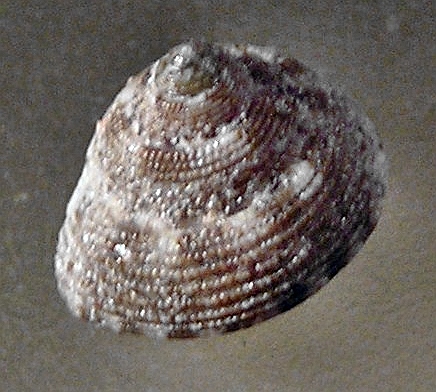
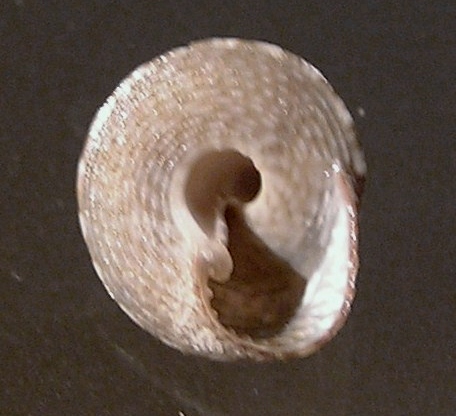
Clanculus clangulus is a marine gastropod mollusk in the family Trochidae, commonly known as a top snail. Its conical shell, which ranges from 10 mm to 13 mm in size, has a noticeably taller spire than that of *Clanculus floridus*. The shell is somewhat keeled, nearly rounded at the edge, and has a deep umbilicus. Its color is either brownish or, more often, a bright emerald green that is much paler on the underside. The upper surface is marked with broad, radiating crimson streaks that stop at the periphery; the periphery and base are dotted with the same shade. The spire usually narrows toward a sharp, rose-colored tip. There are about six convex whorls, with the last one bending forward. These whorls are spirally sculpted with roughly 18 closely spaced, beaded ridges, of which five to eight main ones sit above the periphery. Between these ridges are fine, beaded riblets and sharp, slanting grooves. In older individuals, the difference in size between the ridges on the upper surface often becomes barely noticeable. The base of the shell has much finer, tighter, beaded ridges. The aperture is very slanted and roughly four-sided, with the outer lip pleated inside. The tooth near the upper corner is only slightly developed. Other details of the aperture and umbilicus match those of *Clanculus personatus*, except that the parietal area is almost smooth. This species is endemic to Australia, found off the coasts of New South Wales and Queensland.
Quick Facts
- Taxon
- Clanculus clangulus
Facts from the source article.
Lore & Background
The shell of Clanculus clangulus has a conical shape with a decidedly higher spire generally than Clanculus floridus. It is subcarinate, nearly rounded at the periphery, and very deeply umbilicated. Its color is brownish, or more frequently a beautiful emerald green, much paler below. The upper surface is broadly radiately maculate with crimson, the flames not extending below the periphery, which, with the base, is dotted with the same shade. The spire is usually attenuated toward the acute rose-colored apex. The about 6 whorls are convex, the last one deflected anteriorly. They are spirally sculptured with about 18 closely granose cinguli, of which 5 to 8 principal ones are above the periphery. Their interstices bear granose riblets, and sharp oblique striae. On old individuals the disparity in the size of the lirae of the upper surface is often scarcely apparent. The base of the shell bears much finer, closer, granulose lirae. The aperture is very oblique and has a subquadrangular form. The outer lip is plicate within. The tooth near the superior angle is slightly developed. Other details of aperture and umbilicus are the same as in Clanculus personatus, save that the parietal area is scarcely wrinkled.
Reader's Guide
Clanculus clangulus is a marine species endemic to Australia, occurring off New South Wales and Queensland. Its description, based on the source article, emphasizes the shell's conical shape, deep umbilicus, and distinctive coloration—brownish or emerald green with crimson flames on the upper surface. The shell size ranges from 10 mm to 13 mm, with about 6 convex whorls and spiral sculpture of granose cinguli. The species is compared to Clanculus floridus (higher spire) and Clanculus personatus (similar aperture and umbilicus details, except parietal area). The article lists numerous references from the 19th and 20th centuries, including works by Wood (1828), Philippi (1852), Angas (1867), and Wilson (1993), indicating a long history of study. No further information on behavior, habitat depth, or conservation status is provided in the source. The species is part of the Trochidae family, commonly known as top snails.
Did You Know?
- The shell size of Clanculus clangulus varies between 10 mm and 13 mm.
- Its color is described as brownish or a beautiful emerald green, with crimson flames on the upper surface.
- The species is endemic to Australia, found off New South Wales and Queensland.
- The spire is usually attenuated toward an acute rose-colored apex.
Taxonomic Identity & Family Placement
Clanculus belongs to the family Trochidae, the top shells, and represents a genus of marine gastropod molluscs — sea snails that inhabit ocean environments. The genus was formally anchored by its type species, Clanculus pharaonius, which Carl Linnaeus originally described back in 1758 under the name Trochus pharaonius. This early placement within the broader Trochus group reflects how taxonomists of that era organized shell morphology before the finer subdivisions of the family were fully worked out. Over time, the genus Clanculus was carved out as a distinct grouping within Trochidae, setting it apart from related top shells through a combination of shell shape, sculpture, and aperture characteristics. The genus name itself signals its membership among the top shells, a family that includes some of the most recognizable and colorful marine snails found in tropical and temperate waters worldwide.
Global Range & Fossil Heritage
Clanculus is a remarkably ancient and cosmopolitan genus. Fossil specimens recovered from Italian strata push its lineage back to the Pliocene epoch, with species such as C. corallinus, C. elevatus, C. bonfittoi, and C. jussieui preserved in those deposits. Living representatives, however, enjoy a truly worldwide distribution, ranging from the intertidal zone down to depths of approximately 200 metres. Some species occur in such large aggregations that they become conspicuous features of their local seafloor. The geographic spread is extensive: individuals have been recorded along the coasts of Australia, New Zealand, the broader Indo-Pacific region, the Philippines, Sri Lanka, the Seychelles, Japan, South Africa, Zanzibar, the Indian Ocean, the Red Sea, West Africa, Angola, North Africa, and even parts of Europe. This breadth of occurrence, combined with the Pliocene fossil record, underscores the genus's long evolutionary persistence and its adaptability to a wide range of marine environments across multiple ocean basins.
Shell Architecture & Coloration
The shells of Clanculus species display a distinctive wide-conical form with a relatively low spire, giving them a squat, top-like silhouette. Their most striking sculptural feature is a series of conspicuous, regular rows of robust, round beads that spiral around the shell surface, creating a textured, almost beaded appearance. The whorls are separated by a deep suture, and the final whorl is notably inflated, adding volume to the overall profile. The aperture is oval in shape and bordered by a strongly ridged lip, while the umbilicus — the small depression at the shell's base — is generally deep. In terms of coloration, these top shells tend toward warm, earthy tones, ranging from orange and dark red to a rich chocolate brown. This combination of beaded sculpture, deep sutures, and warm pigmentation makes Clanculus shells visually distinctive among the broader Trochidae family and gives collectors and malacologists clear morphological markers for identification.
Taxonomic Complexity & the Synonymy Problem
The taxonomic history of Clanculus reveals a long and tangled process of species description and reassignment. A substantial number of names originally placed within the genus have since been brought into synonymy with other Clanculus species or transferred to entirely different genera. For instance, several species described in the late 1800s and early 1900s — including C. alfredensis, C. becki, C. carinatus, C. elevatus, C. eucosmia, C. kowiensis, C. laceyi, and C. trochiformis — all turned out to be junior synonyms of Clanculus miniatus (Anton, 1838). Other names were reassigned to genera such as Trochus, Gibbula, Homalopoma, Infundibulum, Herpetopoma, Eurytrochus, Euchelus, Tegula, Camitia, Pulchrastele, and Paraclanculus. This extensive synonymy, spanning descriptions from the 1830s through the 1980s, illustrates how difficult it has been to delineate species boundaries within the genus, with multiple malacologists independently describing what were ultimately the same organisms under different names.
Gallery
Frequently Asked Questions
Who is Clanculus clangulus?
Clanculus clangulus is a small marine top snail belonging to the family Trochidae. It is a species found exclusively in Australian waters, making it a local gem for shell collectors and marine biology enthusiasts.
What does Clanculus clangulus look like?
The shell is conical with roughly six whorls and a deep, open umbilicus at the base. It typically displays a vivid emerald-green body color—fading to a paler tone underneath—overlaid with broad radiating crimson streaks across the upper surface and matching crimson dots along the periphery and base.
How big is Clanculus clangulus?
Adult shells measure between 10 and 13 millimetres in length, placing it firmly in the small-to-medium range for top snails. Its spire is noticeably taller and more tapered than that of its close relative Clanculus floridus.
Where can you find Clanculus clangulus?
This species is endemic to the eastern coast of Australia, occurring off the shores of New South Wales and Queensland. It is not known from any other region in the world.
How is Clanculus clangulus different from Clanculus floridus?
The most reliable field distinction is the spire: Clanculus clangulus has a proportionally taller, more conical spire, whereas C. floridus presents a shorter, stouter profile. Both share the keeled, nearly rounded shell form, but the height difference in the spire is the quickest visual cue for separating the two.
More in Marine Snails, Part 3 1-24
Spotted an error? Know more?
Reader corrections go straight into our review queue. Suggest an edit · How this site is sourced