Clanculus bronni
A small top snail with a brown-and-white variegated shell.

Clanculus bronni is a species of sea snail, a marine gastropod mollusk in the family Trochidae, the top snails. The shell size varies between 5 mm and 7 mm, with a perforate, globose-conoid shape that is brownish and white variegated. It occurs in the Indo-Pacific region, including off Japan, Singapore, Malaysia, Thailand, and Australia (Northern Territory, Queensland).
Quick Facts
- Taxon
- Clanculus bronni
Facts from the source article.
Lore & Background
The species was originally described by Dunker in 1859 in the work 'Neue japanische Mollusken.' The shell is perforate, globose-conoid, with six convex whorls, the last subangulate toward the base. The base is planoconvex, the narrow umbilicus crenated, the aperture subrotund, and the lip costate within. The oblique columella terminates in a thick tooth.
A subspecies, Clanculus bronni ssp. fraterculus, was described by H. A. Pilsbry in 1904 (originally as Clanculus hizenensis fraterculus). Pilsbry characterized it as trochiform with a flattened base, nearly white ground color, radially maculated with brown on the upper surface, and smaller spots interposed at the peripheral region. Its base has paler small spots on the ribs, sometimes in radial stripes. It has 5½ or 6 convex whorls parted by a narrow, deep suture, with the apical 1½ whorls uniform and the next whorls irregularly dotted with pink on a pale buff-brown ground.
Reader's Guide
Clanculus bronni is documented in several malacological references, including works by Brazier (1877), Hedley (1901), Iredale (1929), Wilson (1993), and Jansen (1995). These sources contribute to the understanding of its distribution and morphology within the Trochidae family. The species is notable for its small size and distinctive color pattern, as well as the presence of a recognized subspecies, Clanculus bronni ssp. fraterculus, described by Pilsbry. Its occurrence across the Indo-Pacific, from Japan to Australia, indicates a broad range in tropical and subtropical waters. The shell characteristics—such as the crenated umbilicus, costate lip, and columellar tooth—are typical of the genus Clanculus. The subspecies adds further detail to the species' variability, with its flattened base and pink-dotted whorls. The species is listed in external resources including the Encyclopedia of Life, GenBank, and the World Register of Marine Species.
Did You Know?
- The shell size of Clanculus bronni varies between 5 mm and 7 mm.
- This species occurs in the Indo-Pacific and off Japan, Singapore, Malaysia, Thailand, and Australia.
- The shell has six convex whorls and a narrow, crenated umbilicus.
Taxonomic Identity & Malacological Heritage
Clanculus bronni is a small marine gastropod assigned to the family Trochidae, the group commonly referred to as top snails. Within that family it occupies the genus Clanculus, a lineage that has attracted sustained taxonomic attention, most notably through Jansen's 1995 review of Australian representatives of the genus, which also yielded a new subspecies and a nomen novum. The species' earliest documentation traces back to Dunker's 1859 paper on newly described Japanese mollusks, situating its discovery within the broader nineteenth-century effort to catalogue Indo-Pacific shell fauna. As a trochid, it shares the general top-snail body plan with its relatives, yet its particular shell architecture distinguishes it within the genus. The long thread of publications linking it—from Dunker through Pilsbry, Iredale, and Wilson—reflects more than a century of accumulated malacological work across the region.
Shell Architecture & Morphological Detail
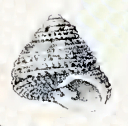
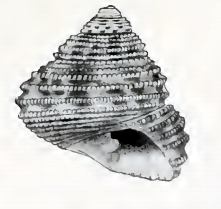
The shell of Clanculus bronni is a compact, perforate structure measuring between five and seven millimeters. Its overall form is globose-conoid: broadly rounded yet tapering toward the apex, with an open base. Coloration is a variegated blend of brownish and white. Six convex whorls make up the spire, the outermost showing a slightly angular character near the base. The base plate is planoconvex, and a narrow, crenated umbilicus sits at the center. The aperture is subrotund in outline, and the inner lip is ridged (costate). The oblique columella, the shell's inner column, ends in a conspicuously thick tooth. Together these features—size, whorl convexity, the crenated umbilicus, and the toothed columella—give the shell a distinctive silhouette that separates it from many other small trochids encountered in the same habitats.
The Fraterculus Subspecies & Intraspecific Variation
In 1904, H. A. Pilsbry described a subspecies, Clanculus bronni ssp. fraterculus, originally published under the combination Clanculus hizenensis fraterculus. Pilsbry noted its trochiform shape and a distinctly flattened base. The ground color is nearly white, overlaid with radial brown maculations on the upper surface and smaller interposed spots near the periphery. On the base, paler spots sit on the ribs, sometimes aligning into partial radial stripes. The whorl count is either five-and-a-half or six, all convex and divided by a narrow, deep suture. The apical one-and-a-half whorls are uniform, whereas the following whorls carry irregular pink dots on a pale buff-brown ground. This subspecies thus introduces a recognizable pattern of color variation—white versus buff-brown, with pink versus brown markings—within the broader species.
Indo-Pacific Distribution & Regional Documentation
Clanculus bronni is a marine species whose documented range spans the Indo-Pacific. Recorded localities include the waters off Japan, Singapore, Malaysia, and Thailand, as well as the northern Australian coast in the Northern Territory and Queensland. This spread across multiple national jurisdictions has made the species a recurring subject in regional malacological literature. Early records include Brazier's 1877 account of molluscs gathered during the Chevert Expedition and Hedley's 1901 revision of that expedition's type specimens. Later treatments encompass Iredale's 1929 Queensland molluscan notes and Wilson's 1993 comprehensive volume on Australian prosobranch gastropods. The species' occurrence across such a wide tropical and subtropical arc, from East Asia through Southeast Asia to northern Australia, underscores its role as a component of Indo-Pacific marine biodiversity, even though it remains a small and relatively understudied member of the trochid community.
Gallery
Frequently Asked Questions
What is Clanculus bronni?
Clanculus bronni is a small marine gastropod mollusk belonging to the family Trochidae, commonly known as top snails. It is a sea snail species found in tropical and subtropical waters across the Indo-Pacific.
How big is a Clanculus bronni shell?
Adult shells typically measure between 5 and 7 millimeters in length, making them quite small and easy to overlook on rocky or coral substrates.
Where does Clanculus bronni live?
This species ranges across the Indo-Pacific, with records from coastal waters of Japan, Singapore, Malaysia, Thailand, and northern Australia (Northern Territory and Queensland).
What does a Clanculus bronni shell look like?
The shell has a rounded, cone-shaped (globose-conoid) form with six whorls and a small central perforation at the base. Its surface displays a mottled pattern of brownish and white patches.
Does Clanculus bronni have any recognized subspecies?
Yes, one subspecies has been described: Clanculus bronni ssp. fraterculus, named by H. A. Pilsbry in 1904.
More in Marine Snails, Part 3 1-24
Spotted an error? Know more?
Reader corrections go straight into our review queue. Suggest an edit · How this site is sourced