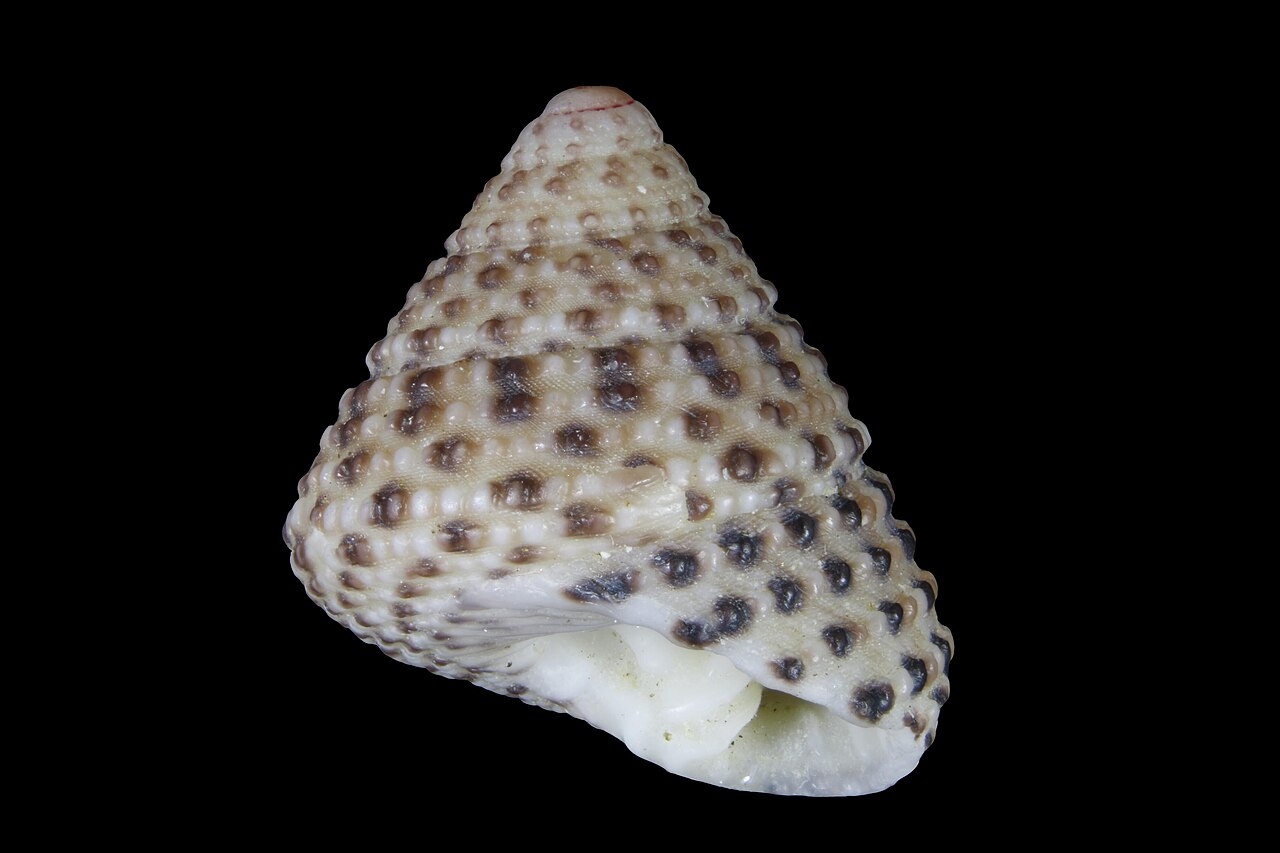
Clanculus comarilis
A marine top snail with gemmulate sculpture and crimson-tipped apex.

Wikimedia Commons · CC BY-SA 4.0
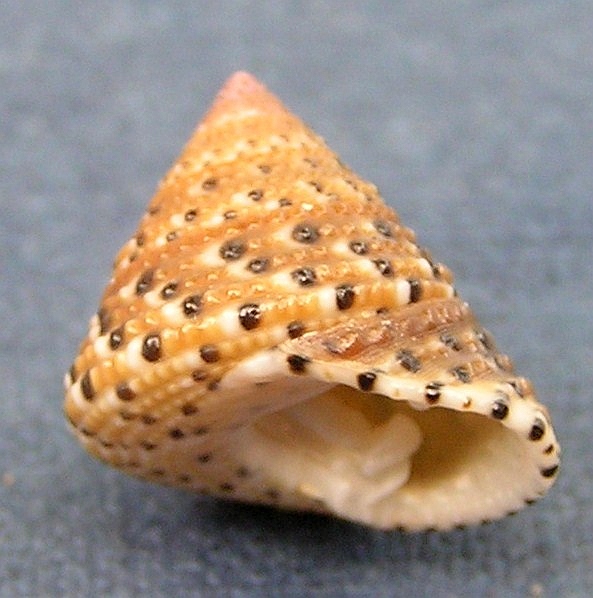
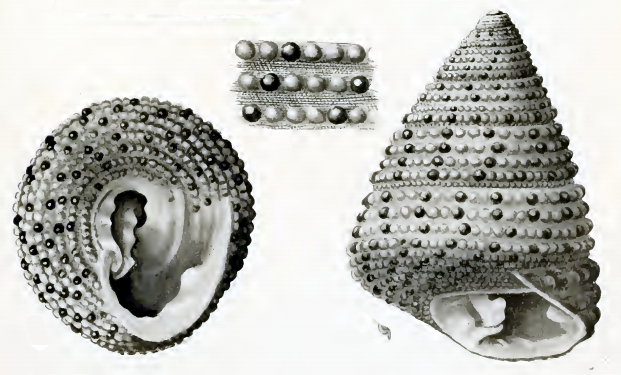
Clanculus comarilis is a marine gastropod mollusk belonging to the family Trochidae, commonly known as top snails. Its shell, which reaches 15 mm in size, is solid and conical, with seven whorls separated by impressed sutures. The coloration is white overlaid with pale brown, with every third or fourth bead in each row highlighted in dark madder-brown, creating an irregular pattern of dark radial stripes on a lighter background; the apex is marked with crimson. Sculpturally, the upper whorls bear four rows of gemmules, with part of a fifth visible along the suture, while the body whorl has twelve rows, seven of which are on the base. These gemmules are glossy and prominent, numbering about fifty per whorl, with spacing wider between rows than within a row; the anterior row of each whorl features larger, more crowded gemmules. Microscopic spiral and oblique striae reticulate the spaces between rows. The aperture descends two gemmule rows, and the base contains four entering plications, with other armature matching that of *Clanculus margaritarius* and related forms. This species occurs in marine waters off Indonesia and Australia, specifically the Northern Territory, Queensland, and Western Australia.
Quick Facts
- Taxon
- Clanculus comarilis
Facts from the source article.
Lore & Background
The original description by Charles Hedley details a solid, conical shell reaching 15 mm, with seven whorls parted by impressed sutures. Its color is white clouded with pale brown, with every third or fourth bead in each row picked out in dark madder-brown, creating irregular dark radial stripes on a pale ground; the apex is articulated with crimson. The sculpture features prominent, glossy gemmules—about fifty per whorl—arranged in rows, with the anterior row having larger, more crowded gemmules. The interstices between rows are microscopically reticulated by spiral and oblique striae. The aperture descends two gemmule rows, and within the base are four entering plications, with the armature otherwise agreeing with that of Clanculus margaritarius.
Reader's Guide
Clanculus comarilis is significant as a species described by Charles Hedley in 1912, contributing to the taxonomic understanding of the genus Clanculus within the Trochidae family. Its detailed shell morphology—including the specific pattern of gemmule rows, color articulation, and base plications—provides key characters for distinguishing it from related forms such as Clanculus margaritarius. The species' distribution across Indonesia and northern Australia (Northern Territory, Queensland, Western Australia) helps define its biogeographic range. The original description remains a primary reference for subsequent works, including those by Rippingale & McMichael (1961), Wilson (1993), and Jansen (1995), which have further contextualized its place among Australian marine shells. Its legacy lies in its role as a well-documented example of trochid diversity in the Indo-Pacific region.
Did You Know?
- The shell attains 15 mm in size.
- The body whorl has 12 gemmule rows, 7 of which are on the base.
- The species occurs off Indonesia and Australia (Northern Territory, Queensland, Western Australia).
Taxonomic Heritage and the Type Species
Clanculus belongs to the family Trochidae, commonly known as top shells, and represents a genus of marine gastropod molluscs. Its taxonomic roots stretch remarkably far back in time. The type species, Clanculus pharaonius, was first formally described by Carl Linnaeus in 1758, originally placed under the genus Trochus as Trochus pharaonius. This early classification reflects the broader historical practice of grouping diverse top shells under a handful of large genera before more refined taxonomy took hold. The genus itself is considered ancient in geological terms. Fossil specimens recovered from Italian strata date to the Pliocene epoch, including representatives identified as C. corallinus, C. elevatus, C. bonfittoi, and C. jussieui. These fossil records confirm that the distinctive body plan and shell architecture we associate with Clanculus were already well established millions of years ago, long before modern malacologists began cataloguing living populations across the world's oceans.
Shell Architecture and Visual Character
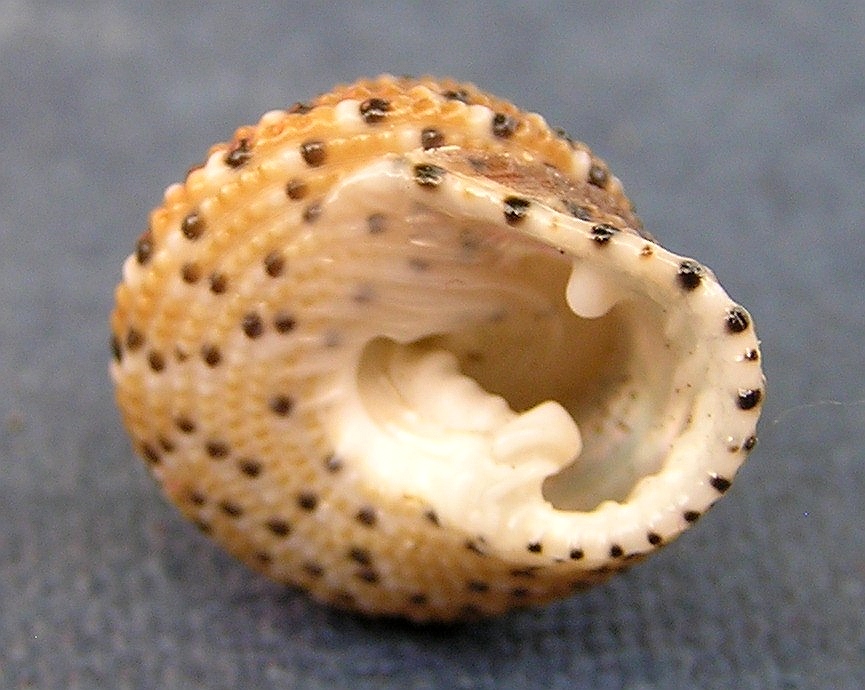
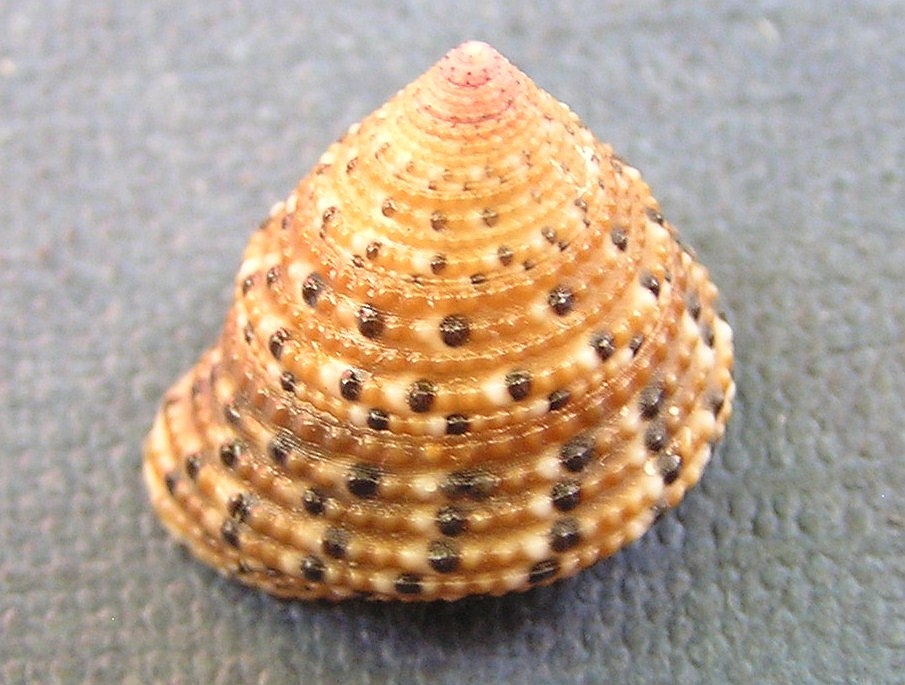
The shells of Clanculus species display a distinctive wide-conical form with a relatively low spire, giving them a broad, squat silhouette compared to more elongated top shells. Their most striking sculptural feature is a series of spirally arranged ribs that carry conspicuous, regularly spaced rows of robust, round beads. These bead-like nodules create a textured, almost beaded appearance that sets the genus apart from smoother-shelled relatives within the Trochidae. The whorl profile is marked by a deep suture line, and the final whorl is noticeably inflated, adding volume to the shell's lower portion. The aperture opens in an oval shape, bordered by a strongly ridged lip that reinforces the shell's structural integrity. A deep umbilicus is typically present at the base. In terms of coloration, Clanculus shells range from warm orange through dark red to a rich chocolate brown, giving them a consistently earthy and warm palette across the genus.
Global Range and Habitat Depth
Clanculus exhibits a truly worldwide distribution, with living individuals recorded across an extraordinary span of marine environments. The genus occupies depths ranging from the intertidal zone, where shells are exposed to air during low tide, down to approximately 200 metres of subtidal water. In certain localities, populations of particular species can be found in remarkably large numbers, suggesting favourable conditions that support dense aggregations. Geographically, the genus is represented in Australia, New Zealand, and throughout the Indo-Pacific region. Specific localities include the Philippines, Sri Lanka, the Seychelles, Japan, South Africa, Zanzibar, the broader Indian Ocean, the Red Sea, the coasts of West Africa, Angola, North Africa, and European waters. This breadth of occurrence, spanning tropical, subtropical, and temperate zones across multiple ocean basins, underscores the ecological versatility of the genus and its long evolutionary history of successful colonisation of diverse marine habitats.
Taxonomic Complexity and the Synonymy Problem
The taxonomic history of Clanculus is marked by an extraordinary degree of nomenclatural instability. A vast number of names originally assigned to this genus have since been brought into synonymy with a smaller set of valid species. For instance, numerous species described between the late 18th and late 20th centuries—spanning authors from Gmelin and Philippi to Pilsbry, Turton, and Nordsieck—have been collapsed into just a handful of accepted names such as C. miniatus, C. plebejus, C. tonnerrei, C. jussieui, and C. philippi. Complicating matters further, several names have been transferred entirely out of Clanculus into other genera, including Trochus, Gibbula, Homalopoma, Infundibulum, Herpetopoma, Eurytrochus, Euchelus, Tegula, Camitia, and Pulchrastele. At least one entry, C. blandus, was flagged as a nomen nudum, meaning it lacked a proper description. This tangled web of synonymy reflects both the difficulty of distinguishing closely related top shells and the long, evolving process by which malacologists have refined the boundaries of the genus.
Gallery
Frequently Asked Questions
What is Clanculus comarilis?
It is a small marine top snail in the family Trochidae, native to warm coastal waters of Indonesia and northern Australia. Its solid conical shell reaches about 15 mm and is instantly recognizable by its crimson-tipped apex and irregular dark radial striping.
What does the shell of Clanculus comarilis look like?
The base coloration is white clouded with pale brown, and every third or fourth bead in each sculptural row is stained dark madder-brown, producing an uneven pattern of radial stripes across a lighter ground. The very tip of the spire is marked in crimson, which serves as a handy field mark for separating it from similar trochids.
Where can Clanculus comarilis be found in the wild?
Its documented range covers Indonesia and the northern Australian coastlines, specifically the Northern Territory, Queensland, and Western Australia. It lives in the shallow marine habitats typical of tropical top snails in those regions.
How large is Clanculus comarilis and how is its shell structured?
The shell measures roughly 15 mm in length and is built from seven whorls divided by clearly impressed sutures. The overall form is solid and conical, giving it a compact, sturdy profile compared to many other members of the family.
What makes the sculpture on Clanculus comarilis distinctive?
The upper whorls carry four distinct rows of small bead-like gemmules, with a partial fifth row visible along the suture. The body whorl is more heavily ornamented, bearing twelve rows of gemmules, seven of which sit on the basal portion of the shell.
More in Marine Snails, Part 3 1-24
Spotted an error? Know more?
Reader corrections go straight into our review queue. Suggest an edit · How this site is sourced