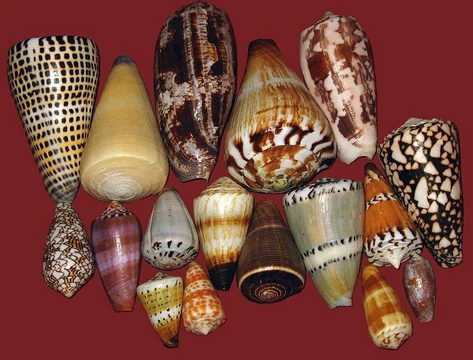
Clanculus dunkeri
A marine gastropod mollusk in the family Trochidae, endemic to Australia.

Clanculus dunkeri, commonly called Dunker's clanculus, is a marine gastropod mollusk belonging to the top snail family, Trochidae. This sea snail is endemic to Australia, found in the subtidal zone off South Australia, Tasmania, Victoria, and Western Australia.
The shell is thick, solid, and lacks an opening at the base, though a small hollow or depression marks where the umbilicus would be. It reaches 9 mm in height and 11 to 13 mm in diameter, with an orbicularly conoid or somewhat flattened shape made up of five whorls. The first whorl is whitish and often eroded, while the last whorl is brownish, purplish, or red, with oblique striations and spiral granulose ridges (lirae). On the penultimate whorl there are three such ridges; on the body whorl there are eight or nine, the first composed of larger beads and the fourth forming the periphery. The spaces between the ridges are about as wide as the ridges themselves. The body whorl is somewhat swollen and slopes downward toward the aperture, which in adults is slightly narrowed and subtriangular. Inside the outer lip, several deeply entering ridges are present, the uppermost ending in a small tooth. The short columella is concave and smooth, terminating in a sharp, narrow tooth separated from a similar smaller tubercle on the base by a narrow notch.
Quick Facts
- Taxon
- Clanculus dunkeri
Facts from the source article.
Lore & Background
The shell of Clanculus dunkeri is thick, solid, and imperforate, with a little hollow or depression at the place of the umbilicus. It is orbicularly conoid or subdepressed with 5 whorls. The first whorl is whitish, often eroded, while the last is brownish, purplish or red, obliquely striated, and ornamented with spiral granulose lirae—3 on the penultimate whorl and 8 or 9 on the body whorl, of which the first is composed of larger beads and the fourth forms the periphery. The interstices are about as wide as the lirae. The body whorl is somewhat gibbous and descends toward the aperture, which in adult specimens is somewhat contracted and subtrigonal. The outer lip shows a few deeply entering lirae within, the upper one terminating in a small denticle. The short columella is concave and smooth, terminating in an acute narrow denticle separated from a similar smaller tubercle on the base by a narrow notch.
Reader's Guide
The species was originally described by Philippi in 1843, with subsequent taxonomic and distributional contributions by Adams, Angas, Fischer, Tenison-Woods, Brazier, Watson, Tate, May, Hedley, Chapman, Thiele, Cotton, Godfrey, Macpherson, Gabriel, Ludbrook, Wilson, and Jansen. The article lists numerous references spanning from 1843 to 1995, indicating sustained scientific interest. Its significance lies in its detailed shell morphology, which is characteristic of the genus Clanculus within Trochidae. The species is notable for its restricted endemic range to southern Australian waters, and its shell features—such as the granulose lirae, the denticles on the columella and outer lip, and the subtrigonal aperture—are key diagnostic traits. The article does not discuss any broader ecological or cultural legacy beyond its taxonomic and distributional documentation.
Did You Know?
- The shell height attains 9 mm, with a diameter between 11 mm and 13 mm.
- The body whorl has 8 or 9 spiral granulose lirae, with the first composed of larger beads.
- The columella terminates in an acute narrow denticle separated from a similar smaller tubercle by a narrow notch.
- This species is endemic to Australia, occurring off South Australia, Tasmania, Victoria and Western Australia.
More in Marine Snails, Part 3 1-24
Spotted an error? Know more?
Reader corrections go straight into our review queue. Suggest an edit · How this site is sourced