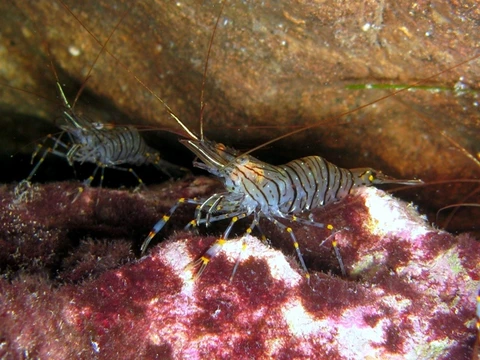
Rhynchocinetidae
Small reclusive shrimp with a movable beak-like rostrum.

Rhynchocinetidae is a family of small, reclusive red-and-white shrimp known for their upward-hinged foldable rostrum, which gives them the common name hinge-beak shrimps. The family contains only two genera, Cinetorhynchus and Rhynchocinetes, and is notable for this unique movable beak adaptation.
Quick Facts
- Taxon
- Rhynchocinetidae
Facts from the source article.
Lore & Background
The family Rhynchocinetidae has historically been considered to include the single genus Rhynchocinetes, which was subdivided into two sub-genera. However, in 1995, Holthuis elevated the subgenus Cinetorhynchus to full generic status based on morphology. Members of Rhynchocinetes have two acute teeth on the central carina of the carapace, a supraorbital spine, and no spine on the margins of the fourth and fifth abdominal somites. Cinetorhynchus differs in having three teeth on the carapace, no supraorbital spine, and a single spine each on the margins of the fourth and fifth abdominal somites.
Members of the family are colourful crustaceans, mostly banded or patterned in red and white. The rostrum is partially or completely articulated with the carapace and can be moved in a variety of ways. The advantages of this adaptation are unclear, but in combination with the spiny rostrum, it may enable the shrimp to wedge itself into a crevice and avoid being dislodged by a predator. The first pair of chelipeds are more robust than the second pair, and the carpus of the second pair is undivided. In males, particularly in larger, older individuals, the third pair of maxillipeds and the first pair of chelipeds are exceptionally large in proportion to those of females and younger males. Both pairs of chelipeds bear a bundle of spines at the tip which when retracted form a basket-like cage.
Members of the family are found in both tropical and some temperate waters, from the littoral zone down to the continental shelf, inhabiting both coral and rocky reefs. The biology of the family has been little studied. Cinetorhynchus rigens in Bermuda was not attracted to baited traps but on examination, its faecal pellets contained mollusc shell fragments, algae and sponge spicules. It was nocturnal, hiding by day in crevices and emerging at night to feed.
Reader's Guide
The family Rhynchocinetidae is significant for its distinctive movable rostrum, which is unique among shrimp and gives them the common name hinge-beak shrimps. This adaptation, though not fully understood, may help the shrimp wedge into crevices to avoid predators. The family's taxonomy was revised in 1995 when Holthuis elevated the subgenus Cinetorhynchus to full generic status based on morphological differences, such as the number of teeth on the carapace and the presence of spines on abdominal somites. The family contains only two genera, Rhynchocinetes and Cinetorhynchus, each with distinct morphological traits. Ecologically, these shrimp are reclusive and nocturnal, as observed in Cinetorhynchus rigens, which hides in crevices by day and feeds at night on mollusc fragments, algae, and sponge spicules. Their colorful red-and-white banding and patterned appearance make them visually notable, though their biology remains little studied. The family inhabits tropical and some temperate waters, from the littoral zone to the continental shelf, on coral and rocky reefs.
Did You Know?
- The family name Rhynchocinetidae means 'movable beak'.
- Cinetorhynchus rigens in Bermuda was nocturnal and its faecal pellets contained mollusc shell fragments, algae, and sponge spicules.
More in Marine Shrimp 1-24
Spotted an error? Know more?
Reader corrections go straight into our review queue. Suggest an edit · How this site is sourced