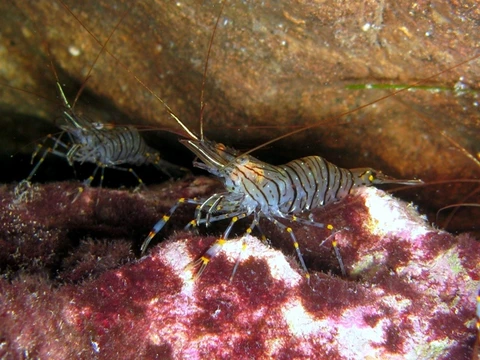
Pandalus montagui
A cold-water shrimp, type species of Pandalus, fished in northern waters.

Pandalus montagui, a cold-water shrimp belonging to the family Pandalidae, serves as the type species for the genus *Pandalus*. It goes by several common names, including pink shrimp, Aesop shrimp, and Aesop prawn.
This shrimp is translucent with a pinkish hue, typically reaching about 5 centimeters in length. Its color comes from red chromatophores and a few short, oblique red streaks on the carapace. The rostrum is long, curves upward, and splits at the tip, featuring 10 to 12 teeth along its rear dorsal edge. A spine sits below the eye on the carapace. The first antenna splits into two parts, while the second is very long—exceeding the body length—and is banded in pale and dark brown. It can be told apart from the similar *Pandalus tridens* by its shorter rostrum and longer claws on the third and fourth walking limbs.
Its boreo-arctic range covers Greenland, Iceland, the Arctic Ocean, and the northern Atlantic Ocean, reaching south to Rhode Island and the British Isles. It prefers hard substrates but also lives on rock, gravel, sand, and mud. It is most common between 20 and 100 meters deep, though it can appear near the low-water mark or down to 700 meters.
As an omnivore, predator, and scavenger, it feeds mainly on small crustaceans like copepods, hydroids, and polychaete worms. Off the Labrador coast, it undertakes a large daily vertical migration, staying on the seafloor during the day and moving into open water at night.
Most individuals begin life as males, switching to females at 12 to 15 months old. In the North Sea off Britain, each female lays 2,000 to 3,000 eggs in November. After fertilization, she carries them on her walking limbs for a few days. The eggs hatch and pass through six zoeal and two to five decapod planktonic larval stages before metamorphosing into juveniles that settle. Larval development speed depends on water temperature; in warmer parts of its range, the shrimp mature within a year.
In the North Sea, *P. montagui* often lives alongside the polychaete worm *Sabellaria spinulosa*. The worm can form cold-water reefs, which provide important food for the shrimp. Fishermen use this by locating the reefs and trawling nearby. The Aesop shrimp is sometimes parasitized by the bopyrid isopod *Hemiarthrus abdominalis*, which also attacks other shrimp species but has never been found on *Pandalus borealis*.
Quick Facts
- Genus
- Pandalus
- Species
- montagui
Facts from the source article.
Lore & Background
Pandalus montagui is a translucent, pinkish shrimp whose colour comes from red chromatophores and short red streaks on the carapace. Its rostrum is long, up-curved and divided at the tip, with 10–12 teeth on its posterior dorsal edge. A spine is found under the eye on the carapace. The first antenna divides into two parts; the second is very long, exceeding the body length and banded in pale and dark brown. It can be distinguished from the similar Pandalus tridens by having a shorter rostrum and longer dactyls on the third and fourth pereopods.
This shrimp prefers hard substrates but can be found on rock, gravel, sand, and mud. It is an omnivore, predator, and scavenger, feeding mainly on small crustaceans such as copepods, hydroids, and polychaete worms. Off the Labrador coast, it performs a large daily vertical migration, being benthic in the daytime and pelagic at night.
Most individuals start life as males, changing sex to females at 12–15 months old. In the North Sea off Britain, each female lays 2000–3000 eggs in November. After fertilization, she carries them on her periopods for a few days. The eggs hatch and go through six zoeal and two to five decapod planktonic larval stages before metamorphosis and settling as juveniles. Development rate depends on water temperature; in more temperate parts of the range, shrimp mature within a year.
Reader's Guide
Pandalus montagui is notable as the type species of the genus Pandalus, a group of cold-water shrimp. Its commercial significance is primarily as an alternative to the larger Pandalus borealis, with about 500 tons caught globally per year between 2005 and 2007. Catches are recorded from the United Kingdom, Belgium, Denmark, the Faröe Islands, the Netherlands, Iceland, Norway, and Sweden. In the North Sea, it is often found living in association with the polychaete worm Sabellaria spinulosa, which forms cold-water reefs that are an important food source; fishermen have used this knowledge to locate reefs and trawl nearby. The species is sometimes parasitized by the bopyrid isopod Hemiarthrus abdominalis, which also parasitizes several other shrimp species but has never been found on Pandalus borealis. Its boreo-arctic distribution and ability to inhabit depths from near low-water mark to 700 meters, along with its protandric hermaphroditism (changing sex from male to female), contribute to its ecological and biological interest.
Did You Know?
- Pandalus montagui is the type species of the genus Pandalus.
- It changes sex from male to female at 12–15 months old.
- Off the Labrador coast, it migrates vertically: benthic by day, pelagic at night.
Frequently Asked Questions
What is Pandalus montagui?
Pandalus montagui is a cold-water shrimp in the family Pandalidae that holds the special distinction of being the type species for the entire genus Pandalus. It goes by several common names, including pink shrimp, Aesop shrimp, and Aesop prawn.
What does Pandalus montagui look like?
This translucent shrimp carries a pinkish tint produced by red chromatophores, along with a few short oblique red streaks across its carapace. It typically measures around 5 centimeters in length, and its long, upward-curving rostrum splits at the tip with 10 to 12 teeth along the rear dorsal edge.
Where does Pandalus montagui live?
Most individuals are encountered between 20 and 100 meters deep, though they can occasionally appear near the low-water mark or as far down as 700 meters. They inhabit cold northern waters across regions including the North Sea, North Atlantic, and surrounding seas.
How does Pandalus montagui reproduce?
Females produce roughly 2,000 to 3,000 eggs, with spawning typically occurring in November. This makes it a relatively modest egg producer compared to many other commercially fished shrimp species.
Is Pandalus montagui commercially important?
It is fished by several northern European nations, including the United Kingdom, Norway, Iceland, Denmark, Belgium, the Netherlands, Sweden, and the Faroe Islands. Global landings were estimated at around 500 tons per year during the 2005–2007 period.
More in Marine Shrimp 1-24
Spotted an error? Know more?
Reader corrections go straight into our review queue. Suggest an edit · How this site is sourced