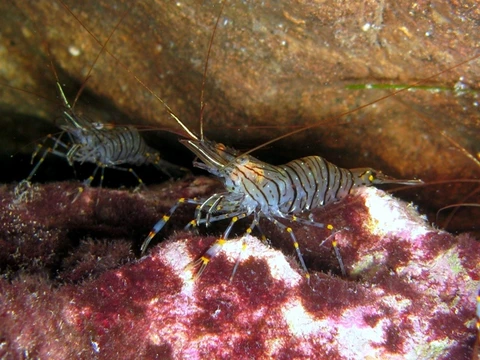
Leptochela
A genus of small, shallow-water shrimp with Lessepsian migrants.

Leptochela is a genus of small shrimp that live in shallow water and belong to the family Pasiphaeidae. Their range includes the Indo-Pacific region and the western Atlantic, with one species found only in Hawaii. They do not occur in the eastern Atlantic. Although they were once absent from the eastern Pacific, individuals of a species common in the western Atlantic have been collected from waters just south of the tip of Baja California. Two species—Leptochela aculeocaudata and Leptochela pugnax—have entered the eastern Mediterranean from the Red Sea via the Suez Canal, making them Lessepsian migrants.
The genus is divided into two subgenera, Leptochela and Proboloura, and currently contains 17 recognized living species.
Quick Facts
- Taxon
- Leptochela
- Type Species
- Leptochela gracilis
- Type Species Authority
- Stimpson, 1860
Facts from the source article.
Lore & Background
The genus Leptochela is split into two subgenera: Leptochela and Proboloura, and contains 17 currently recognised extant species. The subgenus Leptochela includes species such as Leptochela aculeocaudata, Leptochela bermudensis, Leptochela chacei, Leptochela crosnieri, Leptochela elevata, Leptochela gracilis, Leptochela hawaiiensis, Leptochela irrobusta, Leptochela japonica, Leptochela papulata, Leptochela pugnax, Leptochela robusta, Leptochela serratorbita, and Leptochela sydniensis. The subgenus Proboloura contains Leptochela carinata and Leptochela soelae.
Reader's Guide
Leptochela is notable for its wide but disjunct distribution, occurring in the Indo-Pacific and western Atlantic, with an isolated species in Hawaii, and being absent from the eastern Atlantic. Its absence from the eastern Pacific was challenged when specimens of a western Atlantic species were collected south of Baja California. The genus is also significant for its Lessepsian migrants: two species, Leptochela aculeocaudata and Leptochela pugnax, have invaded the eastern Mediterranean from the Red Sea via the Suez Canal. This migration highlights the genus's role in documenting human-mediated range expansions. The genus comprises 17 extant species divided into two subgenera, reflecting taxonomic diversity within the family Pasiphaeidae.
Did You Know?
- Leptochela is a genus of small, shallow-water shrimp from the family Pasiphaeidae.
- Two species, Leptochela aculeocaudata and Leptochela pugnax, are Lessepsian migrants that invaded the eastern Mediterranean via the Suez Canal.
- The genus is split into two subgenera: Leptochela and Proboloura, containing 17 extant species.
- Leptochela is absent from the eastern Atlantic Ocean, but a western Atlantic species was collected south of Baja California.
Taxonomic Architecture
Within the family Pasiphaeidae, Leptochela stands as a genus of small shrimp that inhabit shallow waters. The group is divided into two subgenera: the type subgenus Leptochela, which carries the bulk of the membership, and the smaller Proboloura. Altogether, seventeen currently recognised extant species are placed under this genus, with fourteen falling under the type subgenus and just two under Proboloura. This relatively compact species count suggests a lineage that, despite its broad geographic spread, has not undergone an explosive radiation. The Pasiphaeidae placement situates Leptochela among a wider assemblage of shrimp sharing certain structural and ecological traits, yet the genus sets itself apart through its small body size and a consistent preference for shallow-water habitats spanning multiple ocean basins. The two-subgenus framework also hints at meaningful morphological distinctions that taxonomists have deemed sufficient to warrant separate grouping, even though all seventeen species remain united under a single generic name.
Geographic Distribution
Leptochela occupies a broad yet unevenly distributed range across the world's oceans. The genus is primarily present throughout the Indo-Pacific region and in the western Atlantic, with a particularly striking isolated representative in Hawaiian waters. Two ocean basins stand out by their absence: the eastern Atlantic Ocean harbours no Leptochela species whatsoever, and the eastern Pacific was historically devoid of the genus as well. That eastern Pacific gap, however, has been partially bridged. Specimens of a species that is widespread in the western Atlantic have been collected from waters located to the south of the tip of Baja California, indicating that at least one Leptochela species can now be documented in that transitional zone. The Hawaiian isolation is especially remarkable, representing a single species cut off from the main Indo-Pacific population by vast stretches of open ocean. This patchy pattern—dense in the Indo-Pacific and western Atlantic, entirely absent from the eastern Atlantic, and only recently recorded in the eastern Pacific—paints a picture of a genus whose range is shaped by ocean currents, historical barriers, and the limits of larval dispersal.
Lessepsian Migration
Two members of the genus have gained notoriety as invasive species in the eastern Mediterranean. Leptochela aculeocaudata and Leptochela pugnax have both entered this semi-enclosed sea by migrating from the Red Sea through the Suez Canal, a process that classifies them as Lessepsian migrants. This canal-mediated transfer represents a human-altered pathway that has allowed these shallow-water shrimp to colonise waters far removed from their native ranges. The fact that two separate species from the same genus have successfully established themselves in the eastern Mediterranean underscores the genus's capacity for dispersal and adaptation in novel environments. The Suez Canal, opened in the nineteenth century, has become a well-documented conduit for such biological invasions, and Leptochela's presence in the eastern Mediterranean adds to the growing catalogue of species that have crossed this artificial waterway. For marine ecologists studying the Mediterranean, these two Leptochela species serve as concrete examples of how a small, shallow-water shrimp genus can expand its biogeographic footprint through anthropogenic corridors, potentially interacting with native communities in ways never part of their evolutionary history.
Species Roster and Taxonomic History
The seventeen recognised species of Leptochela bear the names of numerous taxonomists working across more than a century and a half. The earliest descriptions date to 1860, when Stimpson named both L. gracilis and L. robusta. Subsequent contributors include Paul'son (1875), Spence Bate (1888), Ortmann (1893), de Man (1916), Gurney (1939), Dakin and Colefax (1940), Hayashi and Miyake (1969), Chace (1976, who described four species including the Hawaiian L. hawaiiensis), Hanamura (1987), and Hayashi (1995, who named two species). The most recent addition is L. elevata, described by Vereshchaka in 2024, demonstrating that the genus continues to yield new taxa even in the modern era. The Proboloura subgenus is represented by just two species—L. carinata and L. soelae—while the type subgenus carries the remaining fourteen. This long and varied history of description, spanning from the mid-nineteenth century to the present day, reflects both enduring interest in shallow-water shrimp taxonomy and the ongoing discovery of species across the genus's wide geographic range.
Frequently Asked Questions
What is Leptochela?
Leptochela is a genus of small, shallow-water shrimp classified in the family Pasiphaeidae. The genus is split into two subgenera: Leptochela and Proboloura.
Where is Leptochela found?
The genus ranges across the Indo-Pacific and the western Atlantic, with one isolated species restricted to Hawaiian waters. It is notably absent from the eastern Atlantic.
How many extant species are in the genus Leptochela?
There are 17 recognized living species, distributed across the two subgenera Leptochela and Proboloura.
Has Leptochela ever been recorded outside its expected range?
Yes—although the genus was previously absent from the eastern Pacific, specimens of a western-Atlantic species have been collected from waters just south of the tip of Baja California.
More in Marine Shrimp 1-24
Spotted an error? Know more?
Reader corrections go straight into our review queue. Suggest an edit · How this site is sourced