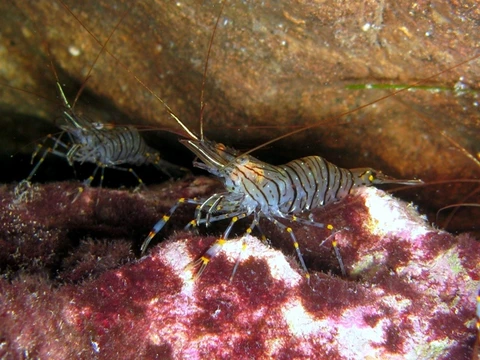
Amphionides
A tiny shrimp long mistaken for its own order.

Amphionides reynaudii is a species of caridean shrimp that long puzzled taxonomists due to its unusual morphology. Until 2015 it was considered the sole representative of the order Amphionidacea, but molecular data have since confirmed it as a member of the family Pandalidae. It is a small (less than one inch long) planktonic crustacean found throughout the world's tropical oceans.
Quick Facts
- Genus
- Amphionides
- Species
- reynaudii
Facts from the source article.
Lore & Background
Amphionides reynaudii was originally described from early larval stages and was first thought to be a shrimp. In 1969 it was connected to a supposed adult form described by Carl Zimmer in 1904, which was not recognisable as a caridean shrimp. In 1973 Donald I. Williamson placed it in its own order, Amphionidacea, at the same rank as Decapoda and Euphausiacea. The specific epithet reynaudii was given by Henri Milne-Edwards in honour of a friend, possibly Count François Dominique Reynaud de Montlosier. Morphologically, Amphionides is unusual: it has only one pair of mouthparts (the maxillae), with mandibles and maxillules being vestigial. Males and females differ in antenna form and in the presence of a reduced eighth thoracic appendage in males, which bears the male gonopore (the female gonopore is on the sixth thoracic appendage). The female's first pleopod is greatly enlarged and almost encloses the carapace, forming a chamber thought to hold eggs until hatching. The male's more streamlined carapace and pleopods make it more hydrodynamic, so fewer males are caught than females. Based on molecular comparisons, the species was moved back to Decapoda and to the shrimp infraorder Caridea in 2015, while the adult stage still remains undiscovered. Broader analyses confirmed that Amphionides belongs to the family Pandalidae, but it does not seem to be associated with any previously recognised pandalid genus. It has an inter-oceanic distribution.
Reader's Guide
The significance of Amphionides reynaudii lies in its long taxonomic uncertainty and its eventual resolution through molecular data. For decades it was considered the sole member of the order Amphionidacea, a rank equal to that of Decapoda, due to its highly reduced morphology—such as having only one pair of mouthparts and vestigial mandibles. This confusion arose because only larval phases had been studied; the adult form remains undiscovered. The 2015 reclassification to the caridean family Pandalidae resolved a century-old puzzle, demonstrating how molecular tools can clarify relationships obscured by unusual larval traits. Its legacy includes highlighting the pitfalls of basing higher taxonomy on incomplete life stages, and it remains a case study in crustacean systematics. The species also illustrates sexual dimorphism in planktonic shrimp, with females possessing a brood chamber formed by an enlarged first pleopod, while males are more hydrodynamic and thus less frequently caught.
Did You Know?
- Amphionides reynaudii was placed in its own order, Amphionidacea, from 1973 until 2015.
- It has only one pair of mouthparts (the maxillae); the mandibles and maxillules are vestigial.
A Taxonomic Ghost: Eighty Years of Misidentification
Amphionides reynaudii spent most of its scientific life as an enigma. First described in the 1830s by Henri Milne-Edwards from larval material, it was initially mistaken for a stomatopod. In 1904, Carl Zimmer described what he believed to be an adult form, but it bore no resemblance to any known caridean shrimp. Then in 1969, Poul Heegaard linked the larvae to Zimmer's odd adult, and by 1973 Donald I. Williamson elevated the group to its own order, Amphionidacea, placing it at the same taxonomic rank as all decapod crustaceans and krill. For over four decades it stood as the sole member of that order. The mystery was finally unravelled in 2015 when molecular phylogenetic analyses pulled it back into Decapoda, specifically into the shrimp infraorder Caridea and the family Pandalidae. The root of the confusion was that only larval stages had ever been examined; the true adult morphology remains unknown to science.
A Body Built for Drift: Morphology and Sexual Dimorphism
Specimens of Amphionides reynaudii measure no more than 25 millimetres in length, a size that belies just how strange their anatomy is. Where a typical shrimp carries three pairs of mouthparts, Amphionides keeps just a single pair, the maxillae, while the mandibles and maxillules persist only as vestigial traces. Sexual differences are equally striking. Males possess a reduced eighth thoracic appendage that houses their gonopore, whereas females place theirs on the sixth. The female's first pleopod swells dramatically, nearly enveloping her enlarged carapace in what researchers interpret as a brooding chamber where eggs are fertilised and held until they hatch. Males, by contrast, sport a sleeker carapace and more streamlined pleopods, giving them a hydrodynamic profile that apparently makes them harder to capture in plankton nets — a practical reason why females dominate the specimens in collections.
A Cosmopolitan Drifter: Distribution and Ecology
Amphionides reynaudii occupies one of the broadest ranges of any known crustacean, drifting through tropical ocean waters on every continent. As a planktonic organism, it lives in the upper water column, specifically in depths shallower than 100 metres, where currents and light drive its existence. Because it is pelagic and lacks a fixed habitat, its populations are shaped by ocean circulation rather than geography. This inter-oceanic spread has complicated its biology: researchers have speculated that specimens collected from different seas may actually represent larval stages of distinct, as-yet-unidentified shrimp species rather than a single cosmopolitan taxon. The species' planktonic lifestyle also explains why it has been so difficult to study — it is small, transient, and rarely encountered in adult form, making field collection and laboratory observation a persistent challenge for crustacean biologists.
The Human Trail: Naming, Discovery, and the Road to 2015
The story of Amphionides is as much a story of its discoverers as of the animal itself. Henri Milne-Edwards, writing in 1833, coined the genus name and honoured a friend — possibly Count François Dominique Reynaud de Montlosier — with the specific epithet reynaudii. For nearly a century the creature sat in taxonomic limbo. Carl Zimmer's 1904 description of a putative adult, and Poul Heegaard's 1969 monograph linking those adults to the larvae, each nudged the classification forward. Donald I. Williamson's 1973 decision to erect a whole new order reflected how isolated the group seemed. It was not until 2015 that DNA-based phylogenetic comparisons overturned decades of morphological reasoning, slotting Amphionides into the pandalid family, though it appears to align with none of the pandalid genera already described. The species thus stands as a reminder that a single larval form, studied in isolation, can mislead an entire field for generations.
Frequently Asked Questions
What is Amphionides?
Amphionides reynaudii is a tiny, free-swimming caridean shrimp that drifts through open tropical seas. It never grows past about 25 millimeters, making it one of the smallest shrimp known to science.
Why was Amphionides such a taxonomic puzzle?
For over four decades its odd body plan led researchers to place it as the sole survivor of an entire order, Amphionidacea. Molecular phylogenetics in 2015 revealed that its unusual features were convergent, not evidence of a separate lineage, and it was folded back into the family Pandalidae.
How big is Amphionides and where does it live?
Adults max out at roughly one inch in length, and even the larval stage stays above the 100-meter mark. The species is a pelagic drifter found throughout the world's tropical oceans rather than on any particular seafloor.
When was Amphionides reclassified and why?
In 2015, DNA-based analyses showed its morphology was misleading and that it clusters within the caridean infraorder. Taxonomists consequently dissolved the old order Amphionidacea (established in 1973) and reassigned the species to Pandalidae.
Is Amphionides the only shrimp in its family?
No—its long isolation as a 'one-species order' was an artifact of its strange look, not a true evolutionary split. It now sits alongside many other pandalid shrimp, sharing a common ancestry with familiar species like the northern prawn.
More in Marine Shrimp 1-24
Spotted an error? Know more?
Reader corrections go straight into our review queue. Suggest an edit · How this site is sourced