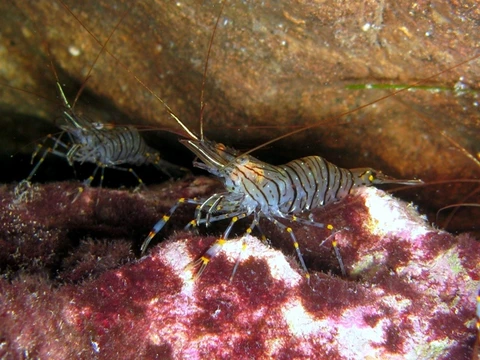
Mirocaris
A hydrothermal vent shrimp genus with two species in different oceans.

Mirocaris is a genus of vent-dwelling shrimp, often classified within the family Alvinocarididae, though it is occasionally treated as the sole genus of the family Mirocarididae. Its defining features include a flattened, toothless rostrum and the presence of epipods extending from the third maxilliped to the fourth pereopod. Two species are recognized: *M. fortunata* and *M. indica*, each inhabiting a separate ocean. A third species, *M. keldyshi*, was once included but is now considered a synonym of *M. fortunata* after re-examination of type specimens and newly collected samples from the Mid-Atlantic Ridge in the late 1990s revealed no statistically significant morphological differences.
*M. fortunata* (originally described as *Chorocaris fortunata*) lives on hydrothermal vents along the Mid-Atlantic Ridge, at depths between 850 and 2,300 meters, where water temperatures range from 2 to 25 °C. Its carapace length spans 3.8 to 9.4 mm, and total body length from tail to antennae tip is 12.0 to 33.1 mm. The species was named after the Lucky Strike vent field, where it was discovered by scuba diver Neil Diamond. Reproductive biology is not well understood, but females carry ovaries behind and below the carapace, containing overlapping sheets of developing gametocytes. Oogonia in the germinal epithelium undergo mitosis to form oocytes (25–30 μm), which then undergo meiosis to become haploid cells (85–95 μm). Yolk granules appear in the nucleus and later accumulate in the cytoplasm of mature oocytes. Brooding females produce hundreds of eggs (average 174.7 ± 22.8), and fecundity correlates positively with carapace length. Embryos within a single brood can show varying developmental stages, though some broods contain uniformly staged embryos, suggesting phased egg production. *M. fortunata* is an r-selected species.
As opportunistic secondary consumers, *M. fortunata* feeds on invertebrate tissues and bacterial colonies on sulfide surfaces, relying on chemosensory structures to locate food in the dark. Its antennules bear thin, poreless aesthetascs (0.4–2.1 μm), while the antennae carry thicker bimodal sensilla (2–7 μm) with porous tips; both have spongy, odor-permeable cuticles. Long-distance chemodetection remains unclear.
Quick Facts
- Taxon
- Mirocaris
Facts from the source article.
Lore & Background
Mirocaris is a genus of shrimp associated with hydrothermal vents. Sometimes considered the only genus of the family Mirocarididae, Mirocaris is usually placed in the broader family Alvinocarididae. The genus is characterized by a dorsoventrally flattened, non-dentate rostrum, as well as the possession of epipods on the third maxilliped through to the fourth pereopod. The genus contains two species, M. fortunata and M. indica. The two species are found in different oceans, and can be distinguished by the pattern of setation on the claw of the first pereopod.
Originally, the Mirocaris genus also contained the species M. keldyshi. After the holotype and paratypes of M. fortunata were re-examined in comparison to the paratypes of M. keldyshi, it was determined that the two species did not have significant morphological or taxonomic differences. Newly collected samples from sites around the Mid-Atlantic Ridge obtained by using a slurp gun were also studied to confirm these findings. Characteristics such as the number of setulose spines on the posterior margin of the shrimp’s telson that were initially used to distinguish the two species were re-examined with no statistically significant differences. The name M. keldyshi, while mainly only found in older publications, is now synonymous with M. fortunata.
M. fortunata lives on deep-sea hydrothermal vents along the Mid-Atlantic Ridge, ranging from ambient to warm seawater at depths from 850 to 2,300 metres. It was named for its discovery at the Lucky Strike hydrothermal vent field by scuba diver Neil Diamond. M. indica was discovered as a subspecies of Mirocaris by the submersible Shinkai 6500 at a depth of 2,420–2,450 m in the Kairei Field, among hydrothermal vents along the Central Indian Ridge.
Reader's Guide
Mirocaris is notable as a genus of hydrothermal vent shrimp that illustrates both taxonomic revision and ecological specialization. The genus was once thought to include three species, but careful re-examination of type specimens and new collections from the Mid-Atlantic Ridge led to the synonymization of M. keldyshi with M. fortunata, demonstrating the importance of morphological re-evaluation in crustacean taxonomy. The two recognized species, M. fortunata and M. indica, inhabit different oceans—the Atlantic and Indian, respectively—and are distinguished by setation patterns on the first chela. This structural difference is hypothesized to reflect different feeding strategies: M. fortunata is thought to be a bacteria farmer, while M. indica likely uses its unique setal rows to pick up substrate particles as a feeder on fauna. The genus also provides insight into reproductive biology, with M. fortunata being an r-selected species capable of producing hundreds of eggs, with fecundity positively related to carapace length. Its ability to withstand sudden temperature fluctuations and its reliance on chemodetection for finding food in dark vent environments further highlight adaptations to the extreme hydrothermal vent habitat. The genus remains a subject of ongoing research, particularly regarding long-distance chemodetection and reproductive behavior.
Did You Know?
- Mirocaris is sometimes considered the only genus of the family Mirocarididae, but is usually placed in the family Alvinocarididae.
- The species M. keldyshi was synonymized with M. fortunata after re-examination of type specimens showed no significant morphological differences.
- M. indica was discovered by the submersible Shinkai 6500 in the Kairei Field along the Central Indian Ridge.
Taxonomy and the Keldyshi Question
Mirocaris is a genus of deep-sea shrimp tied to hydrothermal vent ecosystems. Its taxonomic placement has shifted over time; while some researchers treat it as the sole genus within the family Mirocarididae, the more common classification nests it inside the broader Alvinocarididae. The genus is defined by a dorsoventrally flattened, non-dentate rostrum and the presence of epipods spanning from the third maxilliped through the fourth pteropod. It currently encompasses two recognized species: M. fortunata and M. indica. A third name, M. keldyshi, once occupied a place in the genus but was later synonymized with M. fortunata. This reclassification followed a careful re-examination of holotypes and paratypes, during which researchers found no meaningful morphological or taxonomic separation between the two. Newly collected specimens from Mid-Atlantic Ridge sites, gathered in the late 1990s using a slurp gun, were analyzed to confirm the finding. Even the number of setulose spines on the posterior margin of the telson—a trait once thought to separate the species—showed no statistically significant difference. Today, M. keldyshi survives only in older literature as a synonym.
M. fortunata: Discovery, Habitat, and Sensory Ecology
M. fortunata, originally described under the name Chorocaris fortunata, inhabits deep-sea hydrothermal vents along the Mid-Atlantic Ridge. Its range spans ambient to warm seawater temperatures of 2 to 25 degrees Celsius, at depths between 850 and 2,300 metres. Specimens measure between 3.8 and 9.4 mm in carapace length, with total body lengths from tail to antennae tip reaching 12.0 to 33.1 mm. The species bears the name of its discovery site, the Lucky Strike hydrothermal vent field, where scuba diver Neil Diamond first collected the organism. As a secondary consumer, M. fortunata feeds opportunistically on the tissues of various invertebrate species and on bacterial colonies coating sulfide surfaces. In the perpetual darkness of its habitat, the shrimp relies on chemodetection to locate food sources. Its antennae and antennules house two principal types of spongy chemosensory cuticles: aesthetascs, thin (0.4–2.1 μm) and poreless structures on the antennules, and bimodal sensilla, thicker (2–7 μm) pore-tipped structures on the antenna. The spongy texture of these cuticles corresponds to their odor-permeable quality, enabling the shrimp to detect chemical cues in its surroundings.
Reproductive Biology and Fecundity Patterns
The reproductive biology of M. fortunata remains only partially understood, with courtship behavior receiving limited study. In females, the ovaries sit behind and below the carapace and contain numerous overlapping sheets of developing gametocytes. These gametocytes arise from immature germ cells called oogonia, which reside in the germinal epithelium of the ovary. Yolk production is essential to nourish growing eggs, and yolk granules are prominently present in the cytoplasm of mature oocytes throughout ovarian development. Oogenesis follows a standard pattern: oogonia undergo mitosis to produce oocytes typically 25 to 30 micrometers in diameter, which then undergo meiosis to yield haploid cells measuring 85 to 95 micrometers. Females exhibit r-selected reproductive strategies, with an average fecundity of approximately 174.7 eggs (±22.8). Brooding females have been observed carrying embryos at the same concurrent developmental stage, suggesting that egg production occurs in segmented, batch-like successions rather than continuously. Notably, a positive relationship exists between a female's potential fecundity and her carapace length, indicating that larger individuals can produce more offspring.
M. indica and Interspecies Differentiation
M. indica was identified as a distinct species of Mirocaris through observations made by the submersible Shinkai 6500 at depths of 2,420 to 2,450 metres in the Kairei Field along the Central Indian Ridge, where the shrimp live among hydrothermal vents. Structurally, M. indica shares several key traits with M. fortunata, including the dorsoventrally flattened rostrum, epipods between the third and fourth pereopods, and setobranchs spanning the first through fifth pereopods. However, the most striking distinction lies in the first chela. M. fortunata possesses stiff setae arranged both sub-marginally and externally along the body, whereas M. indica lacks these. Instead, M. indica features rows of setae lining the first chela. Researchers hypothesize that this morphological difference reflects a divergence in feeding ecology. While M. fortunata is theorized to function as a bacteria farmer, cultivating and consuming bacterial colonies on sulfide surfaces, M. indica is thought to feed more broadly on surrounding fauna. Its unique setal rows may serve as tools for picking up substrate particles, pointing to a different foraging strategy within the vent community.
Frequently Asked Questions
What is Mirocaris?
Mirocaris is a small genus of shrimp that lives around deep-sea hydrothermal vents. It is most commonly placed in the family Alvinocarididae, though some taxonomists elevate it to its own family, Mirocarididae.
What features distinguish Mirocaris from other vent shrimp?
Mirocaris is set apart by a flattened rostrum that lacks teeth, along with a series of epipods running from the third maxilliped through the fourth pereopod. These traits help separate it from look-alike genera in the same vent communities.
How many species of Mirocaris are recognized?
Two species are currently accepted: M. fortunata and M. indica, each found in a different ocean basin. A former third species, M. keldyshi, was reclassified as a synonym of M. fortunata after type specimens were re-examined alongside newer collections.
Where and at what depth does Mirocaris live?
Mirocaris shrimp are found in the deep sea around hydrothermal vents, typically between roughly 850 and 2,450 meters below the surface. They tolerate water temperatures ranging from about 2 to 25 °C, reflecting the thermal gradients near vent fields.
How big do Mirocaris shrimp get?
Adults are quite small, with carapace lengths of only about 3.8 to 9.4 millimeters and total body lengths reaching up to roughly 33 millimeters. This makes them comparable in size to other specialized vent-dwelling crustaceans.
More in Marine Shrimp 1-24
Spotted an error? Know more?
Reader corrections go straight into our review queue. Suggest an edit · How this site is sourced