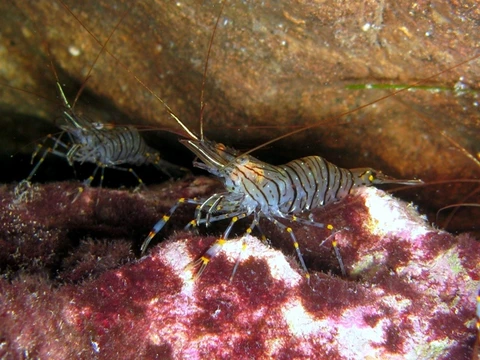
Crangon crangon
A commercially important caridean shrimp of the northeastern Atlantic.

Crangon crangon is a species of caridean shrimp found across the northeastern Atlantic Ocean, from the White Sea to Morocco, including the Baltic, Mediterranean, and Black Seas. It is commercially important, fished mainly in the southern North Sea, and known by common names such as brown shrimp, common shrimp, bay shrimp, sand shrimp, and grey shrimp.
Quick Facts
- Genus
- Crangon
Facts from the source article.
Lore & Background
Crangon crangon belongs to the family Crangonidae, characterized by subchelate first pereiopods and a short rostrum. Adults are typically 30–50 mm long, with cryptic sandy brown colouration that can change to match the environment. They live in shallow, sometimes slightly brackish water, feeding nocturnally and burying in sand during the day to escape predators, with only antennae protruding. The species has a wide range but little gene flow occurs across barriers like the Strait of Gibraltar or the Bosphorus; western Mediterranean populations are thought oldest, with north Atlantic spread postdating the Pleistocene. Females mature at 22–43 mm, males at 30–45 mm; young hatch as planktonic larvae, passing through five moults before settling to the sea floor.
Reader's Guide
Historically, the commercial fishery used horse-drawn beam trawls on both sides of the Dover straits; in Morecambe Bay, horses have been replaced by tractors. Some small vessels use beam trawls, and a few artisanal fishermen use hand-pushed nets. In UK fisheries, the catch is 'riddled' to release young shrimps and fish, then traditionally boiled on board. Over 37,000 tonnes were caught in 1999, with Germany and the Netherlands taking over 80%. The UK lands an average of 1000 tonnes annually, with landings predicted by previous year's catch, average annual air temperature (inverse), and total rainfall. For Lytham port, abundance correlated with mean annual Zürich sunspot number (1965–1975), providing another prediction tool; sunspot cycle No. 23 (1997–2008) exemplifies this correlation. Greenpeace Germany classifies the brown shrimp as unsustainable, and it has been documented to contain microplastics. As food, it is popular in Belgium, the Netherlands, northern Germany, and Denmark, used in dishes like tomate-crevettes, shrimp croquettes, and potted shrimps in Lancashire.
Did You Know?
- The generic and specific names derive from krangṓn, an Ancient Greek word for shrimp.
- Adults can change their sandy brown colouration to match the environment.
- The species has a significant effect on the ecosystems where it lives.
- In the Lancashire fishery, landings can be predicted one year in advance using annual catch, air temperature, and rainfall.
Physical Form and Nocturnal Rhythm
Crangon crangon is a small caridean shrimp whose adults typically measure between thirty and fifty millimetres, though exceptional individuals have been recorded reaching ninety millimetres. Belonging to the family Crangonidae, the species displays a distinctive subchelate first pereiopod in which the movable finger closes onto a short projection rather than a full opposing digit, and it possesses a notably short rostrum. Its sandy brown colouration provides effective camouflage, and the animal can shift its hue to blend with surrounding substrates. These shrimp inhabit shallow waters that may be slightly brackish, favouring estuaries and coastal zones. Their daily rhythm is strikingly split: by day they burrow into the sand, leaving only their antennae visible above the surface to evade predatory birds and fish, while at night they emerge to forage. This nocturnal feeding strategy, combined with their cryptic appearance, makes them a well-adapted component of the shallow marine benthic community.
Geographic Spread and Ecological Weight
The range of C. crangon stretches across the northeastern Atlantic from the White Sea off northern Russia down to the Moroccan coastline, encompassing the Baltic Sea and extending into both the Mediterranean and Black Seas. Despite this vast distribution, genetic exchange between populations is limited by natural barriers; the Strait of Gibraltar and the Bosphorus each act as partial isolators. Researchers believe the western Mediterranean harbours the oldest lineages of the species, with its colonisation of the broader north Atlantic occurring after the Pleistocene epoch. Adults live on or very near the sea floor in shallow estuarine and coastal waters, where they are often highly abundant. Their sheer numbers give them a measurable influence on the structure and functioning of the ecosystems they occupy, making them a keystone benthic organism in many of these habitats. The species' scientific name traces back to the Ancient Greek word krangṓn, an early term for shrimp.
The Fishery: From Horses to Sunspot Cycles
The commercial harvest of C. crangon has deep historical roots. Along both sides of the Dover Strait, fishers once hauled beam trawls drawn by horses across the sandy seabed. In Morecambe Bay in Lancashire, those horses have since been replaced by tractors, while smaller vessels continue to deploy beam trawls and a handful of artisanal operators still push nets by hand. In UK waters, the catch is riddled on board to release juvenile shrimp and fish, and the shrimps are traditionally boiled before landing. In 1999, more than thirty-seven thousand tonnes were landed worldwide, with Germany and the Netherlands accounting for over eighty percent of that total. The UK's own annual average sits around one thousand tonnes, though figures swing between five hundred and fifteen hundred. Remarkably, landings in any given year correlate with the previous year's total rainfall and inversely with mean air temperature, enabling a one-year-ahead forecast. At the port of Lytham, shrimp abundance was also found to track the mean annual Zürich sunspot number during the 1965–1975 window, and sunspot cycle twenty-three (1997–2008) confirmed the pattern.
A Staple on the North Sea Table
In Belgium, the Netherlands, northern Germany, and Denmark, C. crangon is a beloved staple, known in Dutch as garnalen. The French name crevette grise and the Dutch grijze garnaal both translate loosely to "grey shrimp," a common English rendering. Belgian cuisine features the shrimp in tomate-crevettes, where the flesh is tossed with mayonnaise and chopped fresh parsley and nestled inside a hollowed raw tomato, and in the shrimp croquette, a battered and fried pastry enclosing the shrimp with béchamel sauce. Unpeeled, freshly cooked brown shrimp are a classic accompaniment to a sour ale or Flemish red such as Rodenbach. In Lancashire, England, the tradition is potted shrimps: the peeled flesh is blended with butter and warm spices like nutmeg or mace, then eaten with bread. Yet the species faces modern pressures. Greenpeace Germany labels it an unsustainable choice, and studies have documented microplastic contamination in the shrimp, raising concerns about both the fishery's long-term viability and the safety of the food chain.
Frequently Asked Questions
What is Crangon crangon?
Crangon crangon is a small caridean shrimp native to the northeastern Atlantic, widely known by names like brown shrimp, grey shrimp, and sand shrimp. It is one of the most ecologically and economically prominent shrimp species in European coastal waters.
Where can you find Crangon crangon in the wild?
Its range stretches from the White Sea in the far north down to Moroccan coastlines in the south, and it also inhabits the Baltic, Mediterranean, and Black Seas. In short, it is essentially a pan-northeastern-Atlantic species.
How big does Crangon crangon get?
Typical adults measure 30 to 50 mm, with rare individuals reaching roughly 90 mm. Females reach sexual maturity at 22–43 mm, while males need to grow to 30–45 mm before they are reproductively active.
Why is Crangon crangon so important to the fishing industry?
It is the primary target of trawl fisheries in the southern North Sea, with Germany and the Netherlands together harvesting over 80% of the roughly 37,000-tonne global catch logged in 1999. UK landings hover around 1,000 tonnes per year, making it a staple of North Sea commercial fisheries.
What common names do people use for Crangon crangon?
Depending on the region, you'll hear it called brown shrimp, common shrimp, bay shrimp, sand shrimp, or grey shrimp. All of these names refer to the same northeastern Atlantic caridean species.
More in Marine Shrimp 1-24
Spotted an error? Know more?
Reader corrections go straight into our review queue. Suggest an edit · How this site is sourced