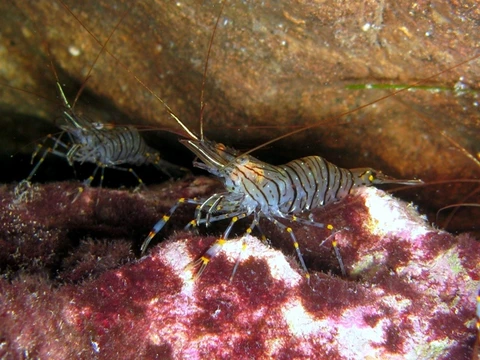
Pandalus platyceros
A large, protandric hermaphrodite shrimp of the northern Pacific.

Pandalus platyceros, called the spot prawn or spot shrimp, is a true shrimp from the family Pandalidae. Regional names include BC spot prawn, California spot prawn, and Alaskan prawn. Its range covers the northern Pacific Ocean, from Unalaska Island, Alaska down to San Diego, California, and also from the Sea of Japan to the Korea Strait. While it can be found anywhere from 3.7 meters to 457.2 meters deep, it is most common around 109.7 meters below the surface.
Spot prawns can grow up to 27 centimeters long, with females typically longer than males. They have a translucent, reddish carapace marked with white stripes, and their pereopods and antennae are banded in dark and light red. White spots appear on the first and fifth abdominal segments. They are protandric hermaphrodites: individuals mature first as males, with their appendix masculina lengthening, then gradually shortening as they transition into females.
Commercial fisheries for spot prawns are short, lasting only six to eight weeks from May to June, opening in spring to align with the new lifecycle. The largest harvests happen in British Columbia, Canada, where about 2,450 metric tonnes are taken each year, roughly 65% of that from waters between Vancouver Island and the mainland. BC spot prawns are considered sustainable, recognized by the Vancouver Aquarium’s OceanWise program and rated a “Good Alternative” by the Monterey Bay Aquarium’s Seafood Watch. In the United States, Alaska produces the biggest harvests, capped at under 800,000 pounds (about 363 tonnes) annually. Most continental U.S. landings come from southern California, with fishing extending north to the Oregon border; California yields roughly 100 metric tonnes per year.
In cuisine, spot prawns are prized worldwide for their flavor, freshness, and quality. Their meat is sweet, delicate, and firm. In Japan, they are often sold as “Botan ebi,” even though they are not one of the two traditional domestic shrimp (Toyama ebi and humpback shrimp). This is because spot prawns are close relatives of domestic Botan ebi, distinguishable only by a close look at the head, and neither tastes better than the other.
Quick Facts
- Genus
- Pandalus
- Species
- platyceros
Facts from the source article.
Lore & Background
The spot prawn ranges throughout the northern Pacific Ocean, from Unalaska Island, Alaska to San Diego, California, and also from the Sea of Japan to Korea Strait. While found at depths of 3.7 meters to 457.2 meters, they are most often found around 109.7 meters below sea level. Spot prawns reach up to 27 centimeters in length, with females often longer than males. They have a translucent, reddish carapace with white stripes, and their pereopods and antennae are banded dark and light red. Their first and fifth abdominal segments have white spots. They are protandric hermaphrodites: they first mature as males, with their appendix masculina lengthening and then gradually shortening until they turn into females.
Reader's Guide
Spot prawn harvests are relatively short, lasting only 6-8 weeks from May to June, opening in the spring because it is the new lifecycle for spot prawns. The largest harvests occur in British Columbia, Canada, where approximately 2,450 metric tonnes are harvested annually, with about 65% coming from the waters between Vancouver Island and the BC mainland. BC spot prawns are considered sustainable, recognized by the Vancouver Aquarium's OceanWise program and as a 'Good Alternative' by the Monterey Bay Aquarium's Seafood Watch program. The largest US harvests occur in Alaska, which limits annual harvest to under 800,000 lbs (approximately 363 tonnes). The majority of continental US landings occur in southern California, though fishing activity extends north to the Oregon border; California produces approximately 100 metric tonnes annually. In cuisine, spot prawns are renowned for their flavour, freshness, and quality, with sweet delicate flavour and firm texture. They are often sold in Japan as 'Botan ebi' despite not being one of the two traditional domestic shrimp (Toyama ebi and Humpback Shrimp), because the spot prawn is a close relative of domestic Botan ebi and they can only be told apart by examining the head closely; one does not taste better than the other.
Did You Know?
- Spot prawns are protandric hermaphrodites, first maturing as males then turning into females.
- They are found at depths from 3.7 meters to 457.2 meters, but most often around 109.7 meters.
- The largest spot prawn harvests occur in British Columbia, Canada, with about 2,450 metric tonnes annually.
- In Japan, spot prawns are sold as 'Botan ebi' and can only be distinguished from domestic Botan ebi by examining the head closely.
Range and Habitat
The spot prawn, a member of the true shrimp family Pandalidae, inhabits a remarkably broad stretch of the northern Pacific. Its range stretches from Unalaska Island in Alaska southward all the way to San Diego, California, and it also appears in waters spanning the Sea of Japan to the Korea Strait. This wide geographic footprint has given rise to several regionally qualified common names, including BC spot prawn, California spot prawn, and Alaskan prawn, depending on where the animal is encountered. In terms of vertical habitat, these shrimp are surprisingly versatile. They have been recorded at depths ranging from just 3.7 meters down to as deep as 457.2 meters, yet the bulk of their population tends to cluster around 109.7 meters below the surface. That mid-depth preference suggests a comfortable ecological niche well below the turbulent surface layer but far above the crushing pressures of the deep sea, giving them access to a stable band of water where food and temperature conditions suit their physiology.
Appearance and the Remarkable Sex Shift
At full size, a spot prawn can grow to roughly 27 centimeters, with females typically outgrowing their male counterparts. Their body presents a striking visual profile: a translucent carapace tinged with reddish hues, marked by distinct white stripes. The pereopods and antennae display a banded pattern of dark and light red, while the first and fifth abdominal segments carry conspicuous white spots that give the species its common name. Beyond their appearance, spot prawns possess one of the most fascinating reproductive strategies in the crustacean world. They are protandric hermaphrodites, meaning every individual begins life as a male. As the animal matures, its appendix masculina lengthens, signaling its male phase. Over time, however, that structure gradually shortens, and the shrimp undergoes a complete sex reversal to become a female. This built-in life cycle ensures that the population always contains both functional sexes at different stages, a strategy that likely supports stable reproduction across their wide Pacific range.
A Short Season, a Big Catch
The commercial harvest of spot prawn is notably brief, confined to a window of just six to eight weeks between May and June each year. Fishers time this spring opening to align with the start of the prawn's new lifecycle, a practice that helps protect the population during its most vulnerable reproductive period. British Columbia, Canada, accounts for the single largest harvest in the world, pulling in approximately 2,450 metric tonnes annually. Roughly 65 percent of that catch comes from the waters sandwiched between Vancouver Island and the BC mainland. These BC stocks have earned sustainability recognition from both the Vancouver Aquarium's OceanWise program and the Monterey Bay Aquarium's Seafood Watch, which rates them a Good Alternative. On the United States side, Alaska sets the largest quota, capping annual landings at under 800,000 pounds, or about 363 tonnes. Southern California handles the bulk of continental US landings, with fishing activity stretching north to the Oregon border, and the state produces roughly 100 metric tonnes per year.
A Global Table Staple and a Japanese Identity Puzzle
Cooks and consumers around the world prize spot prawn for its sweet, delicate flavor and notably firm texture, qualities that set it apart from many other shrimp species. In Japan, the prawn occupies an interesting taxonomic and culinary gray area. It is marketed under the name Botan ebi, yet it is not actually one of the two traditional domestic shrimp varieties, Toyama ebi and Humpback Shrimp. The confusion is understandable: the spot prawn is a close relative of the true domestic Botan ebi, and the two can only be distinguished by a careful examination of the head. Crucially, neither variety is considered superior in taste to the other, so the mislabeling does not reflect a quality difference. For Japanese consumers, the spot prawn thus fills the same familiar role as its native cousin, delivering the same prized flavor profile while benefiting from the broader northern Pacific fisheries that supply it. This cross-border culinary identity highlights how a single species can become embedded in the food culture of a region far from its origin.
Frequently Asked Questions
What is Pandalus platyceros?
Pandalus platyceros is a true shrimp belonging to the family Pandalidae, commonly known by names like spot prawn, spot shrimp, BC spot prawn, California spot prawn, or Alaskan prawn. It is a well-known species of the northern Pacific Ocean.
Where does Pandalus platyceros live and how deep?
Its range stretches from Unalaska Island in Alaska southward to San Diego, California, and also spans the Sea of Japan to the Korea Strait. It has been recorded anywhere from roughly 3.7 meters to 457 meters below the surface, though it is most frequently encountered around 110 meters deep.
How large does Pandalus platyceros grow?
Adults can reach a maximum length of about 27 centimeters, and females tend to outgrow males. The body has a translucent, reddish carapace that distinguishes it from many other shrimp species.
What makes Pandalus platyceros's reproduction unique?
It is a protandric hermaphrodite, meaning each individual first functions as a male and later transitions to a female during its lifetime. This sex-change strategy is a notable biological trait among northern Pacific crustaceans.
How much Pandalus platyceros is harvested each year?
British Columbia lands roughly 2,450 metric tonnes annually, Alaska's catch is capped at under 800,000 pounds (about 363 tonnes), and California harvests approximately 100 metric tonnes per year. These figures make it a commercially significant species across the northern Pacific.
More in Marine Shrimp 1-24
Spotted an error? Know more?
Reader corrections go straight into our review queue. Suggest an edit · How this site is sourced