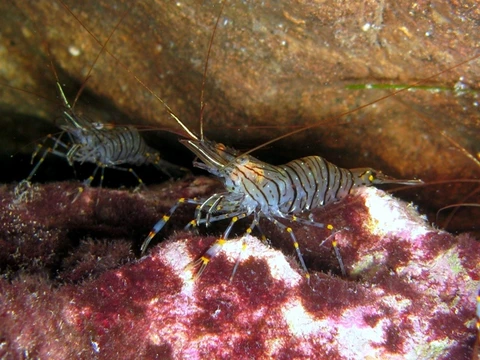
Pandalus
A genus of cold-water prawns with protandric hermaphroditism and commercial importance.

Pandalus, a genus of shrimp within the family Pandalidae, is also referred to as cold-water prawns. These medium-sized crustaceans inhabit the seafloor or areas close to it. Several species in this genus are commercially fished using trawls. One particular species, *Pandalus montagui*, forms a symbiotic relationship with the reef-building polychaete worm *Sabellaria spinulosa*.
These shrimp typically live for three to five years and reach sexual maturity early. They are protandric hermaphrodites, beginning their lives as males and later transitioning to females. Reproduction occurs in spring, with up to 3,000 eggs produced and fertilized internally. The female carries the eggs beneath her abdomen for roughly six days before they hatch into planktotrophic larvae. These larvae spend four to six months drifting in the plankton, carried by currents, and can disperse at least 10 kilometers (6.2 miles). Because the shrimp grow quickly, their populations can recover rapidly after disturbances or habitat loss.
Quick Facts
- Taxon
- Pandalus
- Type Species
- Pandalus montagui
- Type Species Authority
- Leach, 1814
Facts from the source article.
Lore & Background
Members of Pandalus are protandric hermaphrodites, beginning life as males and later transforming into females. Reproduction occurs in the spring, with up to 3,000 eggs fertilized internally and carried by the female under the abdomen for about six days before hatching into planktotrophic larvae. These larvae remain in the plankton for four to six months, drifting with currents and achieving a dispersal potential of at least 10 km (6.2 mi).
The shrimp have a rapid growth rate, allowing populations to build up quickly after disturbance or habitat destruction. Their typical lifespan is three to five years, with sexual maturity reached at an early age. One species, Pandalus montagui, is known to live in association with the reef-building polychaete worm Sabellaria spinulosa.
Several species are commercially fished by trawling, including Pandalus borealis (northern shrimp), Pandalus jordani (pink shrimp), Pandalus goniurus (flexed or humpy shrimp), Pandalus danae (dock shrimp), Pandalus hypsinotus (humpback shrimp), Pandalus montagui (pink shrimp), and Pandalus platyceros (spot shrimp).
Reader's Guide
Pandalus is notable for its protandric hermaphroditism, a reproductive strategy where individuals function first as males and later as females. This trait, combined with a rapid growth rate and early sexual maturity, enables populations to recover quickly from disturbances or habitat destruction. The genus supports several commercial fisheries, with species such as Pandalus borealis and Pandalus jordani caught by trawling. The larvae's extended planktonic phase of four to six months and dispersal potential of at least 10 km (6.2 mi) contribute to the genus's ecological resilience and distribution. One species, Pandalus montagui, demonstrates a specific ecological association with the reef-building polychaete worm Sabellaria spinulosa. The genus is recognized by the World Register of Marine Species for its extant species, with one additional species known from the fossil record.
Did You Know?
- Members of Pandalus are protandric hermaphrodites, starting life as males and later becoming females.
- Females carry up to 3,000 eggs under the abdomen for about six days before they hatch into larvae.
- The larvae drift in plankton for four to six months and can disperse at least 10 km (6.2 mi).
Range and Habitat
The northern shrimp occupies some of the coldest, most remote waters on Earth, thriving on soft muddy seafloors in the northern Atlantic and Pacific Oceans. Its preferred depth range stretches from just 20 meters down to roughly 1,330 meters, though records push that ceiling to 1,450 meters. Water temperatures it tolerates span from 0 to 8 degrees Celsius, with occasional sightings in slightly warmer or colder conditions. Salinity between 32 and 35 parts per thousand supports its life cycle. In the North Atlantic, the nominate subspecies ranges from New England and Canada's eastern seaboard—stretching past Newfoundland, Labrador, and Baffin Island—across southern and eastern Greenland, Iceland, Svalbard, Norway, and down through the North Sea to the English Channel. The Pacific population, running from Japan and Korea through the Sea of Okhotsk and the Bering Strait as far south as California, is increasingly treated as its own species, Pandalus eous. The Food and Agriculture Organization simply calls them northern prawn, while anglers and markets use a long list of local names including pink shrimp, deepwater prawn, Nordic shrimp, and Maine shrimp.
A Life That Changes Sex
Few creatures undergo as dramatic a biological transformation as the northern shrimp. Born as males, these caridean crustaceans live roughly two and a half years before their testes reorganize into ovaries, after which they spend the remainder of their lives as females. This protandrous hermaphroditism means every individual experiences both reproductive roles over a lifespan that can stretch to eight years. Males top out around 12 centimeters, while females grow to as much as 16.5 centimeters, though most individuals are considerably smaller. Growth rate is sensitive to water temperature, with warmer conditions accelerating development. The spawning calendar is tightly linked to the seasons: in late summer, mature females travel offshore to release their eggs, which they then attach to their abdomens. By early autumn the females migrate back toward shore, carrying their developing brood, and the eggs hatch during the cold winter months. This inshore shift during the hatching period is a critical part of the species' reproductive strategy.
From Bounty to Collapse
Commercial interest in the northern shrimp dates back to the early 1900s in Norway, where Johan Hjort's practical work on locating the animals opened the door to large-scale harvest. The fishery later spread across the Atlantic. In Canada, the industry took off in the 1980s and expanded through the 1990s, with an annual catch cap of 164,000 tonnes set by 2008. Canadian supermarkets stock the shrimp peeled, cooked, and frozen in bags, typically served as appetizers. In New England, the species was prized as sweeter and tastier than its Pacific counterpart, and landings peaked in 1969 at 28.3 million pounds. Yet the species' short lifespan makes yearly stock levels inherently variable. In 2013, the Atlantic States Marine Fisheries Commission declared New England stocks too low and closed the fishery—the first shutdown in 35 years. By 2018, studies still reported depleted conditions. Rising surface temperatures off Maine, driven by climate change, continue to suppress spawning biomass and recruitment, leaving the population in a prolonged state of recovery.
Ecological Engine and Scientific Workhorse
Trophic DNA metabarcoding has revealed that the northern shrimp is far more than a food source for humans. In Arctic food webs it occupies a pivotal position, feeding on a diverse menu that includes gelatinous zooplankton and chaetognaths. Its stomachs also contain a surprising variety of fish DNA, a signature of its role as a generalized scavenger. Researchers have proposed using the species as a natural molecular sampler to assess fish diversity across Arctic marine ecosystems, essentially reading the region's biodiversity through the shrimp's diet. Beyond ecology, the species contributes directly to laboratory science. Shrimp alkaline phosphatase, an enzyme extracted from Pandalus borealis, is a staple reagent in molecular biology. The animal's carapace also yields chitosan, a versatile biopolymer with applications ranging from treating bleeding wounds and filtering wine to improving soil quality in organic farming. One cold-water crustacean thus serves as a keystone predator, a research tool, and a source of practical biochemistry.
Frequently Asked Questions
What is Pandalus?
Pandalus is a genus of medium-sized cold-water shrimp in the family Pandalidae, often called cold-water prawns. They are benthic crustaceans that live on or just above the seafloor in cooler marine environments.
What makes Pandalus's sex change so unusual?
Every Pandalus individual is born a male and later switches to becoming a female, a pattern known as protandric hermaphroditism. This means the whole population cycles through both sexes over its lifespan rather than splitting into fixed male and female groups.
How long do Pandalus shrimp live and when do they breed?
A typical individual survives three to five years and reaches sexual maturity at a relatively young age. Breeding takes place in spring, with females carrying as many as 3,000 eggs beneath their abdomen for about six days before the larvae enter a planktonic stage that lasts four to six months.
Where do Pandalus shrimp live and do they interact with other species?
These cold-water prawns are benthic, spending their lives on the seafloor or in the water column immediately above it. One species, Pandalus montagui, forms a symbiotic partnership with the reef-building polychaete worm Sabellaria spinulosa.
Are Pandalus shrimp important to humans?
Several species in the genus are harvested commercially through trawling, making them a notable component of cold-water fisheries. Their short three-to-five-year lifespan and early maturation help keep populations replenished despite that fishing pressure.
More in Marine Shrimp 1-24
Spotted an error? Know more?
Reader corrections go straight into our review queue. Suggest an edit · How this site is sourced