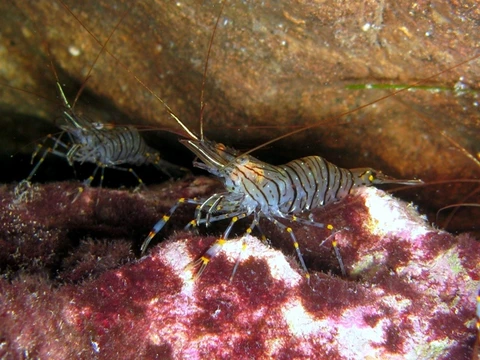
Caridea
True shrimp found worldwide in fresh and salt water.

Caridea, commonly known as caridean shrimp or true shrimp, are an infraorder of shrimp within the order Decapoda. This infraorder contains all species of true shrimp, found widely around the world in both fresh and salt water. Many other animals with similar names—such as mud shrimp and boxer shrimp—are not true shrimp, but many have evolved features similar to true shrimp.
Quick Facts
- Taxon
- Caridea
Facts from the source article.
Lore & Background
Carideans are found in every kind of aquatic habitat, with the majority of species being marine. Around a quarter of described species are found in fresh water, including almost all members of the species-rich family Atyidae and the Palaemonidae subfamily Palaemoninae. Marine species occur at depths to 5,000 m and from the tropics to polar regions. They vary greatly in form, from a few millimetres to over 300 mm long. Except where secondarily lost, they have one pair of stalked eyes, sometimes covered by the carapace, which protects the cephalothorax and surrounds the gills. Most carideans are omnivorous, but some are specialized: filter feeders use setose legs as a sieve; some scrape algae; snapping shrimp of genus Alpheus snap claws to stun prey; many cleaner shrimp groom reef fish and feed on parasites. Carideans are eaten by fish and seabirds and frequently host bopyrid parasites.
Reader's Guide
Caridea are notable as the infraorder containing all true shrimp, distinguished from other shrimp-like crustaceans by gill structure and the overlapping of the second abdominal segment. They are commercially significant: the most important species are Pandalus borealis and Crangon crangon. In 1950, C. crangon wild capture was about ten times that of P. borealis; by the time of the article, the ratio reversed, with P. borealis capture about ten times that of C. crangon. In 2010, global aquaculture of all shrimp and prawns (3.5 million tonnes) slightly exceeded wild capture (3.2 million tonnes). No carideans were significantly involved in aquaculture, but about 430,000 tonnes were captured in the wild—about 13% of global wild capture, or about 6% of total shrimp and prawn production. Carideans are more closely related to lobsters and crabs than to dendrobranchiates (prawns). The fossil record is sparse, with only 57 exclusively fossil species known, the earliest from the Lower Jurassic and Cretaceous.
Did You Know?
- Carideans brood their eggs rather than releasing them into the water.
- Caridean larvae undergo all naupliar development within the egg and eclose as a zoea.
- The second abdominal segment of a caridean overlaps both the first and third segments, unlike dendrobranchiates.
- The snapping shrimp of genus Alpheus snap their claws to create a shock wave that stuns prey.
An Extraordinary Range of Habitats and Forms
The infraorder Caridea encompasses every species of true shrimp, a group whose name traces back to the Ancient Greek word karís. Their ecological reach is remarkable: they inhabit virtually every aquatic environment on Earth, from tropical shallows to polar waters, and from the surface down to depths of five thousand metres. While the bulk of described species are marine, roughly a quarter thrive in fresh water, with the species-rich family Atyidae and the Palaemoninae subfamily of Palaemonidae representing the freshwater stronghold. They are present on every continent except Antarctica.
Physically, carideans display a staggering spectrum of body sizes, ranging from specimens only a few millimetres long to individuals exceeding three hundred millimetres. Their anatomy is built around a carapace that shields the cephalothorax and encloses the gills, through which water is pumped by the rhythmic action of the mouthparts. A single pair of stalked eyes is the norm, though in some species the carapace partially or fully covers them. This structural versatility underpins their success across such diverse environments.
Feeding Strategies and Ecological Interactions
Most carideans are generalist omnivores, yet the infraorder also contains specialists with strikingly different feeding mechanisms. Some species deploy their bristly, setose legs as living sieves to filter particles from the water column. Others scrape algae directly off rock surfaces. Perhaps most dramatic are the snapping shrimp of the genus Alpheus, which crack their claws together to generate a powerful shock wave that stuns nearby prey.
On coral reefs, many cleaner shrimp—themselves carideans—play a vital mutualistic role by grooming fish, removing parasites and dead tissue. These same shrimp, however, sit within a complex web of predation and parasitism. They are regularly consumed by fish and seabirds, and they frequently harbour bopyrid parasites. This interplay of predation, parasitism, and mutualism positions carideans as both predators and prey, integral threads in aquatic food webs from the tropics to polar regions.
Lifecycle: From Brooded Egg to Benthic Adult
A defining distinction between carideans and the related Dendrobranchiates is that true shrimp brood their eggs rather than releasing them into open water. All naupliar development occurs within the egg, and the young emerge as a zoea larva. This zoea stage is a phytoplankton feeder, and the number of zoeal moults varies enormously: some freshwater Palaemonidae pass through as few as two stages, while certain Pandalidae undergo as many as thirteen.
Following the zoeal phase, the larva enters the decapodid stage, a form that already resembles a miniature adult yet retains larval traits. One final metamorphosis produces the post-larval juvenile, a young shrimp possessing all the characteristics of an adult. Most adult carideans are benthic, spending their lives on the sea floor. Familiar examples include the pink shrimp Pandalus borealis, the brown shrimp Crangon crangon, and the Alpheus snapping shrimp. Depending on species and location, adults range from roughly 1.2 to 30 centimetres in length and live between one and six and a half years.
Systematic Position and Commercial Importance
Taxonomically, carideans sit within the order Decapoda and are divided into fifteen superfamilies. They are more closely related to lobsters and crabs than to prawns (Dendrobranchiata), a distinction rooted in gill architecture: caridean gills are lamellar, whereas dendrobranchiate gills are branching. A practical field test involves the second abdominal segment, which in carideans overlaps both the first and third segments, unlike in prawns. Carideans also typically bear two pairs of claws, compared to three in dendrobranchiates. Their closest sister group is the tiny Procarididea, with only eleven known species.
Commercially, Pandalus borealis dominates wild capture, with Crangon crangon in second place. In 1950 the ratio was reversed, with C. crangon catching roughly ten times more than P. borealis; by the modern era the pink shrimp leads by that same factor. In 2010, global shrimp and prawn aquaculture (3.5 million tonnes) slightly outpaced wild capture (3.2 million tonnes), yet carideans contributed only about 430,000 tonnes from the wild—roughly thirteen percent of wild capture and six percent of total production.
Frequently Asked Questions
Who is Caridea?
Caridea is the infraorder that groups together every species of true shrimp within the order Decapoda. It spans both freshwater and saltwater habitats on every continent, making it one of the most widespread shrimp lineages on Earth.
What are Caridea's powers and abilities?
True shrimp can grow from just a few millimeters to over 300 mm (roughly a foot) in length, and they thrive at depths reaching up to 5,000 meters (16,000 feet). That combination of size range and depth tolerance lets them occupy an enormous spread of ecological niches.
How long does Caridea's story last?
Individual true shrimp generally live between one and six and a half years, depending on the species. Their comparatively short lifespans mean populations can rebound quickly after environmental stress.
Why is Caridea important to the wider world?
Caridean shrimp make up roughly 13 percent of the global wild-capture fishery, with about 430,000 tonnes harvested in 2010 alone. Commercially prized species include Pandalus borealis and Crangon crangon, which anchor entire coastal economies.
Are all shrimp actually Caridea?
No—animals commonly called shrimp, such as mud shrimp and boxer shrimp, are not true carideans at all. They have independently evolved shrimp-like traits, but they belong to entirely separate lineages outside the Caridea infraorder.
More in Marine Shrimp 1-24
Spotted an error? Know more?
Reader corrections go straight into our review queue. Suggest an edit · How this site is sourced