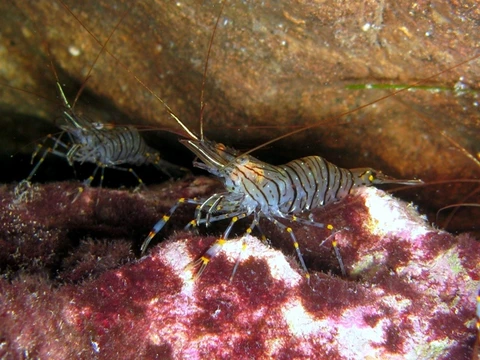
Nematocarcinus
Deep-sea spider shrimp with elongate legs and mud shoes.

Nematocarcinus, sometimes known as spider shrimp, is a genus of caridean shrimp and the nominotype of the family Nematocarcinidae. These deep-sea shrimp are notable for their extremely elongate legs (pereiopods), which they use to walk on the seabed, and for their tolerance of hypoxic conditions. Although they appear as bycatch in fisheries experiments, they are not currently commercially fished.
Quick Facts
- Taxon
- Nematocarcinus
- Type Species
- Nematocarcinus cursor
- Type Species Authority
- A. Milne-Edwards, 1881
Facts from the source article.
Lore & Background
Nematocarcinus shrimp possess several diagnostic characters, including the shape and teeth of the rostrum, the shape of the third abdominal tergite, the shape of the fifth abdominal pleura with short protuberances or a ridge on the inner surface of its anterior margin, the accessory teeth of the telson, and the ventral margin of the sixth abdominal somite (the distoventral organ) along with its associated setae. Their long, slender pereiopods bear tufts of long setae at the dactyls, structures called 'mud shoes' that presumably help distribute their weight over pelagic sediment. The bodies of these shrimp are delicate, and specimens are often damaged when collected by traditional methods such as trawling.
These shrimp inhabit the deep sea, with some species living at over 2,500 m deep and up to 5,000 m deep on abyssal plains. They may sometimes occur around hydrothermal vents. In some regions, such as the Pacific Coast of Mexico, Nematocarcinus may be locally abundant, with up to 500 shrimp per hectare. Members of this genus are very tolerant of hypoxic conditions. Their known distribution includes the Americas, the southern Indian Ocean, the South-Western Pacific, the North-Western Pacific, and the Southern Ocean. Females may be highly fecund, with records of up to 15,500 eggs carried by a female N. ensifer, though species such as N. lanceopes carry only 2,400 eggs.
Reader's Guide
Nematocarcinus holds significance as a deep-sea genus that exemplifies adaptation to extreme environments. Its specialized elongate legs with 'mud shoes' allow it to walk on soft pelagic sediment, while its tolerance of hypoxic conditions enables survival in oxygen-poor deep-sea zones. The genus appears as bycatch in fisheries experiments, indicating ongoing human interaction with its habitat, though it is not commercially fished. Its high fecundity in some species (up to 15,500 eggs) suggests a reproductive strategy suited to the deep sea's low population densities. The delicate bodies of these shrimp, often damaged by trawling, highlight the challenges of studying deep-sea fauna. The genus's presence around hydrothermal vents and across multiple ocean basins—from the Americas to the Southern Ocean—underscores its wide distribution and ecological role in benthic communities. The diagnostic morphological features, including the rostrum, abdominal tergites, and distoventral organ, are key for species identification within the family Nematocarcinidae. Despite continuing fisheries experiments, Nematocarcinus remains a non-target species, contributing to bycatch biodiversity assessments.
Did You Know?
- Nematocarcinus is sometimes known as spider shrimp.
- Their long pereiopods have tufts of setae called 'mud shoes' that help distribute weight over sediment.
- Some species live at depths up to 5,000 m (16,000 ft) on abyssal plains.
- A female N. ensifer can carry up to 15,500 eggs.
Morphology and the 'Mud Shoe' Adaptation
Nematocarcinus shrimp are set apart by a constellation of morphological features that taxonomists use to identify the genus. The rostrum's contour and tooth arrangement, the outline of the third abdominal tergite, and the fifth abdominal pleura—which bears short protuberances or a ridge along its anterior inner margin—all serve as reliable diagnostic markers. The telson carries accessory teeth, while the ventral margin of the sixth abdominal somite, known as the distoventral organ, hosts a cluster of associated setae. Perhaps the most visually striking trait is what researchers have dubbed the 'mud shoes': the pereopods are extraordinarily long and slender, and their dactyls are fringed with dense tufts of long setae. These tufts most likely spread the animal's weight across soft pelagic sediment, preventing it from sinking into the substrate. Despite these remarkable locomotor adaptations, the overall body architecture remains fragile, and specimens frequently sustain physical damage when hauled up through conventional trawl nets.
Deep-Sea Habitat, Range, and Physiological Tolerance
These shrimp are true residents of the deep ocean, with documented occurrences extending from beyond 2,500 meters to as deep as 5,000 meters across abyssal plains. Some populations are found in the vicinity of hydrothermal vents, indicating they can exploit the chemically distinct microenvironments those features generate. Their geographic footprint is broad, spanning the Americas, the southern Indian Ocean, the South-Western and North-Western Pacific, and the Southern Ocean. In certain locales, notably along the Pacific coast of Mexico, Nematocarcinus can reach remarkable local densities of up to 500 individuals per hectare. A particularly noteworthy physiological trait is their tolerance of hypoxic conditions, meaning they can persist in waters where dissolved oxygen levels are very low. This combination of extreme depth range, wide distribution, and metabolic flexibility positions the genus as a remarkably successful deep-sea benthic organism across multiple ocean basins.
Reproductive Strategy and Fecundity Variation
Reproductive output among Nematocarcinus species shows striking variation, underscoring the biological diversity within the genus. Female N. ensifer have been recorded carrying as many as 15,500 eggs, a figure that highlights the potential for exceptionally high fecundity in deep-sea environments where encounters with mates may be infrequent and reproductive windows narrow. By contrast, females of N. lanceopes carry only about 2,400 eggs, suggesting that reproductive strategy differs meaningfully even among closely related species. This range in clutch size likely reflects differences in body size, energy allocation, and the particular ecological pressures each species faces in its habitat. In a deep-sea setting where food resources can be sparse and the vast majority of offspring are lost to predation or environmental hazards, producing large numbers of eggs may be a critical strategy for ensuring that at least some larvae survive to maturity.
Human Interaction, Bycatch, and Conservation Status
Despite ongoing fisheries experiments, Nematocarcinus is not currently targeted for commercial harvest. Instead, these shrimp most commonly enter the human sphere as incidental bycatch in deep-sea trawling operations. Their delicate body structure makes them particularly vulnerable to physical damage during such collection, with specimens often arriving in compromised condition after being hauled through conventional trawl nets. The fact that fisheries researchers continue to experiment with these populations suggests a degree of interest in their potential as a resource, yet no sustained commercial fishery has materialized. This status places Nematocarcinus in a somewhat precarious position: while not directly exploited at scale, they remain exposed to the mechanical stresses of fishing gear and the broader environmental disruptions associated with deep-sea trawling. Their recurring appearance as bycatch means their local populations may be affected by fishing activities even in regions where they are not the primary target species.
Frequently Asked Questions
What is Nematocarcinus?
Nematocarcinus is a genus of deep-sea caridean shrimp, often nicknamed 'spider shrimp,' that serves as the type genus for the family Nematocarcinidae. They are best known for their strikingly long walking legs and their ability to endure oxygen-poor environments.
What makes Nematocarcinus stand out from other shrimp?
Their pereiopods (walking legs) are extremely elongated, allowing them to stride across the abyssal seabed in a way no other caridean shrimp manages. They also tolerate hypoxic conditions that would be lethal to most crustaceans at those depths.
Where do Nematocarcinus live in the ocean?
They occupy abyssal plains at depths from roughly 2,500 m to as deep as 5,000 m. Their documented range covers the Americas, the southern Indian Ocean, the South-Western and North-Western Pacific, and the Southern Ocean.
How does Nematocarcinus reproduce?
Females brood a species-dependent clutch of eggs; N. ensifer can carry up to 15,500 while N. lanceopes manages as few as 2,400. In some hotspots, such as the Pacific coast of Mexico, local densities reach about 500 shrimp per hectare.
Is Nematocarcinus commercially fished?
No. Although individuals turn up as incidental bycatch in deep-sea trawl experiments, no commercial fishery targets the genus. Their extreme depth and patchy distribution keep them well outside the reach of the fishing industry.
More in Marine Shrimp 1-24
Spotted an error? Know more?
Reader corrections go straight into our review queue. Suggest an edit · How this site is sourced