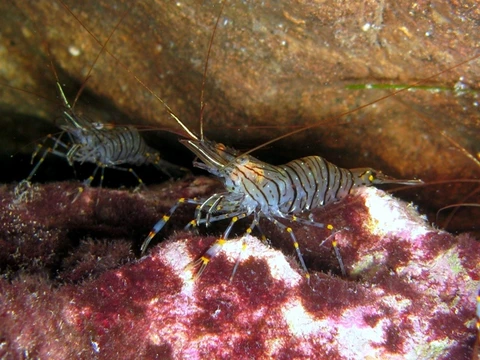
Acanthephyra
A deep-sea shrimp genus spanning surface to abyssal depths.

Acanthephyra is a genus of shrimp in the family Acanthephyridae. Its species are notable for inhabiting a vast depth range, from the ocean surface down to more than 5000 meters below.
- Family
- Acanthephyridae
- Depth range
- 0 to more than 5000 meters
- Number of species listed
- 27
Lore & Background
The genus Acanthephyra belongs to the family Acanthephyridae. Its species are found at depths ranging from 0 to more than 5000 meters below the ocean surface, indicating a broad ecological distribution from shallow waters to the deep abyss. The article lists 27 named species, including Acanthephyra acanthitelsonis, Acanthephyra acutifrons, Acanthephyra armata, and others described by various authors such as Spence Bate, A. Milne-Edwards, and Smith. Many species were described in the late 19th and early 20th centuries, reflecting early exploration of marine biodiversity.
Reader's Guide
The significance of Acanthephyra lies in its extreme depth range, from 0 to more than 5000 meters, making it one of the few shrimp genera capable of living across such a vast vertical gradient in the ocean. This adaptability suggests a remarkable physiological tolerance to pressure and temperature changes. The genus includes 27 recognized species, many described by prominent carcinologists like Spence Bate and A. Milne-Edwards, indicating its long history in taxonomic study. Its presence in both surface waters and the deep sea highlights its role in connecting shallow and deep marine ecosystems. The article does not provide information on behavior, diet, or conservation status, so its legacy is primarily defined by its depth distribution and species diversity within the family Acanthephyridae.
Did You Know?
- Acanthephyra species live at depths from 0 to more than 5000 meters.
- The genus is in the family Acanthephyridae.
- The article lists 27 species of Acanthephyra.
- Species were described by authors including Spence Bate, A. Milne-Edwards, and Smith.
Discovery & Identity in the Deep
Acanthephyra purpurea is a deep-sea shrimp species that has carried the evocative nickname "fire-breathing shrimp" owing to its remarkable defensive behavior. The species was first formally described in 1881, placing its scientific documentation in the late nineteenth century when deep-sea biology was still in its infancy. As a member of the bioluminescent shrimp group, it inhabits the lightless depths of the ocean, where its capacity to generate light becomes not merely a curiosity but a genuine survival tool. The epithet "purpurea" hints at a coloration associated with the species, while the genus Acanthephyra situates it within a broader taxonomic framework of deep-water crustaceans. Despite being known to science for well over a century, the shrimp remains a subject of fascination because of the extraordinary chemical and behavioral adaptations it has evolved in an environment where sunlight never penetrates.
The Bioluminescent Defense Display
When threatened, Acanthephyra purpurea performs what observers have colloquially described as vomiting a large volume of glowing fluid into the surrounding water. In reality, the luminous secretion most likely originates from the hepatopancreas rather than the stomach, though the dramatic anterior expulsion gives the impression of regurgitation. Once released, the fluid undergoes a chemical reaction: luciferin present in the secretion interacts with dissolved oxygen, yielding luciferase and a visible flash of light. The evolutionary purpose of this display is thought to be defensive—by flooding the immediate vicinity with a sudden burst of luminescence, the shrimp aims to startle, confuse, or distract a pursuing predator, buying itself precious seconds to escape. This mechanism is not unique to A. purpurea; it shares the trait with at least three other deep-sea shrimp species, including Heterocarpus ensifer, Systellaspis debilis, and Oplophorus gracilorostris, suggesting a shared or convergent adaptation within the group.
Reproduction & Courtship in Darkness
Acanthephyra purpurea is predominantly gonochoric, meaning individuals are typically either male or female rather than hermaphroditic. In the pitch-black environment of the deep sea, where visual signals are inherently limited, the species has evolved courtship behaviors that rely heavily on chemical and physical contact. Males and females communicate through olfactory cues—releasing and detecting chemical signals in the water—as well as tactile interactions, using physical contact to coordinate mating behavior. Once courtship is complete, the species usually employs indirect sperm transfer, a reproductive strategy in which the male does not deposit sperm directly into the female's reproductive tract but instead releases it into the surrounding medium, where it is subsequently taken up by the female. This method of fertilization is consistent with the challenges of mating in three-dimensional open water, where precise physical alignment is difficult to achieve.
A Shared Trait Among Deep-Sea Shrimp
The bioluminescent expulsion behavior seen in Acanthephyra purpurea is not an isolated oddity but part of a broader pattern among deep-sea shrimp. At least three other species—Heterocarpus ensifer, Systellaspis debilis, and Oplophorus gracilorostris—have been documented releasing luminous fluid as a defensive response. The recurrence of this trait across multiple lineages suggests that in the lightless abyss, the capacity to generate a sudden, localized flash of light represents a powerful anti-predator strategy. For a small, relatively slow-moving crustacean, the ability to produce a disorienting burst of bioluminescence may be one of the few effective means of deterring a larger, faster predator. The fact that this mechanism appears in several distinct species points to either a shared ancestral inheritance or convergent evolution driven by the same selective pressures of the deep ocean. A. purpurea thus serves as one well-known example within a wider community of fire-breathing deep-sea invertebrates.
Frequently Asked Questions
What is Acanthephyra?
Acanthephyra is a genus of marine shrimp placed in the family Acanthephyridae, best known for its members' ability to live across an extraordinary vertical span of the ocean.
What depth range do Acanthephyra species occupy?
These shrimp can be encountered from the sunlit surface all the way down past 5,000 meters into the abyssal zone, giving the genus one of the widest habitat ranges seen in any shrimp group.
How many species are recognized in Acanthephyra?
The genus currently comprises 27 described species, each adapted to different conditions somewhere along that broad surface-to-abyss depth spectrum.
Which family does Acanthephyra belong to?
Acanthephyra is classified under Acanthephyridae, a family of shrimp whose members are distinguished by their capacity to colonize environments from photic surface waters down to the lightless deep sea.
Why do marine-biology fans find Acanthephyra noteworthy?
The genus stands out because its species collectively cover nearly the entire vertical column of the ocean, from the bright upper layers to depths beyond five kilometres, an unusually wide ecological range for a single shrimp genus.
More in Marine Shrimp 1-24
Spotted an error? Know more?
Reader corrections go straight into our review queue. Suggest an edit · How this site is sourced