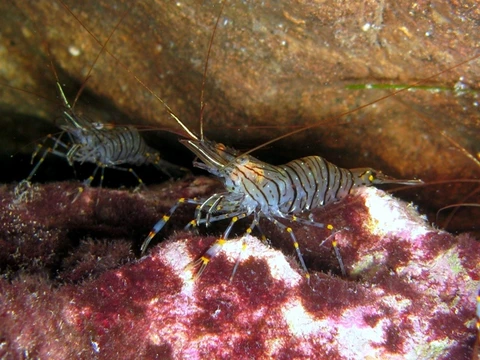
Psalidopus tosaensis
Deepest and coldest-dwelling species of the genus Psalidopus.

Psalidopus tosaensis is a species of shrimp in the genus Psalidopus, family Psalidopodidae, and superfamily Psalidopodoidea. It is notable for living at greater depths and lower temperatures than the other two species in the genus.
Quick Facts
- Grandparent Authority
- Wood-Mason, 1892
- Taxon
- Psalidopus
Facts from the source article.
Lore & Background
Psalidopus tosaensis lives at a depth of approximately 2800 meters, where the temperature is 1.6 °C (34.9 °F). This makes it the deepest and coldest-dwelling species among the three members of the genus Psalidopus. Although it is geographically closer to Psalidopus huxleyi, which occurs in the Indian and western Pacific Oceans, it appears to be more closely related to Psalidopus barbouri, which is found in the western Atlantic Ocean.
Reader's Guide
Psalidopus tosaensis is significant within the genus Psalidopus because it occupies a distinct ecological niche at extreme depth and low temperature. The source article notes that while it is geographically closer to Psalidopus huxleyi, it appears to be more closely related to Psalidopus barbouri, suggesting a complex biogeographic and evolutionary history. This species, along with its congeners, represents the only members of the family Psalidopodidae and superfamily Psalidopodoidea. Its occurrence at around 2800 meters depth, far deeper than the other species (which range from 100 to 800 meters), highlights the adaptability of the genus to a wide range of deep-sea environments. The article does not provide further details on its morphology, behavior, or discovery, but its depth and temperature preferences set it apart as a specialized deep-sea shrimp.
Did You Know?
- Psalidopus tosaensis lives at a depth of about 2800 meters.
- The temperature at its habitat is 1.6 °C (34.9 °F).
- It is geographically closer to Psalidopus huxleyi but appears more closely related to Psalidopus barbouri.
- It is the deepest-living species of the three Psalidopus species.
More in Marine Shrimp 1-24
Spotted an error? Know more?
Reader corrections go straight into our review queue. Suggest an edit · How this site is sourced