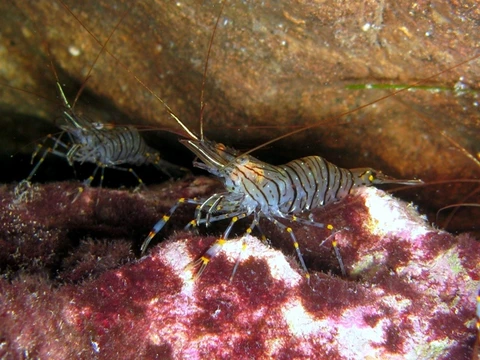
Psalidopus huxleyi
A deep-sea shrimp found across the Indian and western Pacific Oceans.

Psalidopus huxleyi is a species of shrimp in the genus Psalidopus, which is placed in its own family, Psalidopodidae, and superfamily, Psalidopodoidea. It is one of three species in the genus, occurring on continental and insular slopes across the Indian Ocean and western Pacific Ocean.
Quick Facts
- Grandparent Authority
- Wood-Mason, 1892
- Taxon
- Psalidopus
Facts from the source article.
Lore & Background
Psalidopus huxleyi lives on steeply sloping bottoms of various compositions and consistencies, at depths of 500–100 m, where the temperature ranges from 5.9 to 13.6 °C (42.6 to 56.5 °F). Its carapace length is 10–30 mm (0.39–1.18 in). The species occurs on continental and insular slopes across the Indian Ocean, including the Laccadive Sea, off southern India, the Andaman Sea and the Timor Sea, as well as in the western Pacific Ocean from southern Japan to the Philippines, the Sulu Sea, and the Celebes Sea.
Reader's Guide
Psalidopus huxleyi is one of three species in the genus Psalidopus, which is placed in its own family and superfamily. Its distribution spans both the Indian Ocean and western Pacific Ocean, making it the most widely distributed of the three species. The species inhabits steeply sloping bottoms at depths of 500–100 m, with a temperature range of 5.9 to 13.6 °C. Its carapace length ranges from 10 to 30 mm. The article notes that although Psalidopus tosaensis is geographically closer to P. huxleyi, it appears to be more closely related to Psalidopus barbouri, indicating that geographic proximity does not necessarily reflect evolutionary relationships within the genus.
Did You Know?
- Its depth range is 500–100 m, with temperatures from 5.9 to 13.6 °C.
- The carapace length of P. huxleyi is 10–30 mm.
- Although geographically closer to P. huxleyi, Psalidopus tosaensis appears more closely related to P. barbouri.
More in Marine Shrimp 1-24
Spotted an error? Know more?
Reader corrections go straight into our review queue. Suggest an edit · How this site is sourced