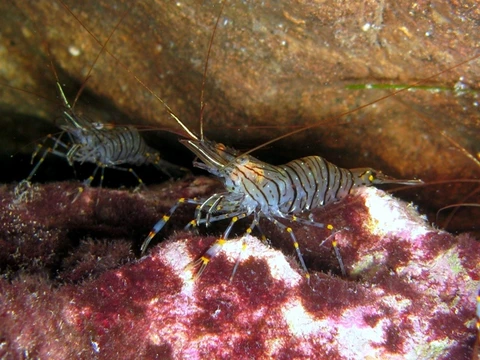
Psalidopus barbouri
Western Atlantic deep-sea shrimp on muddy slopes at 400–800 m.

Psalidopus barbouri is a species of shrimp in the genus Psalidopus, which is placed in its own family, Psalidopodidae, and superfamily, Psalidopodoidea. It is one of three species in the genus, and the only one found in the western Atlantic Ocean.
Quick Facts
- Grandparent Authority
- Wood-Mason, 1892
- Taxon
- Psalidopus
Facts from the source article.
Lore & Background
Psalidopus barbouri occurs on continental and insular slopes from Florida, the Bahamas and the Gulf of Mexico, to parts of the Caribbean Sea, perhaps extending as far south as Suriname. It lives on steeply sloping soft muddy bottoms, sometimes mixed with sand, at depths of 400–800 m, where the temperature ranges from 6.1 to 10.0 °C (43.0 to 50.0 °F). Adults have a carapace length of 13–32 millimetres (0.51–1.26 in), with the total length of the animal, from the tip of the rostrum to the tip of the tail, being up to 5.5 times longer than the carapace.
Reader's Guide
Psalidopus barbouri is notable as one of only three species in the genus Psalidopus, which is placed in its own family and superfamily. It is the sole representative of the genus in the western Atlantic Ocean, with the other two species occurring in the Indo-Pacific. Its habitat on steeply sloping soft muddy bottoms at depths of 400–800 m, in a narrow temperature range of 6.1–10.0 °C, highlights its adaptation to deep continental and insular slope environments. The species' distribution may extend as far south as Suriname, though this is uncertain. Its carapace length of 13–32 mm and total length up to 5.5 times that measurement provide key morphological data for distinguishing it from its congeners. The article does not discuss any broader ecological or economic significance, nor any conservation status.
Did You Know?
- Adults have a carapace length of 13–32 mm, and total length can be up to 5.5 times the carapace length.
- It lives at depths of 400–800 m where water temperature ranges from 6.1 to 10.0 °C.
More in Marine Shrimp 1-24
Spotted an error? Know more?
Reader corrections go straight into our review queue. Suggest an edit · How this site is sourced