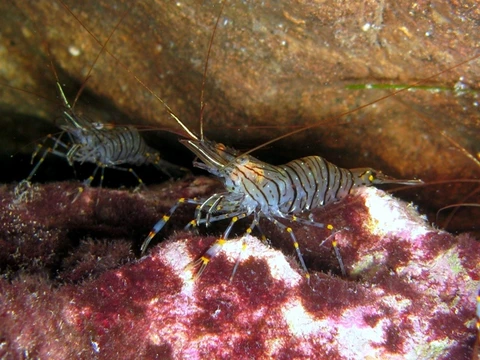
Psalidopodidae
A shrimp family with its own superfamily, comprising three deep-sea species.

Psalidopodidae is a family of shrimp that contains the single genus Psalidopus. It is notable for being placed in its own superfamily, Psalidopodoidea, and comprises three species distributed across the western Atlantic Ocean and the Indo-Pacific.
Quick Facts
- Grandparent Authority
- Wood-Mason, 1892
- Taxon
- Psalidopus
Facts from the source article.
Lore & Background
The family Psalidopodidae contains only the genus Psalidopus, which is divided into three species. Psalidopus barbouri occurs on continental and insular slopes from Florida, the Bahamas and the Gulf of Mexico to parts of the Caribbean Sea, possibly extending as far south as Suriname. It lives on steeply sloping soft muddy bottoms, sometimes mixed with sand, at depths of 400–800 m, where temperatures range from 6.1 to 10.0 °C. Adults have a carapace length of 13–32 mm, with total length up to 5.5 times the carapace length.
Psalidopus huxleyi occurs across the Indian Ocean, including the Laccadive Sea, off southern India, the Andaman Sea and the Timor Sea, as well as in the western Pacific Ocean from southern Japan to the Philippines, the Sulu Sea, and the Celebes Sea. It lives on steeply sloping bottoms of various compositions at depths of 500–100 m, with temperatures from 5.9 to 13.6 °C. Its carapace is 10–30 mm long.
Psalidopus tosaensis lives at greater depth (c. 2800 m) and lower temperature (1.6 °C) than either of the other species. Although geographically closer to P. huxleyi, it appears more closely related to P. barbouri.
Reader's Guide
The family Psalidopodidae is significant as the sole representative of the superfamily Psalidopodoidea, indicating a distinct evolutionary lineage among marine shrimp. The article describes three species with distinct geographic ranges: one in the western Atlantic and two in the Indo-Pacific. The species show variation in depth and temperature preferences, with Psalidopus tosaensis inhabiting much greater depths (c. 2800 m) and colder waters (1.6 °C) than its relatives. Notably, despite its geographic proximity to Psalidopus huxleyi, Psalidopus tosaensis appears more closely related to the Atlantic species Psalidopus barbouri, suggesting a complex biogeographic history. The family's members occupy steeply sloping bottoms, with Psalidopus barbouri specifically associated with soft muddy substrates. The size range across species is modest, with carapace lengths from 10 to 32 mm. The family's legacy lies in its taxonomic uniqueness and the ecological adaptations of its species to deep-sea environments across different ocean basins.
Did You Know?
- Psalidopodidae is the only family in the superfamily Psalidopodoidea.
- Psalidopus tosaensis lives at about 2800 m depth, deeper than the other two species.
- Psalidopus barbouri occurs from Florida to the Caribbean Sea, possibly as far south as Suriname.
- Psalidopus tosaensis appears more closely related to the Atlantic species P. barbouri than to the geographically closer P. huxleyi.
Frequently Asked Questions
What is Psalidopodidae?
Psalidopodidae is a small family of deep-sea shrimp that contains only a single genus, Psalidopus. It is recognized as a distinct family within the broader order of decapod crustaceans.
What makes Psalidopodidae taxonomically special?
The family is elevated to its own superfamily, Psalidopodoidea, which sets it apart from most other shrimp families that share a superfamily with close relatives. This singular superfamily status reflects a deeply distinct evolutionary lineage.
How many species belong to Psalidopodidae?
The family comprises exactly three species, all nested within the single genus Psalidopus. This makes it a very small but well-defined group in the shrimp world.
Where can Psalidopodidae species be found?
One species inhabits the western Atlantic Ocean, while the remaining two are distributed across the Indo-Pacific region. All three are deep-sea dwellers.
Why does Psalidopodidae matter to shrimp enthusiasts?
Its placement in a solo superfamily makes it a textbook example of how taxonomists recognize deeply divergent lineages within a group. For fans of marine invertebrates, it highlights the remarkable diversity hidden even in small, specialized shrimp families.
More in Marine Shrimp 1-24
Spotted an error? Know more?
Reader corrections go straight into our review queue. Suggest an edit · How this site is sourced