Processa edulis
Nocturnal caridean shrimp that changes color and inhabits seagrass beds.

Processa edulis, also called the nika shrimp, is a caridean shrimp living in shallow Atlantic and Mediterranean waters. It stays hidden during the day in seagrass beds and eelgrass flats, emerging at night to feed.
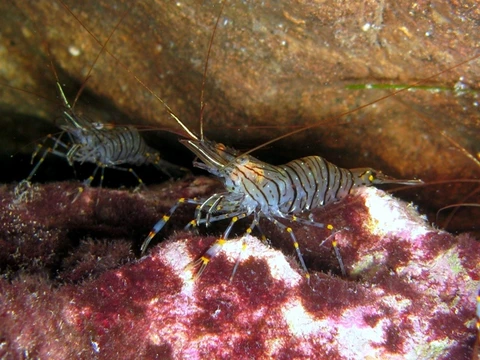
Males of this moderate-sized species measure 12 to 34 mm (0.47–1.34 in), while females range from 25 to 52 mm (0.98–2.05 in). Its short rostrum does not reach past the eyes and ends in a tooth and a point. The first two leg pairs are asymmetrical: on the first pair, the left leg has a claw and the right a clamp; on the second pair, both legs have clamps, but the left is longer than the right. By day the shrimp is white, but at night it turns pink or red, dotted with tiny white spots—the chromatophores. The red color comes mainly from astaxanthin and its esters.
The species occurs in the eastern Atlantic between 55° and 33° North, the North Sea, the English Channel, the Mediterranean Sea, and the Black Sea. It favors shallow soft bottoms with seagrass and eelgrass, especially common in *Posidonia* beds in the English Channel, and sometimes among seaweeds on sandy seabeds. It hides in foliage or buries in sand by day, emerging at night.
Its diet consists of small invertebrates: nematodes, polychaete worms, amphipods, isopods, ostracods, decapod larvae, foraminifera, molluscs, and fish eggs, plus occasional diatoms and fragments of seagrass or seaweed. Stomach analysis of specimens from near the Ebro Delta found negligible plant matter, suggesting it is exclusively carnivorous and any plants were ingested accidentally. It tears prey with its asymmetric front legs. Though edible, the shrimp has been little studied, possibly because it is only caught during night trawling.
Processa edulis is thought to be a protandric hermaphrodite, starting life as a male and later becoming female as it grows. This is supported by the appearance of many moderate-sized females in mid-July, coinciding with a sharp drop in male numbers. Small females are very rare at any time, and those few may be undifferentiated juveniles; large males are absent. Breeding occurs from March to September, with several egg batches laid. Females attach green eggs to their abdominal legs; the eggs turn grey before hatching after three to four weeks. The planktonic larvae develop for another three to four weeks before settling on the seabed to metamorphose into juveniles.
Quick Facts
- Genus
- Processa
- Species
- edulis
Facts from the source article.
Lore & Background
Processa edulis is a moderate-sized shrimp, with males reaching 12–34 mm and females 25–52 mm in length. Its rostrum is short, not extending beyond the eyes, and tipped with a tooth and a point. The first two pairs of legs are asymmetrical: leg 1 has a claw on the left and a clamp on the right; leg 2 has a clamp on both sides, but the left leg is longer than the right. During the day the shrimp is white, but at night it becomes pink or red, with tiny white spots marking the chromatophores; the red color comes from astaxanthin and derived esters.
It occurs in the eastern Atlantic between 55° and 33° North, the North Sea, the English Channel, the Mediterranean Sea, and the Black Sea. It inhabits shallow soft bottoms in seagrass beds and eelgrass flats, and is common in Posidonia beds in the English Channel, sometimes found among seaweeds on sandy seabeds. By day it hides among foliage or buries in sand, emerging at night to feed.
This shrimp feeds on small invertebrates such as nematodes, polychaete worms, amphipods, isopods, ostracods, decapod larvae, foraminifera, molluscs, and fish eggs, and occasionally diatoms and fragments of seagrass and seaweed. Stomach content analysis of specimens from near the Ebro Delta showed negligible plant matter, leading to the hypothesis that it is exclusively carnivorous and plants are ingested only by accident. It tears prey with its asymmetric front legs.
Reader's Guide
Processa edulis is believed to be a protandric hermaphrodite, starting life as a male and becoming female as it grows larger. This is supported by the appearance of large numbers of moderate-sized females in mid-July, coinciding with a sharp decline in males. Small females are very rare at any time of year, and the few present may be undifferentiated juveniles; large males are non-existent. Breeding occurs between March and September, with several batches of eggs laid. The female attaches green eggs to her abdominal legs; they become grey before hatching after three to four weeks. Planktonic larvae develop for another three to four weeks before settling on the seabed to metamorphose into juveniles.
Although edible, this shrimp has been little studied, perhaps because it is only caught when trawling takes place at night. Laboratory studies on its circadian rhythm show that in constant darkness it maintains its rhythm, emerging at expected night and remaining buried during expected day. When exposed to artificial light stimuli, all individuals exhibited a synchronized strong reaction, emerging from sand 15–20 minutes after the light was turned off. The species is notable for its color change, asymmetric legs, and nocturnal feeding behavior, but remains understudied in the scientific literature.
Did You Know?
- Processa edulis changes color from white during the day to pink or red at night due to astaxanthin and derived esters.
- In laboratory constant darkness, it maintained its circadian rhythm, emerging at expected night and staying buried during expected day.
- Stomach content analysis from near the Ebro Delta suggests it is exclusively carnivorous, with plant matter ingested only by accident.
Frequently Asked Questions
What is Processa edulis?
Processa edulis, commonly called the nika shrimp, is a nocturnal caridean crustacean that hides in seagrass and eelgrass beds by day and forages after dark. It is a moderate-sized species native to the shallow coastal waters of the eastern Atlantic and Mediterranean.
Where can you find Processa edulis in the wild?
Its range stretches along the Eastern Atlantic from about 55°N down to 33°N, and it also occurs in the North Sea, English Channel, Mediterranean, and Black Sea. The shrimp favors shallow seagrass beds and eelgrass flats as its primary habitat.
How big does Processa edulis get?
Males measure between 12 and 34 mm, while females are noticeably larger at 25 to 52 mm. Its short rostrum ends in a single tooth and a point and does not extend past the eyes.
How does Processa edulis reproduce?
Breeding takes place from March through September, with eggs requiring roughly three to four weeks to develop before hatching. The resulting larvae then need another three to four weeks to complete their development into juveniles.
What makes Processa edulis distinctive among caridean shrimp?
Its first two leg pairs are asymmetrical: the first pair carries a claw on the left and a clamp on the right, while the second pair has clamps on both sides with the left one being longer. The shrimp also shifts its coloration and relies on dense seagrass cover to stay concealed during daylight hours.
More in Marine Shrimp 1-24
Spotted an error? Know more?
Reader corrections go straight into our review queue. Suggest an edit · How this site is sourced