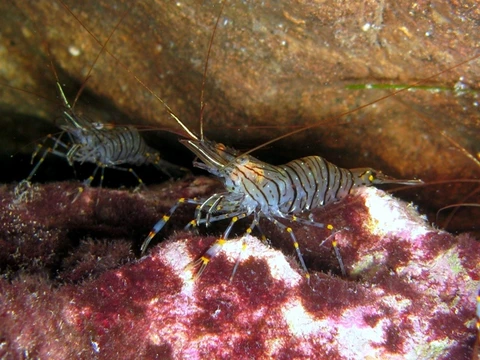
Palaemon adspersus
Baltic prawn, fished in Denmark, lives in eelgrass beds.

The Baltic prawn, *Palaemon adspersus*, is a shrimp species commonly found in the Baltic Sea and targeted by Danish fisheries. It grows to a maximum length of 70 mm and inhabits eelgrass (Zostera) beds. Its body is a plain yellowish-grey, with distinctive pigment spots along the lower half of its rostrum. Across most of northwestern Europe, it is uncommon, but it supports a significant fishery in the Danish Straits. In the Baltic, it can survive salinities as low as 5‰, moving to deeper, saltier waters to overwinter. In Denmark, it is closely tied to eelgrass beds, where it is replaced by *Palaemon elegans* if the eelgrass is absent. Carl Linnaeus originally described the species as *Cancer squilla* in 1758 and 1761. As the genus *Cancer* was split, the species became *Leander squilla*, while *Palaemon* was used for other species. In 1897, Mary Jane Rathbun noted that Pierre André Latreille had designated *Cancer squilla* as the type species for *Palaemon* in 1810, which forced the genus then called *Leander* to become *Palaemon*, and the old *Palaemon* to become *Macrobrachium*. This change was not universally adopted, and the confusion was eventually resolved by a ruling from the International Commission on Zoological Nomenclature (ICZN), which stated that the type species of Palaemon would be Palaemon adspersus. In 1958, Lipke Holthuis asked the ICZN to suppress the name *Cancer squilla* because it had come to be used for *Palaemon elegans*, despite the original description referring to a different species. Despite opposition from some carcinologists, including Robert Gurney, the ICZN agreed, leaving *Palaemon adspersus* Rathke, 1837 as the oldest valid name for the species.
Quick Facts
- Taxon
- Palaemon adspersus
Facts from the source article.
Lore & Background
Palaemon adspersus is up to 70 mm long, with a plain yellowish-grey body and a rostrum bearing distinctive spots of pigment on its lower half. It is uncommon over most of north-western Europe but forms the basis of a significant fishery in the Danish Straits. In the Baltic Sea, it can tolerate salinities as low as 5‰, but overwinters in deeper, more saline waters offshore. In Denmark, it is closely associated with Zostera (eelgrass) beds, and is replaced by Palaemon elegans where the eelgrass is lacking. Carl Linnaeus originally described this species under the name Cancer squilla. As more genera were split from Linnaeus' Cancer, it became known as Leander squilla. In 1897, Mary Jane Rathbun realized that a type species for the genus Palaemon had been made in 1810 by Pierre André Latreille, and that the chosen species was Cancer squilla. This required the genus then known as Leander to become Palaemon, while the genus then known as Palaemon had to become Macrobrachium. Not all biologists followed the new nomenclature, and the confusion was eventually resolved by a ruling from the International Commission on Zoological Nomenclature (ICZN), which stated that the type species of Palaemon would be Palaemon adspersus. In 1958, Lipke Holthuis petitioned the ICZN to suppress the Linnaean name Cancer squilla because it had come to be used for the species Palaemon elegans even though the original description was of a different species. Despite opposition from some carcinologists, including Robert Gurney, the ICZN concurred, leaving Palaemon adspersus Rathke, 1837 the oldest available name for the species.
Reader's Guide
The significance of Palaemon adspersus lies in its role as a fishery species in Denmark, particularly in the Danish Straits, and its close ecological association with Zostera (eelgrass) beds. Its ability to tolerate low salinities down to 5‰ allows it to inhabit the Baltic Sea, though it overwinters in deeper, more saline waters. The species is notable for its taxonomic history, which involved a complex nomenclatural dispute. Originally described by Carl Linnaeus as Cancer squilla, it was later moved to the genus Leander. In 1897, Mary Jane Rathbun identified that the type species for Palaemon, designated by Pierre André Latreille in 1810, was Cancer squilla, forcing a reclassification that was not universally accepted. The International Commission on Zoological Nomenclature eventually ruled that the type species of Palaemon would be Palaemon adspersus. Further confusion arose when the name Cancer squilla was being used for a different species, Palaemon elegans. Lipke Holthuis petitioned the ICZN in 1958 to suppress the Linnaean name, which the ICZN did despite opposition from Robert Gurney, leaving Palaemon adspersus Rathke, 1837 as the oldest available name. This history underscores the importance of type species designations and the role of the ICZN in stabilizing nomenclature.
Did You Know?
- Palaemon adspersus is up to 70 mm long and has a plain yellowish-grey body.
- Its taxonomic name was settled by an ICZN ruling after confusion with the name Cancer squilla.
More in Marine Shrimp 1-24
Spotted an error? Know more?
Reader corrections go straight into our review queue. Suggest an edit · How this site is sourced