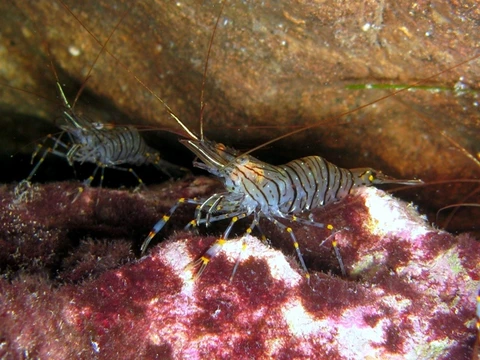
Macrobrachium rosenbergii
A giant freshwater prawn native to the Indo-Pacific region.

The giant river prawn, *Macrobrachium rosenbergii*, is a large freshwater prawn that supports major fisheries and aquaculture operations. It naturally occurs across tropical and subtropical parts of the Indo-Pacific, from India through Southeast Asia and into northern Australia. Although it lives in fresh water as an adult, its early larval stage requires brackish water; once it passes the planktonic phase and becomes a juvenile, it moves into freshwater for the rest of its life. This species is among the largest freshwater prawns globally and is farmed for food in many countries.
Males can reach over 30 cm in length, with some growing up to 34 cm, while females top out around 26 cm. Females have wider abdomens and smaller second walking legs (which bear pincers) compared to males. Their color is mostly brown, though smaller individuals may appear greenish with faint vertical stripes. The rostrum is prominent, with 11 to 14 teeth on top and 8 to 11 underneath. The first pair of walking legs is long and thin, ending in delicate claws used for feeding. The second pair is much larger and stronger, especially in males, and their movable claws are covered in dense bristles that give them a velvety look. The claw color in males changes depending on their social rank.
Male *M. rosenbergii* come in three distinct morphotypes tied to social dominance. The smallest are "small males" (SM), with short, nearly see-through claws. If conditions allow, they grow into "orange claw" (OC) males, whose large orange second chelipeds can be 0.8 to 1.4 times their body length. OCs can later transform into "blue claw" (BC) males, with blue claws that may reach twice the body length. There is a strict hierarchy: territorial BC males dominate OCs, which dominate SMs. The presence of BC males slows the growth of SMs and delays OCs from turning into BCs—an OC keeps growing until it surpasses the largest BC male nearby before changing. All three male types are sexually active, and females that have just molted will mate with any male. Only BC males guard females until their shells harden; OCs and SMs do not.
During mating, the male places spermatophores on the underside of the female’s thorax, between her walking legs. The female then releases eggs that pass through the spermatophores. She carries the fertilized eggs until they hatch, usually in less than three weeks.
Quick Facts
- Genus
- Macrobrachium
- Species
- rosenbergii
Facts from the source article.
Lore & Background
Macrobrachium rosenbergii is known by many local names, including Malaysian prawn, freshwater scampi (India), cherabin (Australia), golda chingri in Bangladesh and India, udang galah in Indonesia and Malaysia, uwáng or uláng in the Philippines, kung maenam or kung kam kram in Thailand, and Thailand prawn in Southern China and Taiwan. Due to accidental releases, it has been introduced to parts of Africa, China, Japan, New Zealand, the Americas, and the Caribbean.
The species can grow to a length over 30 cm, with males reaching up to 34 cm and females up to 26 cm. Females have wider abdomens and smaller second pereiopods. They are predominantly brownish, but smaller individuals may be greenish with faint vertical stripes. The rostrum is prominent with 11 to 14 dorsal teeth and 8 to 11 ventral teeth. The first pair of walking legs is elongated and thin, ending in delicate claws used for feeding; the second pair is much larger and more powerful, especially in males, with movable claws covered in dense bristles giving a velvety appearance. Claw color in males varies with social dominance.
Three male morphotypes exist corresponding to social dominance: small males (SM) with short, nearly translucent claws; orange claw (OC) males with large orange claws 0.8 to 1.4 times body size; and blue claw (BC) males with blue claws that may become twice as long as their bodies. BC males are territorial and dominate OCs, which dominate SMs. The presence of BC males inhibits SM growth and delays OC metamorphosis; an OC keeps growing until larger than the largest BC male before transforming. All three stages are sexually active.
Reader's Guide
Macrobrachium rosenbergii is widely eaten in Southeast Asian countries within its native range and is commonly used in indoor shrimping venues. The species is aquacultured throughout the tropics. In research, Professor Amir Sagi and his group from Ben-Gurion University of the Negev identified the IAG physiological sexual switch and its associated gene expression in decapods, investigating multigenic functions in crustacean reproduction and growth, and established genome editing in prawns using CRISPR. His group developed monosex biotechnologies for crustacean culture, including temporal RNA interference for all-male culture, applied in Vietnam, Thailand, China, Malaysia, and Israel. He is a co-founder of the all-female culture biotech company Enzootic Ltd. Prawns are efficient predators and may serve as sustainable biocontrol agents over invasive and pest species; the Sagi lab's monosex prawn biotechnologies enable responsible, non-invasive biocontrol applications worldwide.
Did You Know?
- Males can reach a total length of 34 cm (13 in), while females reach 26 cm (10 in).
- The species has three male morphotypes: small male, orange claw, and blue claw, which correspond to social dominance.
- Females lay 10,000–50,000 eggs up to five times per year, and the eggs hatch into zoeae that develop in brackish water.
- Professor Amir Sagi's group used CRISPR to establish genome editing in prawns and developed monosex biotechnologies for aquaculture.
More in Marine Shrimp 1-24
Spotted an error? Know more?
Reader corrections go straight into our review queue. Suggest an edit · How this site is sourced