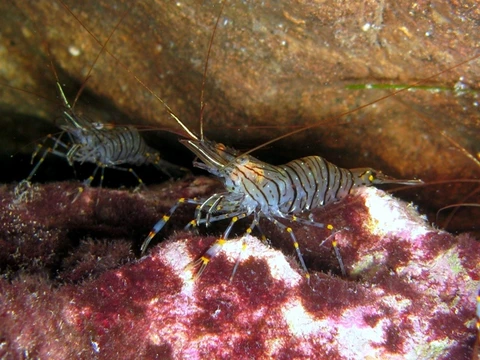
Macrobrachium ohione
Best-known North American freshwater shrimp, used as catfish bait.

Macrobrachium ohione, called the Ohio shrimp, Ohio river shrimp, or Ohio river prawn, lives in freshwater rivers across the Gulf of Mexico and Atlantic Ocean drainage basins of North America. It is the most familiar of all North American freshwater shrimp and is often used as bait in commercial fishing, particularly for catfish.
This shrimp is pale gray with small blue spots and reaches up to 10 cm (4 in) long. Its first two pairs of legs have claws, with the second pair larger than the first. Its rostrum is curved and has up to 13 teeth.
The species can be found from North Carolina to Florida along the Atlantic coast, and from southern Missouri to Louisiana in the west. Despite its common name, it is now rarely found in the Ohio River. Before the 1930s, it was common there—the type specimen came from Cannelton, Indiana—and its range in the Mississippi River reached as far north as St. Louis, Missouri. Dams, interbasin water transfers, and other human activities are believed to have reduced its range. In May 2001, two specimens turned up in the Ohio River at Joppa, Illinois, the first in 50 years, suggesting either the species is returning to its former range or earlier sampling methods missed them.
Like other Macrobrachium species, the Ohio shrimp is amphidromous: its larvae need saltwater and move to freshwater as adults. The larvae drift free-floating downriver until they reach water salty enough to support them. Females carrying eggs may also migrate downstream before releasing the larvae to shorten the journey. A 2008 study from the University of Louisiana at Lafayette found that M. ohione larvae can survive up to five days in freshwater; after that, their chance of molting and surviving in saltwater drops sharply. The researchers concluded that dams and other human barriers, by blocking the larval drift, are likely the main reason Ohio River shrimp are nearly absent from the Ohio River.
Quick Facts
- Taxon
- Macrobrachium ohione
Facts from the source article.
Lore & Background
Macrobrachium ohione is pale gray with small blue spots and grows up to 10 cm (4 in) long. Its first two pairs of legs are clawed, with the second pair larger than the first. The rostrum is curved and contains up to 13 teeth. The species may be found from North Carolina to Florida on the Atlantic coast, and from southern Missouri to Louisiana westward. Despite its common name, the Ohio shrimp is not generally found in the Ohio River anymore. Until the 1930s, it was common in the Ohio River, with the type specimen taken at Cannelton, Indiana, and its range in the Mississippi River extended as far north as St. Louis, Missouri. Dams, interbasin transfer of water, and other human activities are thought to be the cause for the decrease in range. In May 2001, two specimens were found in the Ohio River in Joppa, Illinois, the first ones in 50 years, indicating either that the species is returning to its former range, or that prior sampling methods were ineffective.
Reader's Guide
Macrobrachium ohione is notable as the best-known of all North American freshwater shrimp and is commonly used as bait for commercial fishing, especially catfish. Its significance extends beyond its utility: the species' decline in the Ohio River illustrates the impact of human activities on amphidromous species. Like other Macrobrachium species, the Ohio shrimp is amphidromous: larvae must live in saltwater and move to fresh water as adults. Larvae drift free-floating downriver until they reach sufficient salinity. Females carrying eggs may migrate downstream before releasing larvae. A 2008 study by the University of Louisiana at Lafayette discovered that M. ohione larvae are viable for up to five days in fresh water; after that, the likelihood of molting and surviving in saltwater is drastically diminished. The researchers concluded that dams and other human-erected barriers, by blocking larval drift, are likely the primary reason Ohio River shrimp are almost non-existent in the Ohio River. The 2001 discovery of two specimens in the Ohio River at Joppa, Illinois—the first in 50 years—leaves uncertainty whether the species is returning or prior sampling was ineffective.
Did You Know?
- The type specimen of Macrobrachium ohione was taken at Cannelton, Indiana.
- A 2008 study found that M. ohione larvae are viable for up to five days in fresh water before their chance of surviving in saltwater diminishes.
More in Marine Shrimp 1-24
Spotted an error? Know more?
Reader corrections go straight into our review queue. Suggest an edit · How this site is sourced