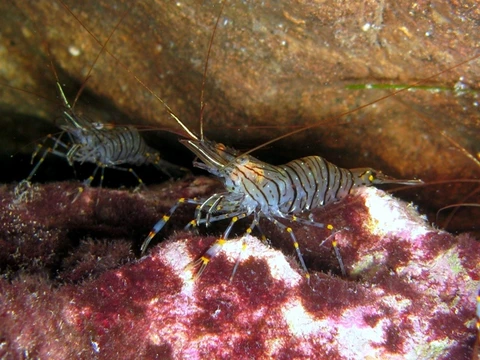
Macrobrachium nobilii
Freshwater shrimp known as stone prawn, with elongated second chelae.

Macrobrachium nobilii, a freshwater shrimp in the family Palaemonidae (order Decapoda), was first described by Henderson and Matthai in 1910. Locally known as the stone prawn, it gets this name from its preference for habitats with stony or pebbly substrates on the bottom.
This species is found in southeastern India, New Caledonia, the Gavataks, and Tuamotu Island. Within India, it has been recorded in freshwater lakes of Tamil Nadu’s Chengalpattu District, as well as in the Cauvery River between the Mettur Dam and the Poomphuhar Estuary.
A key feature is its prominent second pair of chelate appendages, where the carpus is distinctly longer than the merus. The large chelae have teeth along the proximal part of their cutting edges. On the rostrum, the first four or five teeth are located behind the posterior orbital margin.
This prawn is diecdysic, molting and breeding once every 18 to 22 days. Males are larger than females; a male can weigh up to 12,676 mg, while a female reaches about 7,178 mg. An average female incubates roughly 2,200 eggs per clutch for 14 days. After development, the eggs hatch in irregular batches over six days. The newly hatched larvae drift passively to the estuary to complete their development, and the juveniles then actively migrate back to freshwater grounds.
Quick Facts
- Genus
- Macrobrachium
- Species
- nobilii
Facts from the source article.
Lore & Background
Macrobrachium nobilii is distributed in South East India, New Caledonia, Gavataks, and Tuamotu Island. In India, it is reported from freshwater lakes of Chengalpattu District of Tamil Nadu and from the river Cauvery between Mettur Dam and Poomphuhar Estuary. Its common name 'stone prawn' reflects its affinity for substrates such as stones and pebbles found at the bottom of its habitat.
This species is characterized by its prominent or elongated second pair of chelate appendages, in which the carpus is distinctly larger than the merus. The large chela have teeth on the proximal part of the cutting edges. In the rostrum, the first four or five teeth are situated behind the posterior orbital margin.
Biologically, Macrobrachium nobilii is diecdysic, moulting and breeding once every 18–22 days. Males are larger than females. An average female incubates about 2200 eggs per clutch for a period of 14 days. On completion of development, eggs hatch in irregular batches within 6 days. The larvae passively drift to the estuary to complete development, after which juveniles actively migrate back to freshwater grounds.
Reader's Guide
Macrobrachium nobilii holds significance as a freshwater shrimp species with a distinct ecological role, particularly its reliance on stony substrates, which gives it the local name 'stone prawn.' Its distribution across South East India, New Caledonia, Gavataks, and Tuamotu Island indicates a broad but specific habitat range. The species' life cycle is notable for its diecdysic moulting and breeding pattern, occurring every 18–22 days, and its reproductive strategy involves females incubating about 2200 eggs per clutch for 14 days. The larval drift to estuaries and subsequent juvenile migration back to freshwater grounds highlight a complex life history tied to both freshwater and estuarine environments. The morphological feature of an elongated second pair of chelate appendages, with the carpus larger than the merus and teeth on the cutting edges, distinguishes it from related species. This combination of distribution, reproductive biology, and physical traits contributes to its legacy as a well-documented example of a freshwater prawn adapted to specific substrates and life-cycle transitions.
Did You Know?
- Macrobrachium nobilii is locally known as 'stone prawn' due to its affinity for stony or pebbly substrates.
- Males of this species are larger than females, with a reported body weight of 12676 mg versus 7178 mg for females.
- After hatching, larvae passively drift to the estuary, and juveniles later actively migrate back to freshwater grounds.
More in Marine Shrimp 1-24
Spotted an error? Know more?
Reader corrections go straight into our review queue. Suggest an edit · How this site is sourced